


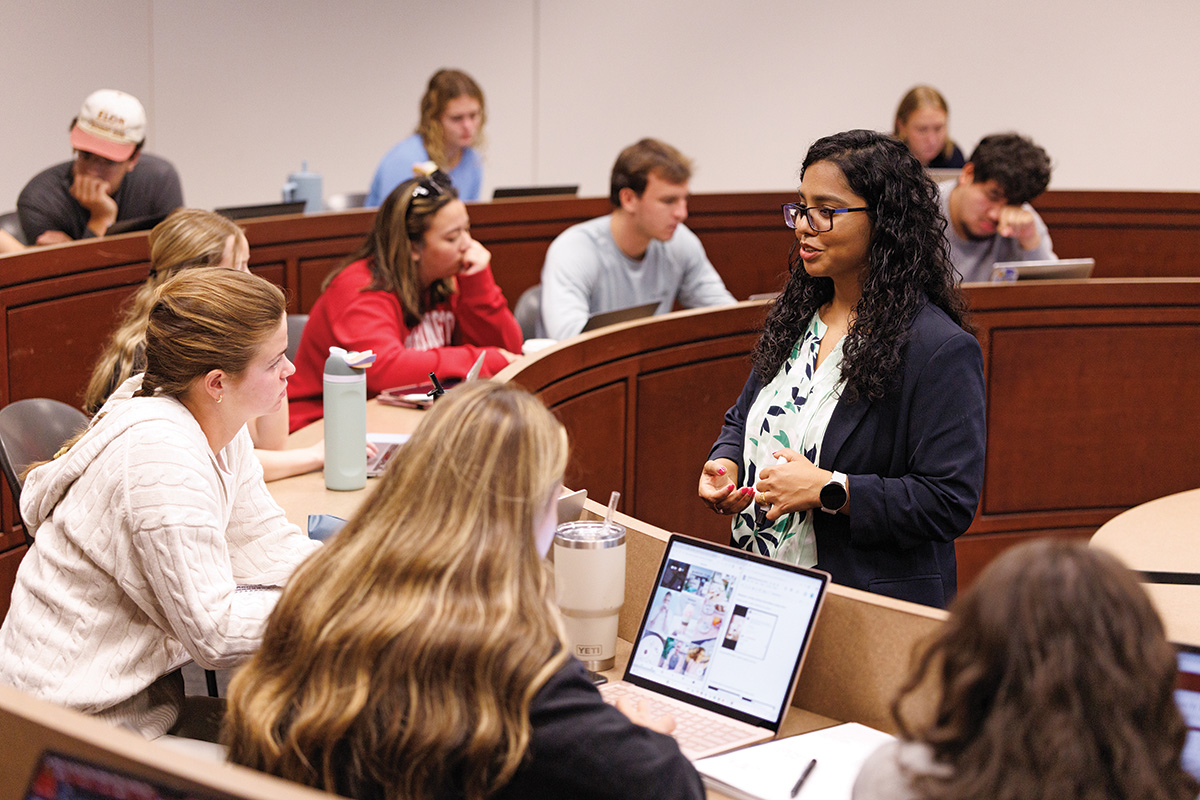
Business faculty member Smaraki Mohanty on how small changes shape what people buy and believe.
A green energy label on a bag of chips.
Your favorite brand changing its profile picture for an awareness month.
A music app suggesting a song you might like.
Where most people glance and move on, Elon’s Doherty Emerging Professor for Entrepreneurial Leadership Smaraki Mohanty looks closer. She sees questions worth testing.
Her research has revealed that:
- A potato chip is still a potato chip, yet adding a label about renewable energy makes it suddenly seem healthier.
- Political ideology influences whether someone accepts an artificial intelligence suggestion.
- Subtle visual cues, like a temporary profile picture, may convince consumers of a brand’s authenticity more than lengthy statements.
“These are small signals,” says the assistant professor of marketing, “but they change behavior in big ways.”
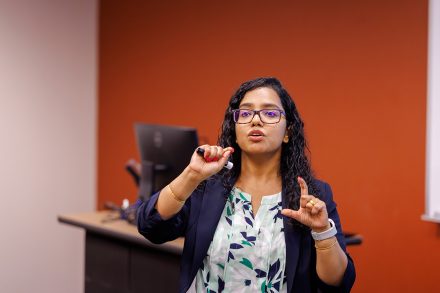 Mohanty grew up in eastern India, where curiosity and creativity shaped her world. By day, she studied electronics engineering. By night, she performed in classical dance, training from age 3 through her undergraduate years. Performances often meant hours of rehearsal in colorful costumes, precise footwork in intricate rhythms and the challenge of holding an audience’s attention with a single raised eyebrow or sweep of the hand.
The discipline demanded precision, but it also taught her how the smallest gesture could change the way an audience responded. “Dance taught me to notice how people react to details,” Mohanty says. “That same curiosity is what I bring to research now.”
She carried that mindset into her graduate studies, where she first encountered marketing research. The idea that she could ask questions, gather data and test her predictions excited her. “The first time the results matched what I had predicted, I thought, ‘this matters,’” Mohanty recalls. “The questions are not vague. They have answers we can find.”
That instinct to pay attention to subtlety has carried throughout her career. Mohanty’s research explores how people interpret brands, technology and causes through cues that are easy to overlook but powerful in effect.
In so many cases, the tiniest cues
are doing the heaviest lifting.
That’s what makes them worth studying.
She is fascinated by the gap between what something is and how people perceive it. Her studies have shown that sustainability signals create a kind of “halo effect,” where the goodness of green energy appears to transfer to the food itself. She has found that in a polarized world, a small design choice can sometimes carry more weight than a long public statement. And she has observed that political identity can shape whether people trust an AI recommendation, with conservatives more likely to embrace the familiar patterns an algorithm reinforces.
“In so many cases, the tiniest cues are doing the heaviest lifting,” Mohanty says. “That’s what makes them worth studying.”
Mohanty joined Elon’s faculty in 2021 in the middle of the COVID-19 pandemic. She had never visited North Carolina and wondered how she and her husband would find their footing. The first year was full of questions, but it also brought answers in the form of community.
A Diwali celebration hosted by the university was one of her first glimpses of belonging. In a room filled with music, food and laughter, she met fellow faculty and staff who shared her cultural traditions. “That was when I realized we could build a home here,” Mohanty says.
Friendships grew from that night, and Burlington soon began to feel like home. Her family has since bought a house in town, and her young son, born after the move, now attends Acorn Academy, Elon’s on-campus employee child care center. For Mohanty, those connections mirror her research in a personal way. “Just as I study how people look for signals of belonging, I was looking for those signals myself when I came here,” she says. “Now I feel them every day.”
This August, Mohanty’s work was recognized in a moment she will never forget. One afternoon, a local number flashed across her phone. Busy settling her toddler for a nap, she let it go, assuming it was one of his doctors. A text followed. When she finally picked up the return call, she was startled to hear the voice of President
Connie Ledoux Book.
For a moment, Mohanty thought she was in trouble. Then came the news: she had been named the Doherty Emerging Professor for Entrepreneurial Leadership.
“I honestly did not hear much after that,” she says with a laugh. “I was just giggling, so happy.”
Her in-laws, visiting from India, were in the audience at the ceremony when she was honored. It was the first time they had seen her recognized in person. Seeing their pride, she says, was as meaningful as the title itself.
Mohanty continues to expand her research while mentoring undergraduate students and creating projects that connect them directly with local businesses. She founded the Consumer Research Behavioral Lab and designs classes in digital marketing, marketing analytics and consumer behavior that give students the chance to test ideas in real-world settings.
What she hopes for the future is simple. “I still feel new every year because there is so much to learn,” Mohanty says. “Questions lead to better answers. That is what I want to model for my students — stay curious, stay kind, keep learning.”