


A Leadership Fellow at Elon Law, Craige won the public lottery to hear oral arguments in two cases before the U.S. Supreme Court calendared during spring break, including a high profile case about immigration asylum.
For most law students, the U.S. Supreme Court exists in excerpts and opinions, but over spring break, Isabel Craige ’24 L’26 stepped inside to watch black-letter law come to life in the nation’s highest court.
Craige traveled to Washington, D.C., to attend oral arguments in two cases — including those for a closely watched immigration asylum case — after securing tickets through the Court’s public lottery.
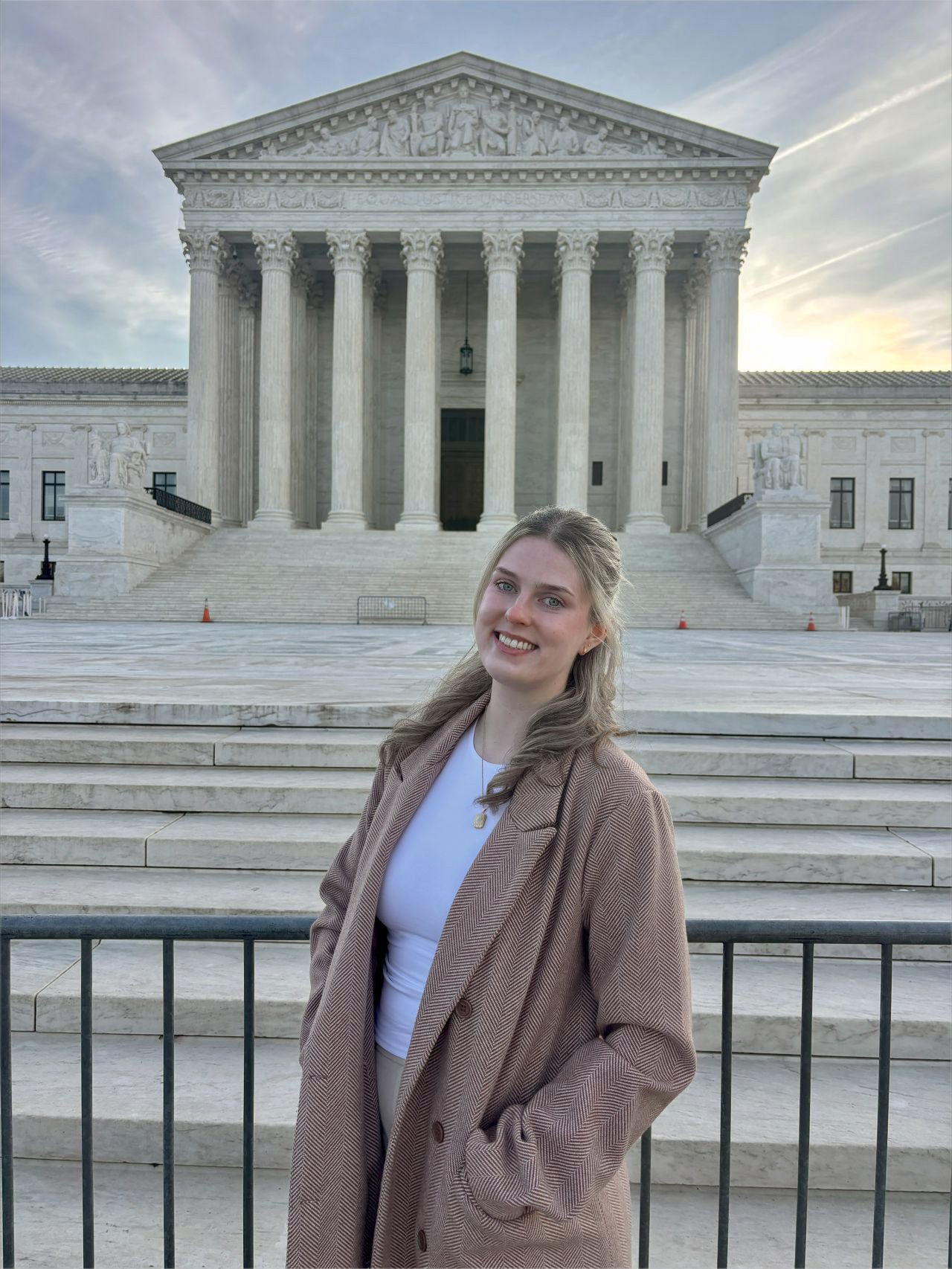
“It was an unforgettable experience to watch the Justices engage in real time: asking questions, testing arguments and shaping the legal issues I’ve spent the past few years studying,” Craige said.
A 2024 graduate of Elon University with a degree in psychology, Craige’s interest in law grew from a desire to lead, advocate and serve her community. At Elon Law, she is a Leadership Fellow and member of the Moot Court Board. The daughter of a U.S. Air Force family, she spent much of her childhood on and near military bases, including in Stuttgart, Germany. Her family now lives in northern Virginia.
During her visit, the Court heard arguments in Keathley v. Buddy Ayers Construction, a bankruptcy case, and Noem v. Al Otro Lado, which centers on the rights of asylum seekers at the U.S.–Mexico border. Craige was especially struck by the immigration case. Justices closely examined the meaning of statutory language, parsing even what it means to “arrive” in the United States. The questioning, she said, revealed how minute distinctions in wording can carry significant consequences in how the law is applied.
“It was incredible to see how even small details can shape the outcome of a case,” she said.
The experience felt both familiar and surreal. Craige recognized concepts from class while watching justices press attorneys in real time.
She also experienced something impossible to capture in textbooks and manuals: The rhythm of the room.
“Seeing the justices interact, even joking at times, made it feel less abstract,” Craige said. “It reminded me these are real people behind the decisions we study.”
This spring, Craige is completing her Residency-in-Practice with the Guilford County District Attorney’s Office. She is exploring a future in the Judge Advocate General’s Corps, a return to the kind of service that shaped her childhood.
“Moments like this remind me why I chose this path,” she said.