


To celebrate Elon University’s Spring Undergraduate Research Forum on April 28, Today at Elon is highlighting several students presenting their research at the annual campus tradition.
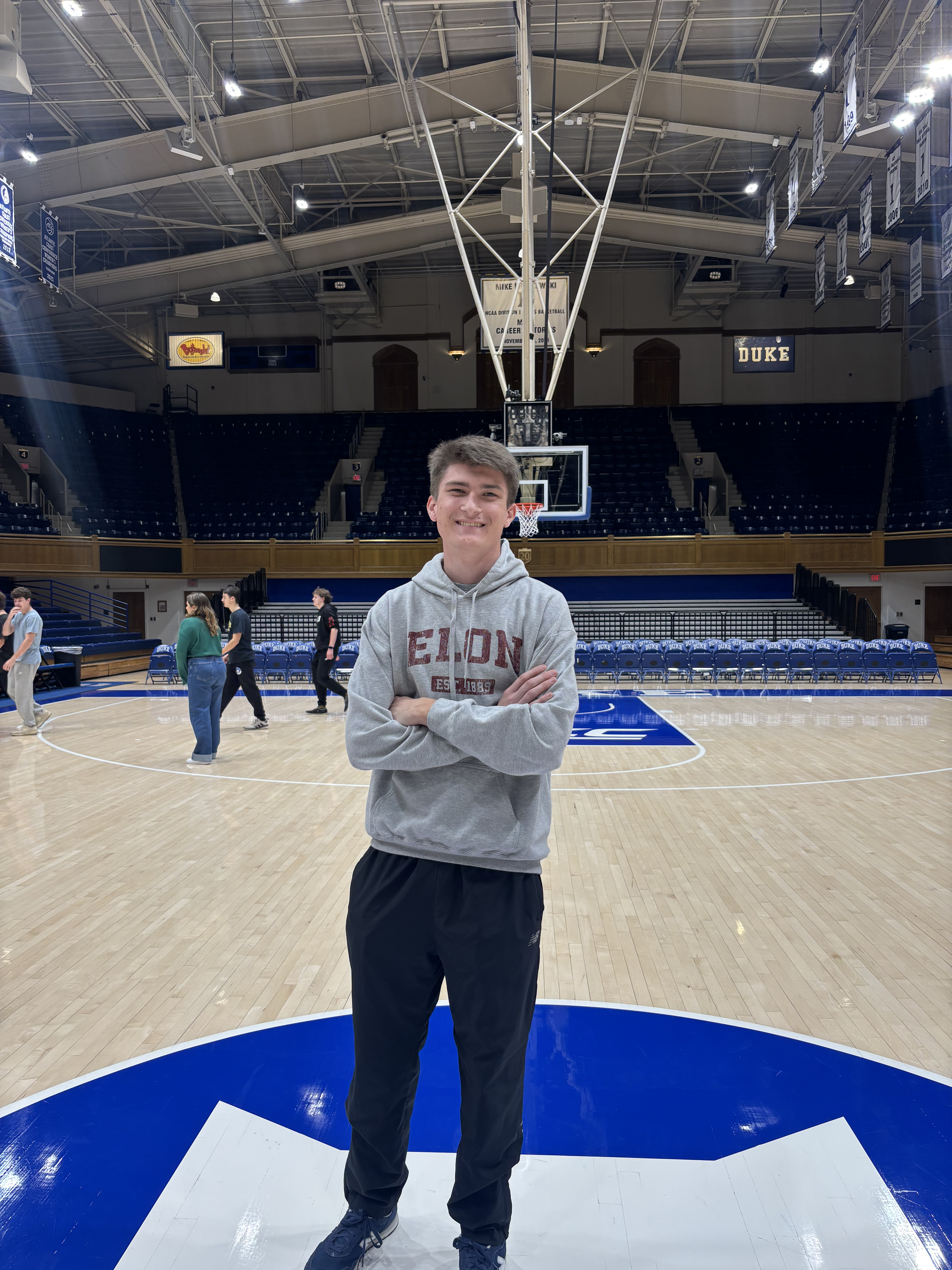
Chris Guider’s research, which will be presented at the Spring Undergraduate Research Forum on April 28, will be more than just a poster session; it will offer insights for a real-world client.
A business analytics and economics double major from Holly Springs, North Carolina, Guider’s project examines the effectiveness of new NFL kickoff rules introduced in 2024. The changes, designed to improve player safety, created multiple “touchback” scenarios, situations where the ball is placed at different yard lines depending on how a kickoff ends.
“We’re looking at the expected outcome based on whether you start at one yard line versus the other,” Guider said. Specifically, Guider is comparing drives that begin at the 20 and 35-yard lines, analyzing how starting position affects offensive success.
The project originated when his mentor, Assistant Professor of Statistics Andre Waschka, approached Guider with an opportunity tied to NFL kicker Joshua Karty, a kicker for the Arizona Cardinals and son of Joel Karty, Elon’s Sydney F. & Kathleen E. Jackson Professor of Chemistry and chair of the Department of Chemistry.
For Guider, who is also involved in Elon’s Sport Management Living Learning Community, the topic was a natural fit: “I like talking sports,” he said, “and I like working with data.”
Using statistical programming tools such as R, along with methods like TMLE and Super Learner, Guider and his team are analyzing thousands of plays across the NFL season. They are measuring variables such as number of plays per drive, total yards gained and scoring outcomes, including touchdowns, field goals and turnovers.
Although the dataset is still being finalized, early findings suggest that field position may not be as influential as expected.
“We’re actually finding there’s not as much of a difference as we thought there would be,” Guider said. “So, 15 yards isn’t really as much of a difference when it comes down to score.”
The research process has been both challenging and rewarding, particularly for a first-year student.
“Actual data collection is mind-numbing,” Guider said with a laugh, describing the hours spent manually inputting thousands of lines of data. “I’ve been working through about 2,000 lines… you’re sitting there for hours at a time doing this.”
Despite the tedious work, Guider emphasized the value of the experience.
“It’s rewarding because there are a lot of skills I’m learning, like coding in R or being able to interpret data,” he said. “It’s just reinforcing that I chose the right school because of the relationship I have with the professors I’ve been able to work with here.”
During SURF Day, all other campus activities are suspended so the Elon community can come together around students’ creative endeavors and research efforts. Undergraduate research is also one of the five Elon Experiences, which provides a natural extension of the work students do in the classroom and ensures that Elon graduates are prepared for both graduate school and careers.
Following SURF, Guider and his team plan to expand their findings into a formal research paper that could be published and shared directly with their NFL collaborator.
“It’s something that’s actually going to be used,” he said. “That to me is the most rewarding thing, being able to see that be implemented.”