


Lumen Scholar Mallory Otten '26 and her mentor, Rena Zito, presented their research at the Southern Sociological Society conference.
Lumen Scholar and public health major Mallory Otten ’26 and her faculty mentor, Associate Professor of Sociology Rena Zito, presented their research, “Perpetrator Gender, Sexuality, and Perceptions of Intimate Partner Violence: Evidence from
an Experimental Vignette Study” at the annual meeting of the Southern Sociological Society on April 11 in Jacksonville, Florida. Their talk was included in the Crime, Law, and Deviance Mini-Conference.
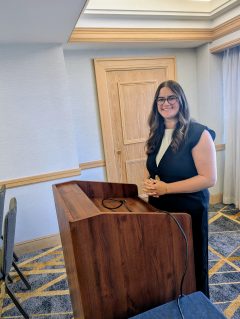
Otten and Zito’s research examined how gender and sexual orientation shape public perceptions of intimate partner violence (IPV). Using a nationally representative survey experiment with more than 1,600 U.S. adults, participants were shown the same IPV scenario, but with the perpetrator’s gender and sexual orientation changed across versions. They found that people judged heterosexual male perpetrators most harshly, while gay male perpetrators and heterosexual female perpetrators were seen as less culpable, less dangerous and less deserving of punishment. Lesbian perpetrators fell in between, suggesting that judgments about violence are shaped by assumptions about who is capable of causing harm and who is seen as a “real” victim.
The study draws attention to how stereotypes about masculinity, femininity and sexuality influence responses to abuse. Because intimate partner violence is often framed as a “women’s issue,” violence against men — especially gay men — can be minimized or dismissed. In contrast, women perpetrators may be seen as less threatening. These perceptions matter because they affect whether victims seek help, how law enforcement and courts respond and whether survivors are believed in the first place.
Zito also presented a study titled “‘It’s Never Stopped Me Doing Anything I Wanted to Do’: Disability (Dis)Identification in Tourette Syndrome” as part of the Disability & Health session. The research explored how adults with Tourette Syndrome (TS) understand and articulate their condition in relation to disability, including how they position themselves as disabled, non-disabled or in-between. Based on 30 in-depth interviews, Zito found that disability identity is shaped less by how people interpret their experiences rather than simply by tic severity. Some rejected the disability label, equating disability with physical incapacitation and having a limited life, while others embraced it by pointing to chronic pain, workplace barriers, stigma and public scrutiny. Many fell somewhere in between, describing TS as disabling at times but hesitating to claim disability status. The research shows that TS exists in the “borderlands” of disability, where identity is influenced by cultural ideas about normality and what counts as a “real” disability.
The Lumen Prize supported Otten’s research. Zito’s research was supported by an Elon University Summer Research Fellowship.