



A new Elon University Poll also found support for less regulation of marijuana in North Carolina.
Three constitutional amendments on the ballot in the November general election receive strong support in a new Elon University Poll, conducted August 21-31.
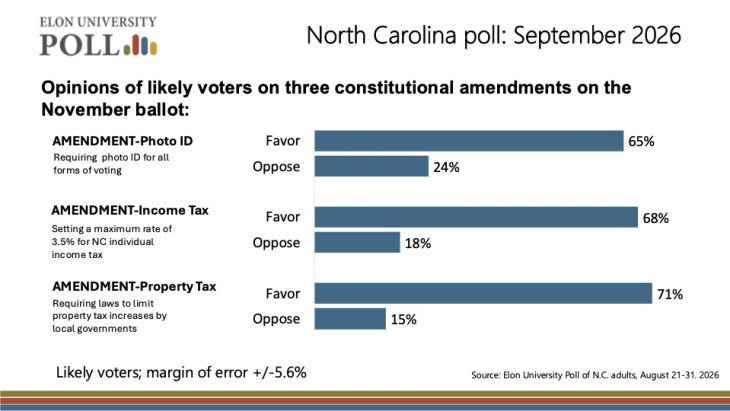
Constitutional Amendment – Photo ID
Likely voters in the November general election are strongly in favor of changes to the North Carolina Constitution to require a photo ID for all forms of voting, including absentee mail-in ballots. The Elon University Poll found that 63% of likely voters favored this constitutional amendment compared with 25% who opposed it and 12% who were unsure. The amendment reads as follows:
Constitutional amendment to require all voters, not just those presenting to vote in person, to present photo identification before voting.
Following an April 2023 ruling by the North Carolina Supreme Court, absentee voters must include a photocopy of their photo IDs with their mailed-in ballots or complete an ID Exception Form. This constitutional amendment would lock that requirement into the state’s constitution so it could not be changed by lawmakers.
Constitutional Amendment – Income Tax
Likely voters strongly favor changes to the North Carolina Constitution to lower the maximum allowable state personal income tax rate from 7% to 3.5%. In this survey, 67% favored this constitutional amendment, compared with 18% who opposed it and 16% who were unsure. The amendment reads as follows:
Constitutional amendment to keep the State income tax rate from being raised higher than three and one‑half percent (3.5%).
North Carolina’s current individual income tax rate is a flat rate of 3.99%, down from 4.25% in 2025. The rate is scheduled to drop to 3.49% in 2027 and 2.99% in 2028. This amendment would set a constitutional cap at 3.5% starting in 2027.
Constitutional Amendment – Property Tax
Likely voters are strongly in favor of changes to the North Carolina Constitution requiring the General Assembly to limit increases in property taxes levied by local governments. In this survey, 72% favored this constitutional amendment, compared with 14% who opposed it and 14% who were unsure. The amendment reads as follows:
Constitutional amendment requiring limits on property tax increases by local governments.
This amendment would not set a specific cap on property tax increases but would require state lawmakers to pass laws that limit how much local governments can increase total property tax revenue from one year to the next. The amendment calls for a “levy limit” to cap growth in total dollars collected by a local government, rather than a “rate cap,” which would limit the tax rate for property owners. If the amendment passes, the General Assembly would need to enact laws defining the revenue limits and any exceptions.
“Following a long history of most constitutional amendments on the Noth Carolina ballot being approved by voters, the three 2026 amendments all have multiples more ‘for’ than ‘against,’ said Jason Husser, director of the Elon University Poll and professor of political science and public policy. “In the case of the 2026 amendments, all three lock in current status quo rather than leading to immediate policy change, which decreases their potential for controversy in an election cycle currently focused on the politicians on the ballot.”
North Carolina constitutional amendment process
All three of these questions were put on the ballot by the General Assembly, which has sole power to pose constitutional questions to voters. In this poll, 58% of likely voters favored creating a process for citizens to introduce constitutional amendments, with 15% opposing citizen-initiated amendments and 27% unsure.
“State constitutional amendments impact state law and policy in complex ways,” Husser said. “However, ballot language that voters see on election day is often short. Our poll very closely replicated the ballot text that voters will see. If the ballot language differed or provided more detailed summaries for each amendment, we would likely find different results.”
Marijuana laws
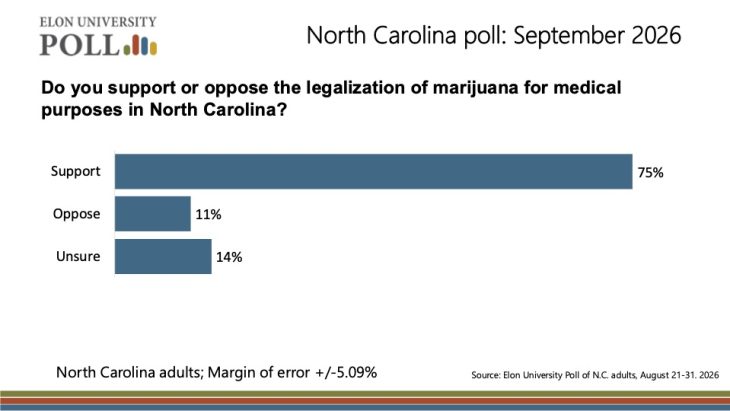
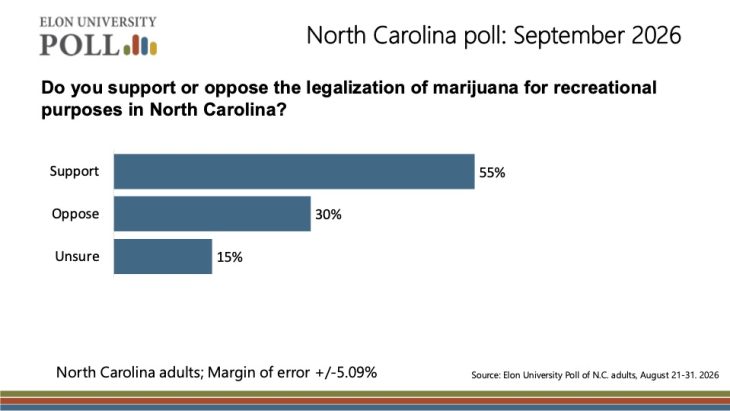
North Carolina adults were strongly in favor of legalizing the use of marijuana for medical purposes and also supported legalizing the recreational use of marijuana in the state. Medical use of the substance was favored by 75% with only 11% in opposition. For recreational use, 55% were in support of legalization compared with 30% who opposed it and 15% who were unsure.
These levels of support for marijuana legalization are mostly unchanged from an Elon University poll in January 2021.
There was a significant partisan divide on the legalization questions with Democrats far more likely to support loosening marijuana laws. Eighty-nine percent of Democrats favored legalizing medical marijuana compared with 57% of Republicans. For recreational use of marijuana, 74% of Democrats favored legalization compared with only 33% of Republicans.
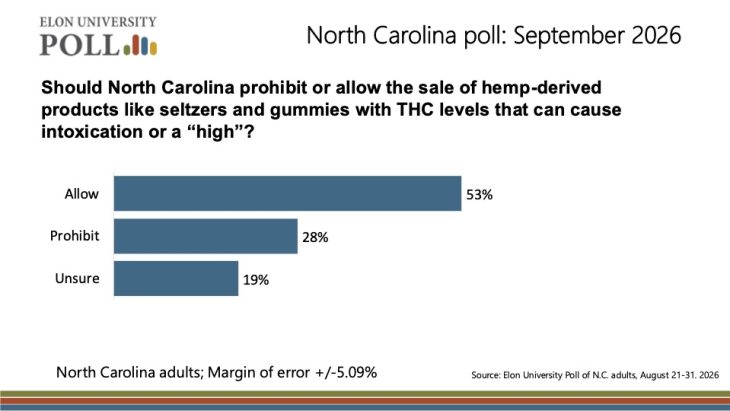
Related to hemp-derived products like seltzers and gummies with THC levels that can cause intoxication, 53% supported legalization and 28% said those products should be prohibited, with 19% unsure. Among Democrats, 62% favored legalization of these THC products compared with only 35% of Republicans.
An overwhelming majority of all adults (82%) favored prohibiting the sale of hemp-derived products to anyone under the age of 21.
Husser pointed out that the Elon University Poll has tracked marijuana attitudes over the last decade in North Carolina. “We found a significant increase in support for legalization between 2017 and 2021 as North Carolinians saw legalization occurring in other states,” Husser said. “Over the last five years, support for legalization has largely been stable with a large majority supporting medical legalization and a small majority favoring recreational legalization. In turn, support for allowing hemp-based THC has similar levels of support and high correlation with support for recreational marijuana. However, North Carolinians are largely unified in wanting hemp consumables restricted to those 21 or older.”
Poll Methodology
Access the poll topline and methodology at: www.elon.edu/elonpoll. The survey was developed by the Elon University Poll and fielded by the international marketing and polling firm YouGov as an online, web-based survey, self-administered through online panels. Between August 21 and August 31, 2026, YouGov interviewed 1,121 North Carolina adults aged 18 and older. These respondents were then matched down to a sample of 800 to produce the final dataset.
The matched cases were weighted to the sampling frame using propensity scores based on age, gender, race/ethnicity, years of education, and home ownership. The margin of error for likely voters in this survey is +/- 5.5%, for registered voters in this survey (adjusted for weights) the margin of error is +/-5.05%, and the margin of error for all adults in this survey is +/-5.09%.