


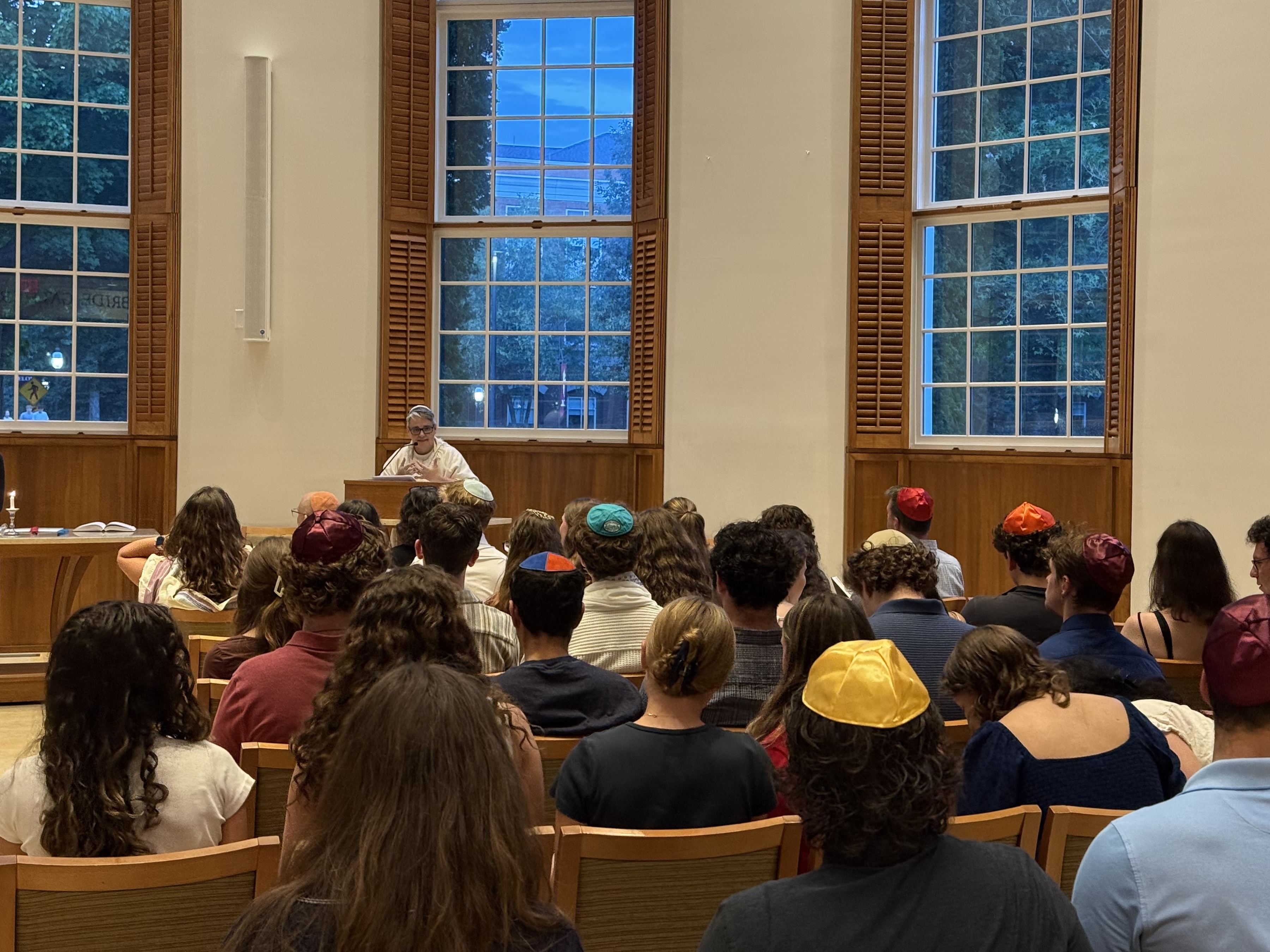
This teaching was delivered at Elon’s Kol Nidrei Service for Yom Kippur on Sept 20, 2026. Yom Kippur is a day of repentance and return. It is a day for the Jewish community to consider its actions of the past year and commit to living better in the year to come. This sermon explores the power of speech and how we can choose to use it for good.
Yom Kippur is called the day of atonement. It is a day when our sins are taken away from us and we are forgiven. We can start anew.
Doesn’t everyone just love the word sin? I know I don’t. Sin is a loaded word. I find it intimidating, scary, and perhaps a little bit shameful. It is uncomfortable to consider all the ways I fail those I care about and contribute to the brokenness of our world. However, just because something is uncomfortable doesn’t mean that it isn’t worth doing. After all, how can I improve myself if I can’t take an honest look (at least once a year) at all the ways in which I fall short?
Every year I remind y’all that Yom Kippur is a day of forgiveness for our communal sins. If we have harmed another person directly, we should apologize to that person directly and work to repair the relationship. On Yom Kippur we confess the collective sins of the Jewish people, hoping, praying, and trusting that God will forgive us and accept us back in love.
The two main prayers of confession are Ashamnu – “We Are Guilty” and Al Cheit – “For Our Sin” As it happens, we may not have committed many of the sins mentioned in these prayers. We also may not consider many of the actions we’re confessing to be sinful – our culture is very different from that of the ancient world. However, some categories of sin – such as speech-based sin – are still relevant today. The ancient rabbis understood just as we do that speech can be one of the most potent and harmful forms of sinning out there.
The prayer Ashamnu has 22 phrases, each corresponding to a letter of the Hebrew alphabet. It is an alphabetized catalog of sins. I count 5 explicit instances of speech-based sinning: dibbarnu dofi – we’ve spoken slander; tafalnu sheqer – we’ve spoken lie after lie; ya’atznu ra’ – we’ve advised wrongly (or advised evil); kizavnu – we’ve deceived; and latznu – we’ve mocked. If you include other phrases that could apply to speech acts, such as angering, rebelling, betraying, causing others to sin or become evil, sinning deliberately or sinning carelessly, committing abominations, making errors, or just being guilty in general, that’s at least 9 more. Whether explicit or implicit, most of the sins in Ashamnu can describe speech. This is an extraordinary number.
A similar focus on speech occurs in the prayer Al Cheit. We have sinned through: bittui s’fatayim – utterance of the lips; dibbur peh – using (or misusing) our mouths; viddui peh – only confessing verbally when actions of repentance are required (we might call this a “lip service” confession); tifshut peh – foolish talk; tum’at s’fatayim – impurity of the lips; kachash uvkhazav – false denial and false promise; lashon hara’ – evil talk (or slander); latzon – scoffing; siach sif’teinu – prattle of our lips; rechilut – gossiping; shevuat shav’ – swearing in vain. Like the Ashamnu prayer, Al Cheit mentions many other kinds of actions that can be applied to speech more broadly.
I don’t know about you, but I find this list of speech-based sins absolutely overwhelming. I have gossiped, scoffed, lied, deceived, and spoken badly of someone not just in the past year, but probably also this past week. I don’t even know how to track the full impact of my speech-based sin: often it is not directed against someone but contributes to a negative culture more broadly.
I think the rabbis were onto something when they lifted up speech-based sin as both extremely harmful and extremely hard to avoid. And the rabbis lived long before social media…. Nowadays, many speech-based sins aren’t even directly attributable to humans – the AI bots have learned from us how to sin with words! They’re having entire conversations without us!
So why does this matter? Let me tell you one place where I see the most harmful effects of sinful speech impacting the Jewish people and our campus today.
Three years ago when I first learned about October 7th, I was horrified. I had lived in Israel for two and a half years and thought of the many friends I still had there. Were they okay? Were their families okay? As a rabbi and a chaplain, the most pressing work right after October 7th was listening to y’all students talk about how Oct 7th impacted you personally. For so many of us here tonight, when we speak about Israel, we’re not talking about some abstract, far away other: we’re talking about family and friends – people near and dear to our hearts.
As I listened to students share after October 7th, it quickly became clear to me that there was a second emotional crisis unfolding: the repeated fracturing of friendships, many of which were caused or exacerbated by social media. I repeatedly heard from students who identified as Zionists that they wanted others to know they didn’t want Palestinian civilians to suffer. And I heard from several pro-Palestinian students (Jewish and non-Jewish alike) that they wanted to express their criticisms of the government of the state of Israel without being antisemitic. Many of them approached me for advice on how to do so.
If we only took our cues from social media or just the media landscape more broadly, we might think that we can either support Israelis OR Palestinians, that we could either support the return of the hostages OR work to safeguard Palestinian civilian lives, or that we need to choose between supporting a Jewish, democratic state OR the creation of a Palestinian state alongside Israel. I don’t believe that we have to make these choices. Our minds are big enough to hold two ideas simultaneously and our hearts are big enough to care for the whole world.
Another error of social media is that it creates an echo chamber that encourages us to be in relationship only with people who agree with us. Social media encourages a latent human tendency to demonize those who are different. Somehow, engaging with people who hold different views than you do has come to be a thing we should do, rather than a thing we get to do. Yes, conversations highlighting differences of opinion can sometimes be uncomfortable and even downright excruciating. But they can also be generative and even delightful. After all, how would we ever learn anything if we only ever heard opinions we agree with? How would we grow?
When we can engage with others who hold different views than we do from a place of mutual respect and curiosity, our conversations and communities become elevated. Engaging with different voices helps us to develop empathy and wisdom. When we can approach these conversations from a place of psychological and physiological safety, they can broaden our minds and open our hearts. We can learn and we can grow. I cannot tell you how many times my own thinking on various topics has become far sharper when I have engaged with those I disagree with. I also cannot tell you the number of times I have been surprised and touched by someone else’s story. Hearing differing perspectives – when practiced in an atmosphere of mutual respect and safety – is a gift.
If I had to pick one of the biggest communal sins of the Jewish people from the past several years, it is that we have too often used our words to tear each other apart for having different views on Israel. We have failed to speak respectfully to one another. We have failed to listen. We have failed to honor the good intentions of others. We have failed to see the humanity of the person who disagrees with us, or the deeper universal values at play behind their specific politics. We have failed to see how learning to understand different opinions – including the opinions of those among us who may just want to be Jewish and not think too much about Israel – can strengthen our community. We have failed to create safe spaces to discuss our differences constructively. And we have failed to open our hearts to each other. We have put politics over relationships.
I want to be clear. I do not believe that we caused this situation on our campus. It is a symptom of a much broader, systemic issue facing the global Jewish community today. However, we do have the opportunity to change how we speak to one another on this campus. We can choose to take a different path together.
On Yom Kippur we confess the collective sins of the Jewish people, hoping, praying, and trusting that God will forgive us and accept us back in love. It is an opportunity for a fresh start. My invitation for us all gathered here tonight is that we may also consider what it might mean to confess our collective speech-based sins to each other. My hope is that this confession might break open our hearts so that we can better connect with one another. I pray that we can work together to build a stronger Jewish community, one based on mutual respect and honoring differences, one that elevates each other and our conversations, and one in which all can trust that we will be accepted in love.
Finally, I want to acknowledge that I have used a lot of words to give this message to you! I am sure my own words have been imprecise and imperfect. I pray my message will be received according to the intention with which it is given – to strengthen the Jewish community in love. And if I’ve said anything tonight that resonates with you – whether you agree or disagree, whether you understand or you have no idea what I’m talking about and want to know more, or if you feel unseen or unheard by what I have said – I invite you to reach out. Let’s talk. I am sure that I have something to learn from you. And together we can create a new story about how we talk about Israel together on campus and beyond. To echo the ancient words of the psalmist (adapted from Psalm 19:15) yehiyu l’ratzon imrei finu vehigiyon libeinu lefanecha Adonai tzureinu vego’aleinu – may the words of our mouths and the meditations of our hearts be acceptable to you Adonai, our rock and our redeemer. Amen.