


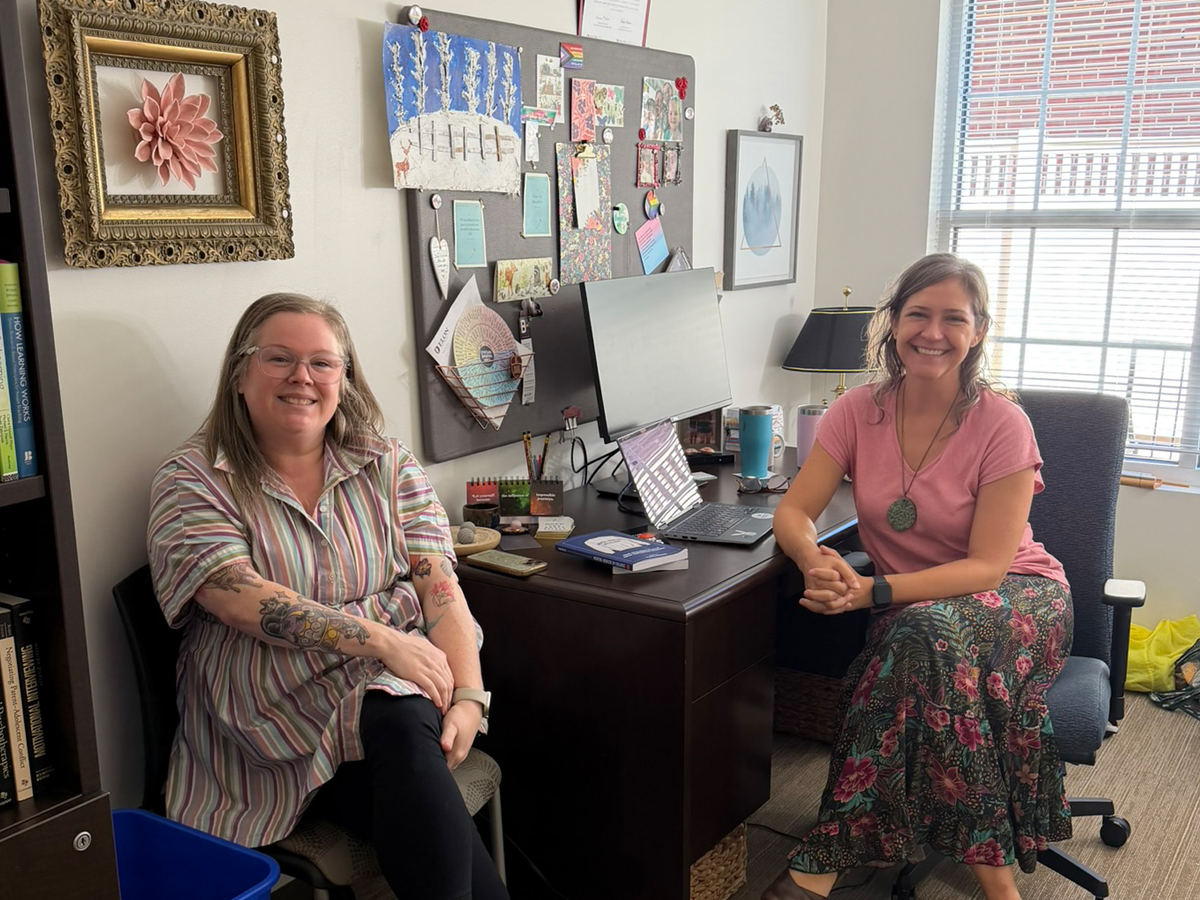
As the Faculty Fellow for Wellness and Well-Being, Iselin helps faculty explore how pedagogical wellness can support faculty, staff, and students, strengthen teaching and foster a culture of well-being at Elon.
For Anne-Marie Iselin, associate professor of psychology, well-being isn’t about achieving perfect balance. Instead, it is dynamic and continually shaped by our experiences, relationships, and environments. Struggle is a normal part of human experience. Well-being includes our capacity to reconnect with what supports us and reorient toward what helps us thrive.
“It’s just common humanity that we’re all going to struggle with well-being across our lifetime,” Iselin said. “It’s allowing that shared experience of struggle and being able to bounce back, reconnect and reorient.”
This perspective has shaped Iselin’s approach to teaching and caring for the whole student. Now, as the Faculty Fellow for Wellness and Well-Being, she is exploring how faculty can integrate well-being into their teaching while also caring for themselves.
Putting the person first
Growing up, Iselin spent time with peers whom others viewed as the “wrong crowd.” However, she saw them first as people and became interested in working with adolescents facing challenges. That interest became her entry into mental health, eventually leading her to work with youth who were in trouble with the law, including beginning as a live-in manager of a group home.
These experiences shaped Iselin’s life philosophy, which still guides her today: putting the person first.
“Trying to understand that person holistically before focusing on perhaps something that’s not going so well,” Iselin said. “The student before the concern. The student before the missed assignment. The adolescent before the criminal behavior.”
The commitment to understanding the whole person continued throughout Iselin’s academic journey. She studied psychology, social welfare and criminal justice at the University of Wisconsin–Madison before completing her Ph.D. in Clinical Child Psychology at the University of Alabama at Tuscaloosa and postdoctoral work at the University of Pittsburgh Medical Center. Her career later took her to Duke University and the University of North Carolina at Wilmington before a family move to the Triangle and time away from full-time academia brought Elon onto her radar.
“Elon felt like a unicorn,” Iselin said. “It was this perfect way of integrating everything that I love, from my research questions to how I live my life and the ways that I care for students in the classroom.”
Iselin joined Elon as a full-time faculty member the semester before the COVID-19 pandemic and began integrating wellness practices, such as deep breathing and values affirmation exercises, into her classroom. Once the pandemic began, she became even more intentional about incorporating wellness practices, drawing on her clinical psychology background.
“I realized I could bring my clinical self into the classroom,” Iselin said. “Not as a clinician, but as little healthy strategies that people can pull into their lives. Part of effective teaching at Elon is caring for the whole student.”
This realization led Iselin to implement what she calls “well-being rituals” into each class, giving students a few moments to reflect, reset or reconnect with themselves.
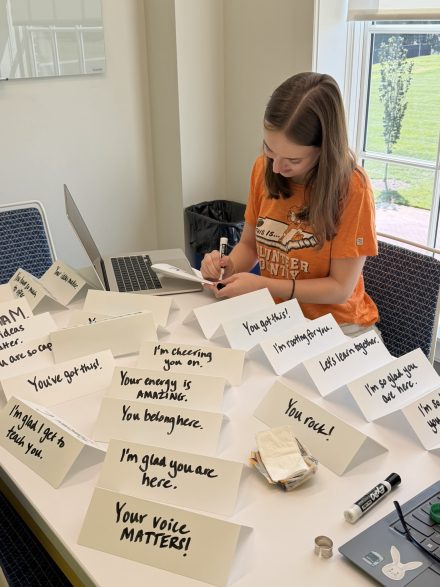
For Iselin’s students, these small practices have made a meaningful difference in the classroom. Anna Grace Gilbert ’27, who took a class with Iselin and now serves as her teaching and learning assistant, has experienced that approach firsthand. She believes Iselin’s care extends beyond the “well-being rituals” and is an important part of how Iselin supports her students.
“At our very first meeting, I made name tags for everyone in the class. After I finished writing their names, she wrote a personalized note of encouragement on the back of each one,” Gilbert said. “I think that just demonstrates how much Anne-Marie cares about her students before she even meets them.”
Iselin’s commitment to integrating wellness practices into the classroom and caring for the whole student ultimately drew her to the Faculty Fellow for Wellness and Well-Being role, allowing her to expand that work beyond her own classroom.
Wellness as part of effective teaching
Central to Iselin’s work as the Faculty Fellow for Wellness and Well-Being is exploring what she calls the “mutuality” of pedagogical wellness, where supporting student and faculty well-being can work together.
“Anne-Marie brings a thoughtful combination of expertise, care and collaboration to this role,” said Marna Winter, associate director for the Center for the Advancement of Teaching & Learning, and Teaching Professor of Education at the Dr. Jo Watts Williams School of Education. “She understands wellness not as an additional task faculty must take on, but as something that can be meaningfully integrated into pedagogy and course design.”
Jill McSweeney, assistant director of CATL, explained how that integration can create an environment where students can learn effectively.
“When a classroom is attentive to how students are doing physically, mentally and socially, it becomes a space that invites them to show up fully and take the risks that deep and meaningful learning requires,” McSweeney said.
Gilbert has experienced the connection between well-being and effectiveness in her role as Iselin’s Teaching and Learning Assistant (TLA).
“In the beginning, she set very clear expectations and made sure that I continued to put my well-being first,” Gilbert said. “She has been an incredible support system for me this semester. This has allowed me to be fully present as her TLA and do my job effectively.”

Iselin also emphasizes that supporting student well-being requires clarity about the faculty role, understanding meaningful ways faculty can support students, and recognizing when to connect students with other university resources.
“With students, I can empathize. I can affirm. I can support. I can reach out,” Iselin said. “But I don’t have to be a counselor. That’s not my role. That’s not my scope of practice.”
Rather than seeing role clarity as separate from care, Iselin views it as part of creating healthy and sustainable relationships with students. Being transparent about what faculty can offer and connecting students with others when different expertise is needed allows faculty to remain caring and responsive without assuming responsibilities that belong to mental health professionals.
Iselin is bringing these approaches to faculty and staff through the Kindness Pedagogy Community of Practice, workshops and one-on-one consultations.
Looking ahead, Iselin hopes that creating multiple entry points through the Kindness Pedagogy Community of Practice, workshops and one-on-one consultations with faculty and staff will help strengthen the culture of well-being at Elon, where pedagogical wellness is recognized as part of effective teaching and learning.
“If faculty want to build their teaching effectiveness, this is another pathway for them to do so,” Iselin said. “To learn how to conceptualize it, implement it effectively and recognize the positive impact that it might have.”