


What does care mean to you? A year-long event series kicks off a discussion about different types of community care.
In September, students, faculty, staff and local community members gathered for two events to consider what it means to give and receive care to kick off a year-long series on Care Webs.
Organized by Elon faculty members Archie Crowley (English), Mel Gil (English), Maria Mejia (Philosophy) and Nikita Shepard (History) and funded by the Phi Beta Kappa Fund for Excellence, the event series explores the various forms that care takes and the role it plays across diverse communities.
“Care webs” refer to networks of people and community resources through which people support one another and meet each other’s needs. This framework challenges assumptions of care as something provided only by individuals, institutions, or professionals. Informed by disability studies scholarship, the concept emphasizes the interconnected relationships that sustain communities.
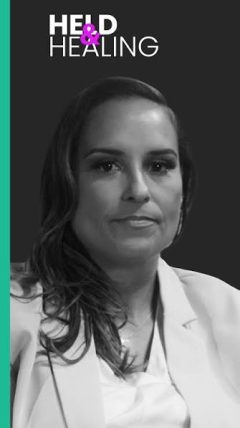
The first event in the series featured a screening of the documentary “Held and Healing,” followed by a Q&A with Kristie Puckett, a formerly incarcerated survivor and advocate for incarcerated mothers. Puckett has successfully lobbied for policies requiring carceral institutions to provide maternal healthcare. Centering Puckett’s experiences, the documentary examines the intersections of race, trauma, addiction, incarceration and Black maternal health. The screening offered an important entry point into the series’ themes, illustrating how care can take the form of collective advocacy, solidarity and efforts to build more responsive systems of support. Organized by Stephanie Baker and Maria Mejia, the event drew more than 50 students for the screening and discussion.
At the official kick-off event for the series, Mutual Aid & Care Mapping, Nikita Shepard opened by facilitating a discussion about how people understand and experience care. Participants reflected on the people, relationships and resources they rely on, as well as the ways they themselves provide care to others.
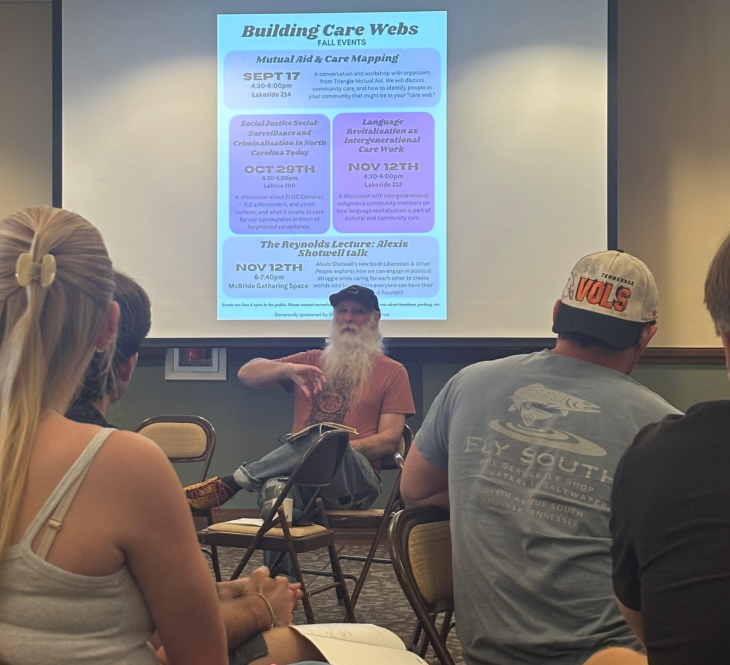
Local community activist Devin Ceartas spoke about his experiences working with Triangle Mutual Aid, a grassroots collective that seeks to support projects of interdependence and resource sharing in response to disaster crises, food insecurity, and other needs. He offered reflections on the difference between charity and mutual aid, and answered questions about how mutual aid operates in practice.
“In mutual aid, the worst thing you can do is pay someone the exact amount of what something costs, because that tells me you don’t want a reason to continue being in community with me,” said Ceartas. “You think sharing resources is a debt to be paid, not a relationship to nourish. In mutual aid, I give you bread now, and you give me eggs later.”
The discussion explored how mutual aid centers reciprocity and the idea that communities can work together to meet shared needs, which is not dependent on a person’s beliefs, identities or citizenship status. Finally, through a zine shared with participants, the event introduced care mapping as a way of making visible the community networks of support that already exist, and how to strengthen those relationships.
The series continues this fall with three upcoming events:
- Social Justice Social: Surveillance and Criminalization in North Carolina Today Thursday, Oct. 29 4:30-6 p.m. in LaRose 200
- A discussion about how local communities are responding to Flock Cameras, ICE enforcement, and youth curfews, and what it means to care for our communities in times of heightened surveillance.
- Language Revitalization as Intergenerational Care Thursday, Nov 12, 4:30-6 p.m. in Lakeside 212
- A discussion facilitated by Elon faculty members Archie Crowley and Corey Roberts with intergenerational indigenous community members on how language revitalization is part of cultural and community care.
- The Reynolds Lecture: Alexis Shotwell Thursday, Nov 12, 6:30-8 p.m. in McBride Gathering Space
- Alexis Shotwell’s new book “Liberation is Other People” explores how we can engage in political struggle while caring for each other to create worlds where everyone can have their needs met and flourish.