


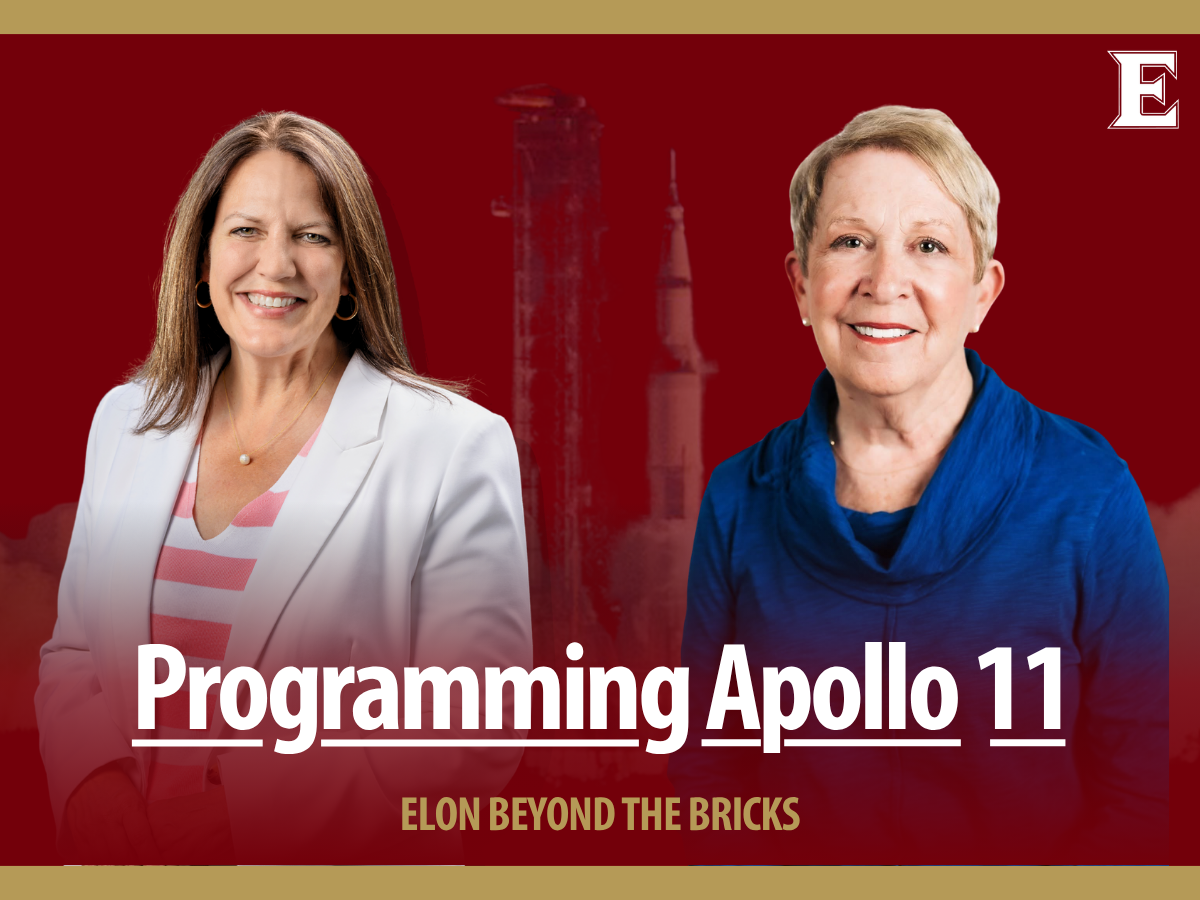
In the latest episode of "Elon Beyond the Bricks," the first Queens alumna featured on the podcast joins President Connie Ledoux Book to reflect on her work with the Apollo missions, the question that shaped her life and her hopes for what Elon and Queens can make possible for future generations.
On July 20, 1969, Queens University of Charlotte alumna Rosie Graham ’67 watched with bated breath as NASA astronauts walked on the moon. But unlike the estimated 600-650 million people around the world who watched Neil Armstrong take his historic first step on what Buzz Aldrin described as “magnificent desolation,” Graham had an unrivaled seat for the moment: the “fishbowl” behind NASA’s Mission Control.
Through a contract with NASA, Graham was an IBM programmer supporting the Apollo missions, processing data for mission controllers and performing computing used to determine coordinates for the missions. When Armstrong and Aldrin walked on the moon, Graham recalled feeling a blend of relief, pride and the realization that something once thought unimaginable was truly happening.
“We just all of us breathed a sigh of relief that this was really happening,” Graham recalled. But as Graham told President Connie Ledoux Book on the latest episode of “Elon Beyond the Bricks,” she does not believe she arrived at that moment by chance.
A few years earlier, Graham was a student at Queens College, where faculty encouraged her and her peers at the then all-women’s institution to think beyond the roles society traditionally expected of women in the 1960s. One prompt from religion professor Mary Faith Carson asked students to consider the lives they expected to lead and posed a simple question: “Is this then enough?”
“That has been my mantra, I think, probably the rest of my life,” Graham said. For her, the answer was not simply to fulfill what was expected, but to consider what she could do best and how she could continue moving forward.
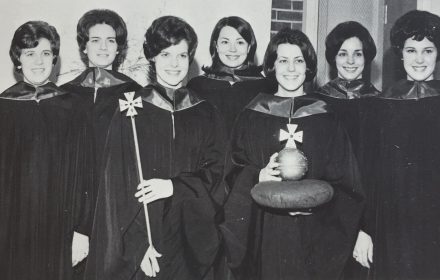
Graham was still unsure exactly what she wanted to do after continuing her education in mathematics when another mentor suggested she apply for a programming role connected to the Apollo program. She had never taken a computer science course, but IBM trained her to program, and she became one of roughly 30 women among 600 programmers working there at the time.
For Graham, the Apollo missions reinforced the value of contributing to something larger than oneself. “You have to be a part of the team that makes it happen,” she said. “And every part matters.”
Her career continued to evolve after the Apollo missions. Following a move to Tullahoma, Tennessee, Graham worked in technology before spending decades teaching computer science and mathematics. “I didn’t have to change what I know,” she said. “I had to change what I did with it.”
That willingness to adapt has carried Graham through technology’s tremendous advances, from mainframe computers to personal devices and now artificial intelligence. She and Book agreed that each generation faces change, and the challenge is to understand new technology, use it thoughtfully and continue learning.
As the first Queens alumna featured on “Elon Beyond the Bricks,” Graham sees a similar opportunity in the future of Queens and Elon. She hopes the institutions continue educating what she calls the “whole person” by giving students opportunities to look beyond a single field, see how disciplines relate to one another and develop a lifelong desire to learn.
Graham believes that breadth helped carry her from Queens to IBM. Mathematics gave her technical knowledge, but art, culture and the liberal arts taught her to communicate and approach problems from different perspectives — skills she believes mattered on a team attempting something that had never been done.
“They were trying to get to the moon,” Graham said. “They wanted a team that could think outside the box.”