


Elon students and alumni stood out at Techstars Startup Weekend in Winston-Salem, earning top finishes and recognition for their startup ideas with support from the Doherty Center for Creativity, Innovation and Entrepreneurship.
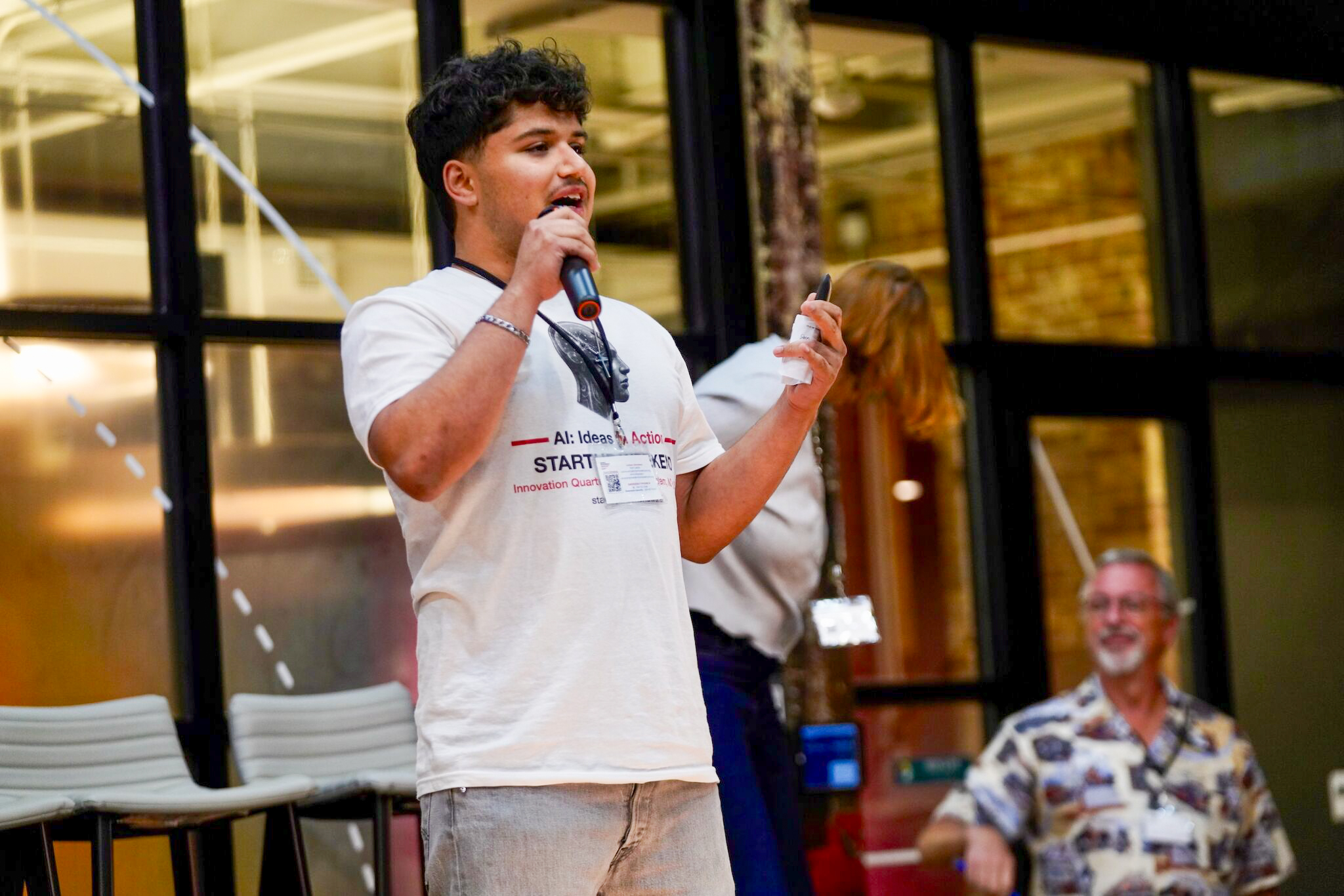
When Jorge Sanchez ’30, an entrepreneurship and innovation major from Wake Forest, N.C., arrived at Startup Weekend, he wanted to find out whether an idea born from his own travel frustrations could hold up in front of other people.
“Your flights, hotel, plans and reservations end up scattered across a dozen apps, emails and screenshots, and when something goes wrong mid-trip you’re the one scrambling to fix it,” Sanchez said.
His answer was Trip Pilot, an organizer and in-trip companion designed to keep travel information in one place and help travelers handle problems as they happen.
Sanchez was one of 21 participants to pitch an idea on the opening night of Techstars Startup Weekend AI: Ideas in Action, held Oct. 2-4 in Winston-Salem. Trip Pilot was among six concepts selected by participants for development over the weekend.
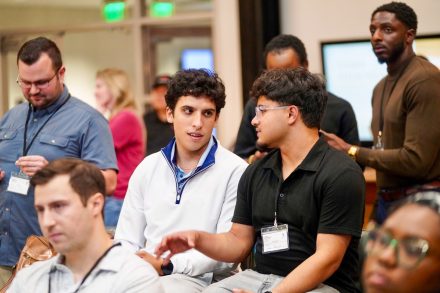
Martha and Spencer Love School of Business students and alumni had a strong showing across the competition, helping develop the first- and second-place ventures while contributing to several other teams. The Doherty Center for Creativity, Innovation and Entrepreneurship served as a facilitator sponsor and helped send Elon students to Winston-Salem, covering registration and lodging for participants.
Startup Weekend moves quickly. Participants pitch ideas Friday, form teams around selected concepts and spend the weekend testing those ideas with customers and mentors, developing business models and preparing final pitches for judges.
For Sanchez, that process changed Trip Pilot significantly.
“We started out targeting older travelers with a text-and-call AI assistant, then moved away from that and repositioned it as an organizer and companion rather than another planning or booking app,” Sanchez said.
By the end of the weekend, he had narrowed his audience to college students taking their first trips as independent adults. As the weekend progressed, Sanchez took on a larger role in developing and testing the idea.
“Working mostly on my own forced me to learn how to validate an idea, not just pitch it,” Sanchez said. “I built a simple survey to see if strangers cared, and I realized how much I had been guessing about my customer. I also learned I can keep going and lead even when things don’t go to plan.”
Sanchez is continuing to develop the concept through customer interviews, including conversations with Elon students who have studied abroad.
Carmine Familletti ‘27, a finance and entrepreneurship major from Basking Ridge, N.J., took a different path into the weekend’s first-place venture. After listening to the opening-night pitches and talking with several teams, the idea behind Little Helper stood out to him.
Little Helper is a safety application for children’s Windows PCs and Macs designed to identify potential signs of grooming, bullying or explicit content in online chats and alert parents.
“I spent time talking with other teams and testing their ideas, and this one stood out as the strongest, so I joined the team,” Familletti said.
Familletti served as chief financial officer, building the pricing model, calculating operating costs and developing a three-year financial plan. His financial work also influenced how the product was designed.
“I used that cost data to see which features were cheap and which were expensive to run,” Familletti said. “That helped us redesign the AI engine to be as cost-efficient as possible, cutting our AI cost from about $26 per family per month to about $1.20.”
By the final pitch, Familletti said the team had more than a concept to show the judges.
“We came in with more than an idea,” Familletti said. “By the final pitch, we had a working product, survey data from real parents, and financial numbers we could defend.”
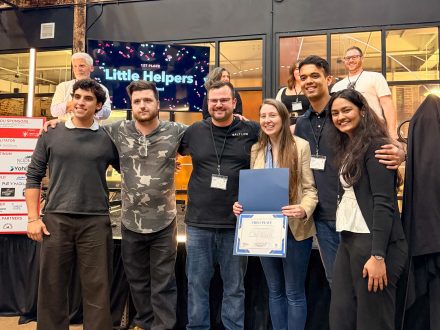
Little Helper earned first place and received Sparq Coworking memberships, app development support from YohDev and a sponsored launch party to help the team continue developing the venture.
Gabi Czerveny ’27, a marketing major from Charlotte, N.C., joined Transfer Ready, a concept pitched by Elon alumnus Aaron Satko ’25 after his own experience trying to buy a business.
“He was like, ‘I have an idea for putting the value from the CEO’s head back into the business,’” Czerveny said.
The team developed the concept around helping business owners capture knowledge that might otherwise exist primarily in their heads before retiring or selling the company.
For Czerveny, part of the work was helping the team turn a wide range of ideas into a focused concept.
“We had a lot of ideas on the table, so I helped us narrow in on what we could realistically accomplish over the weekend,” Czerveny said.
She also helped refine the team’s presentation, cutting down slides and making sure the final pitch clearly communicated the idea.
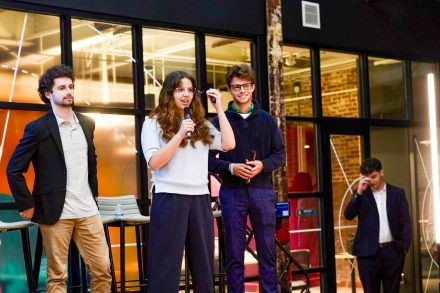
Transfer Ready earned second place and the Social Impact Award, recognizing the venture’s potential to support business and wealth transfer, particularly for minority- and women-owned businesses.
“They said that was so important, especially for small towns, because there are so many small businesses and a lot of them shut down when an owner leaves,” Czerveny said. “Our idea was to keep these companies that have been in business, in business.”
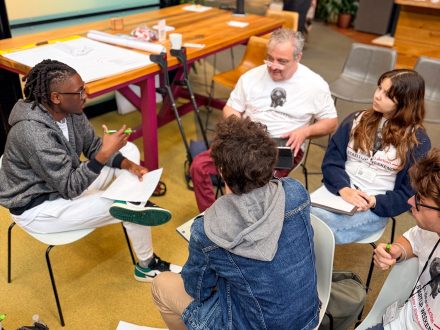
The team also received Sparq Coworking memberships and development support from Sigma Software Vertex to continue building the venture.
The Transfer Ready team also included Elon students Pierson Norris ’27, Aaron Grubman ’29 and Murray Marks Jr. ’28, along with alumni Joshua Mason ’25 and Satko. Kathy Atwiine ’29 participated on another team during the weekend.
Czerveny’s role with Startup Weekend began before the competition. As a Techstars student ambassador, she helped recruit Elon participants and worked with Ashley Wilcox, director of the Doherty Center, to get students involved.
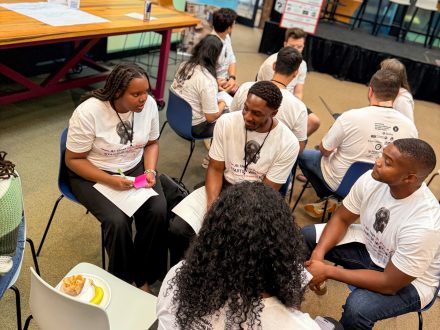
Wilcox also traveled to Winston-Salem and served as a judge during the weekend.
“The experience exposed us to different people, perspectives and ideas than we might otherwise encounter,” Czerveny said. “I would mainly suggest that people go to push themselves out of their comfort zones. There are always new ideas there that you would never think of. You really leave the weekend feeling refreshed and focused”
Familletti echoed that advice for students considering a future Startup Weekend.
“Just do it,” Familletti said. “Whatever your skill set, and whatever you do or don’t know going in, the competition will push you to learn something new.”