


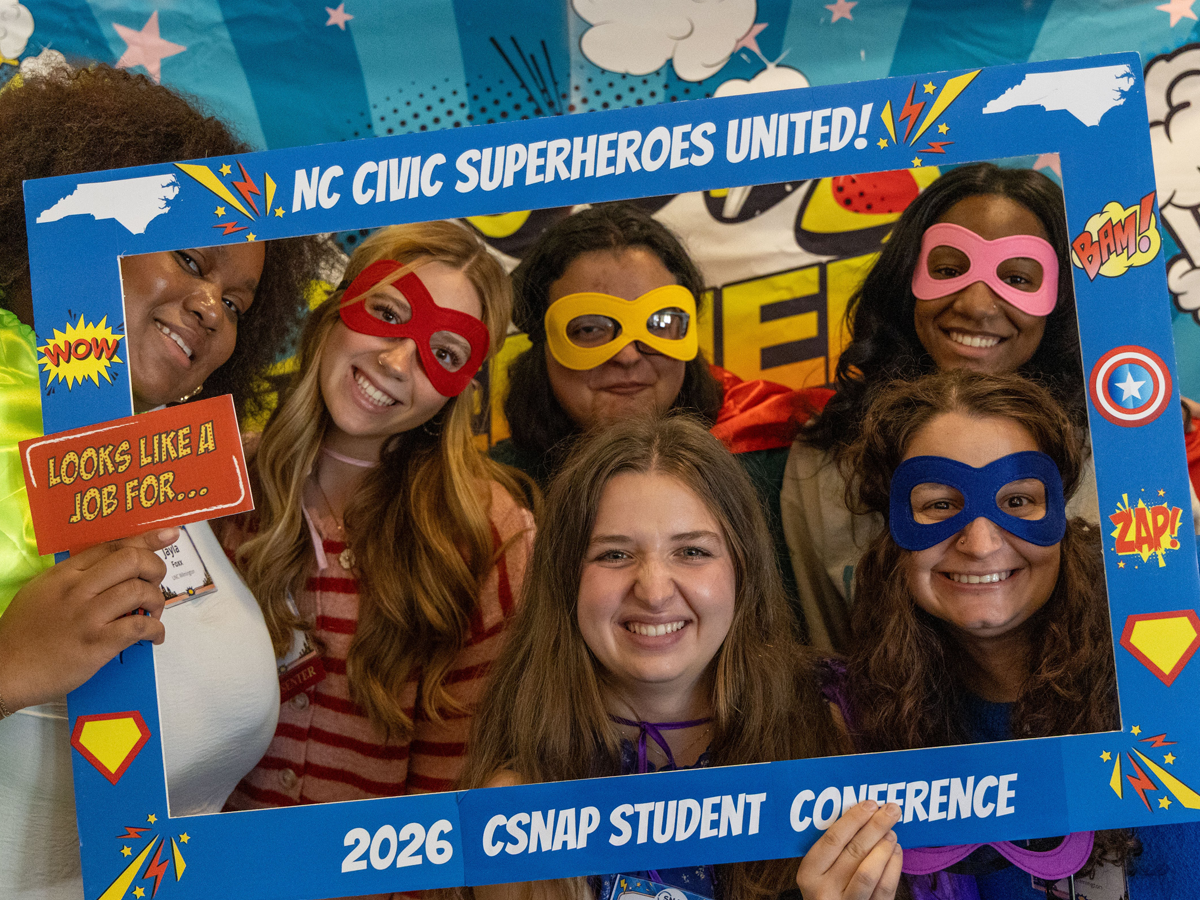
Approximately 80 students from 16 North Carolina campuses gathered for the CSNAP Student Conference to develop strategies for community action and recognize student leadership.
Not all superheroes wear capes. Some organize their peers, build community partnerships or work to strengthen their campus communities.
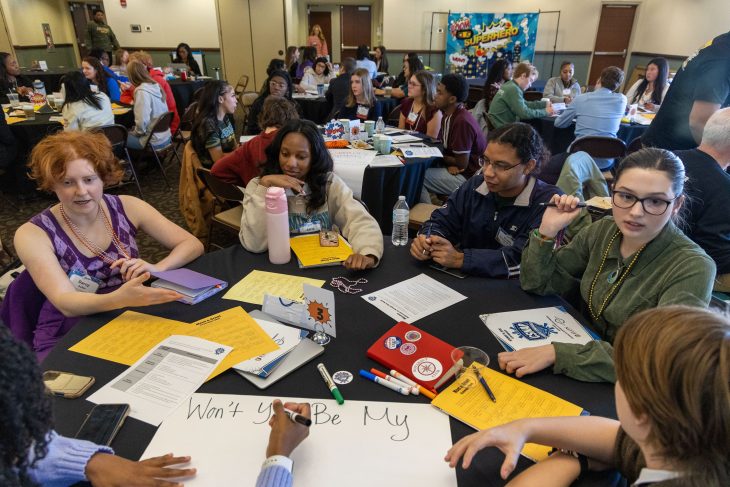
Those everyday acts of civic leadership took center stage at Elon University during the CSNAP (Citizenship, Service, Networking and Partnerships) Student Conference on Nov. 13–14. Organized by North Carolina Campus Engagement, CSNAP provides students opportunities to share ideas, develop skills for community action and build connections that support their work on campuses and in communities.
Centered on the theme “Everyday Heroes: Unleashing Civic Superpowers to Strengthen Communities,” the conference brought students together from campuses across North Carolina to discuss civic health and how communities work together to solve common issues. Through these discussions, the conference aimed to help students learn how to turn ideas into action.
“We’re trying to build students’ skills through activities during the conference that empower them to see themselves as problem solvers,” said Leslie Garvin, executive director of NC Campus Engagement.
Turning ideas into action
Breakout sessions explored how civic engagement could shape students’ careers and their approaches to campus challenges. During the “Do Good. Make a Living. Change the World: Exploring Careers in Social Good,” session facilitator Amber Melanie Smith, a social entrepreneur, social good content creator and owner of ChangeKit, discussed pathways for turning an interest in service into a career.
“I’d love for students to leave feeling like they learned about a new option they hadn’t considered before, and knowing that they can make a career and do good at the same time,” Smith said.
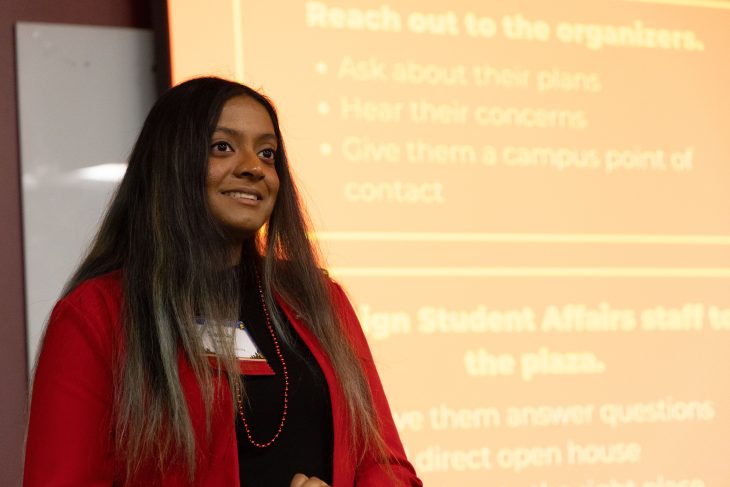
North Carolina State University doctoral student and session facilitator Sasha Sembur, also hoped to broaden students’ perspectives. In “Campus at a Crossroads: A Choose-Your-Path Protest Simulation,” Sembor led a simulation examining campus protests through the perspectives of students, faculty, leadership and the public.
“I hope that students can expand their horizons and know who to talk to if there’s an issue on their campus that they want to help fix,” Semuor said. “I also hope that they gain a different perspective on how they can make a difference in their communities.”
Learning different perspectives was something that both Elon student Michael Fiege ’27 and North Carolina Agricultural and Technical State University student Jyanne Guide valued during the conference.
“Seeing different communities come together from different parts of North Carolina, which are so vastly different, with such vastly different student bodies, is inspiring,” Fiege said. “It allows us to expand and understand what we need to do to help others.”
While the conference offered new perspectives, it also reinforced Guide’s commitment to civic engagement.
“My everyday experiences as a Black woman make me interested in civic engagement,” Guide said. “From political action to community engagement, these topics show up in my daily life, so being committed to civic engagement is a necessity.”
Alongside opportunities to learn from one another, the conference celebrated students already making a difference within their community.
Recognizing student impact
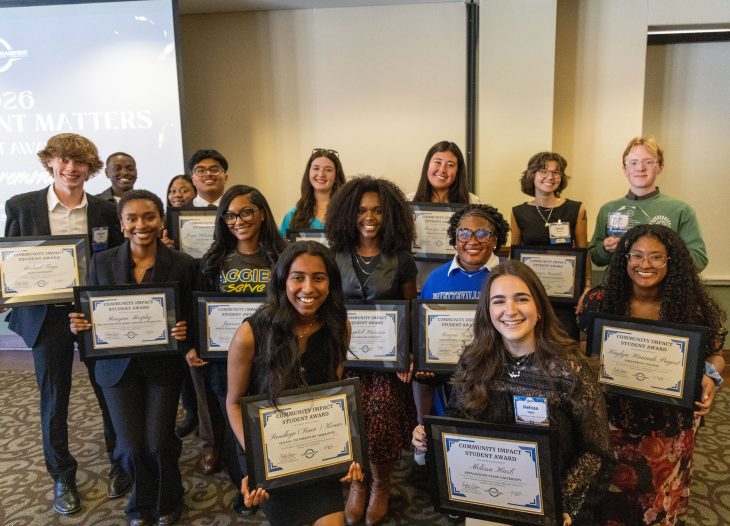
The 2026 Community Impact Student Award (CISA) recognizes student leaders who demonstrate a deep commitment to community involvement and ability to inspire peers. One student from each participating NCCE member campus received an award.
“Having the student awards is a really incredible opportunity to lift up the work that is not often lifted, and shine a spotlight on people who, yes, are doing this out of the goodness of their heart, but are doing it in exceptional, impactful ways,” said Sam Delap, program coordinator for NC Campus Engagement.
Fiege and Guide were both honored, representing their respective universities.
Fiege was recognized for his work at Elon, where he has spent several years coordinating two of Elon’s flagship community engagement programs that support young people and adults with disabilities: Special Olympics and Peacehaven Community Farm. His involvement with Special Olympics grew from volunteering at weekly soccer practices to coaching the soccer, basketball and golf programs.
For Fiege, the work extends beyond sports.
“What’s most important to me is the Special Olympics participants understanding that they have a place where they belong, and that they have a place that is for them,” Fiege said.
Guide was recognized for work empowering her peers as vice president of the Alpha Phi chapter of Alpha Kappa Alpha Sorority, Incorporated®, and team lead for the Aggie Source Food Pantry. Her commitment also extends to her roles as an Andrew Goodman Ambassador and Student Government Association Delegate, along with research, reporting and advocacy involving several organizations and fellowship programs.
The award prompted Guide to reflect on her civic engagement journey.
“This award will continue to remind me of my journey of finding my voice at A&T through advocating for change,” Guide said. “I’m blessed that I have the opportunity to pursue my passions while also making an impact!”
The ceremony also recognized Declan King, a student at Appalachian State University, with the 2026 John H. Barnhill Civic Trailblazer Award for his work and engagement as a civic leader with Appalachian State’s Office of Community-Engaged Leadership and his engagement in the Boone community as a member of the Town of Boone Planning Commission.
Named after Elon alumnus John Barnhill ’92, the award honors his legacy of student service and civic leadership. Barnhill co-founded Elon’s Habitat for Humanity chapter and created Elon Volunteers! before becoming the university’s first paid staff member dedicated to coordinating volunteer service.
That legacy of student leadership was highlighted throughout the awards ceremony and reflected the conference’s broader message: Students can be everyday superheroes by making a difference in their communities without holding a formal title.
“Even as a student, even if they are not elected or appointed somewhere, they still have that power with their voice and their community,” Sembur said.
2026 Community Impact Student Award recipients
- Melissa Harb, Appalachian State University
- Anushka Kumar, Duke University
- Campbell Harrison, East Carolina University
- Michael Fiege, Elon University
- Rayna Sermon, Fayetteville State University
- Kaylyn Pageot, Greensboro College
- Josue Villatoro-Castillo, High Point University
- Jyanne Guide, North Carolina A&T State University
- Chantel Chestnutt, North Carolina Central University
- Sandhya (Sana) Konar, Queens University of Charlotte
- Ella Moore, University of North Carolina at Asheville
- Raegan Murphy, University of North Carolina at Chapel Hill
- Laura Grossheim, University of North Carolina at Wilmington
- Braelyn Howard, Wake Forest University
- Sawyer Goswick, Western Carolina University