


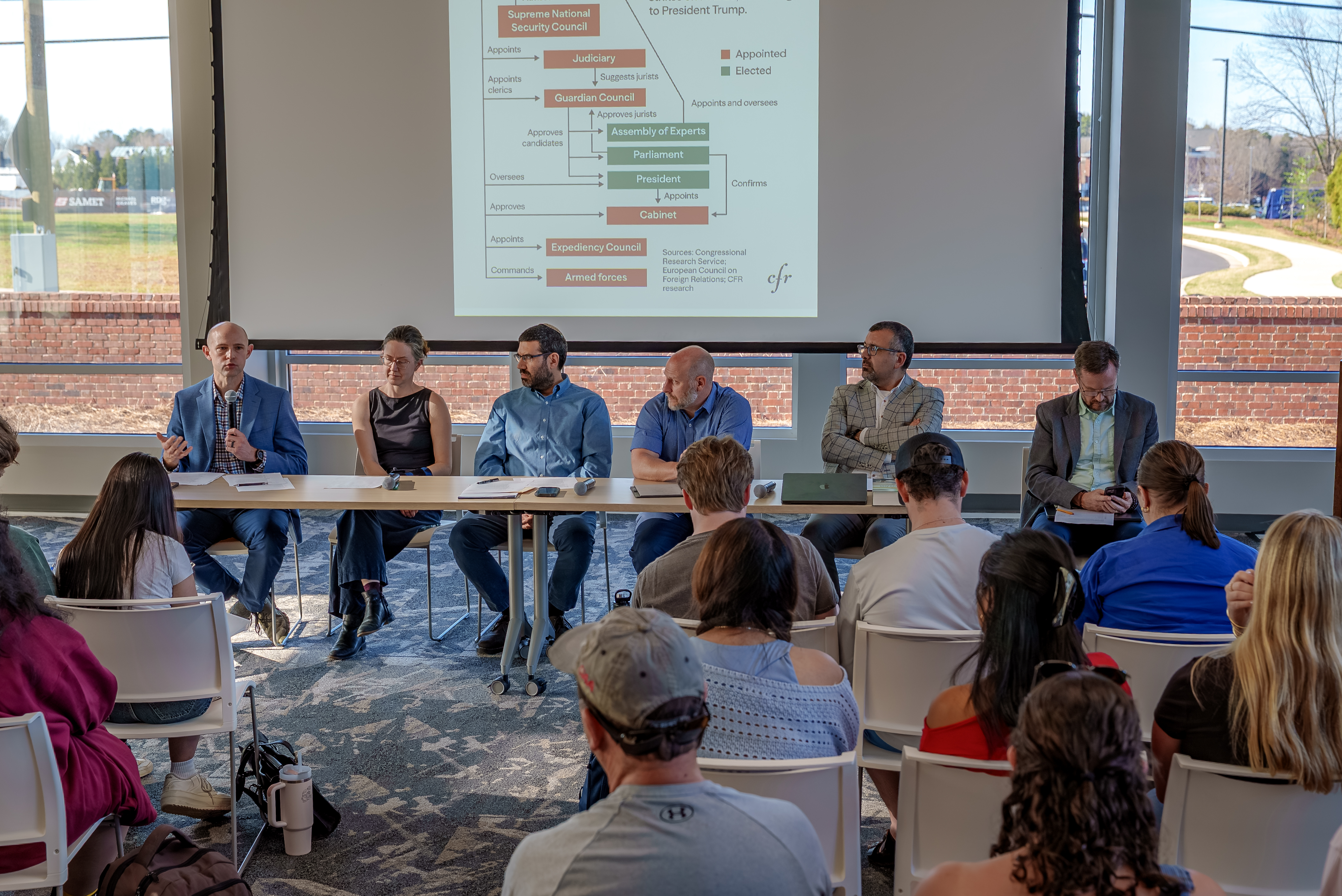
The Elon community gathered on March 10 to hear Elon professors offer information, education and opinions on the US-Iran conflict.
Elon University faculty from the Department of Political Science and Public Policy and the Department of Religious Studies gathered with students in East Neighborhood Commons on March 10 for a panel discussion about the U.S.-Iran conflict. The war began on Feb. 28 with the killing of Iranian Supreme Leader Ayatollah Ali Khamenei in a joint U.S.-Israeli strike. Since then, the conflict has intensified.
During the panel, moderated by Jason Kirk, professor of political science and policy studies, each professor used their academic research to explain the “hows, whys and whats” of the war.
“We are in a very different media and political economy compared to a generation ago,” said Kirk, “and that will be the deciding factor of how we view and remember this conflict.”
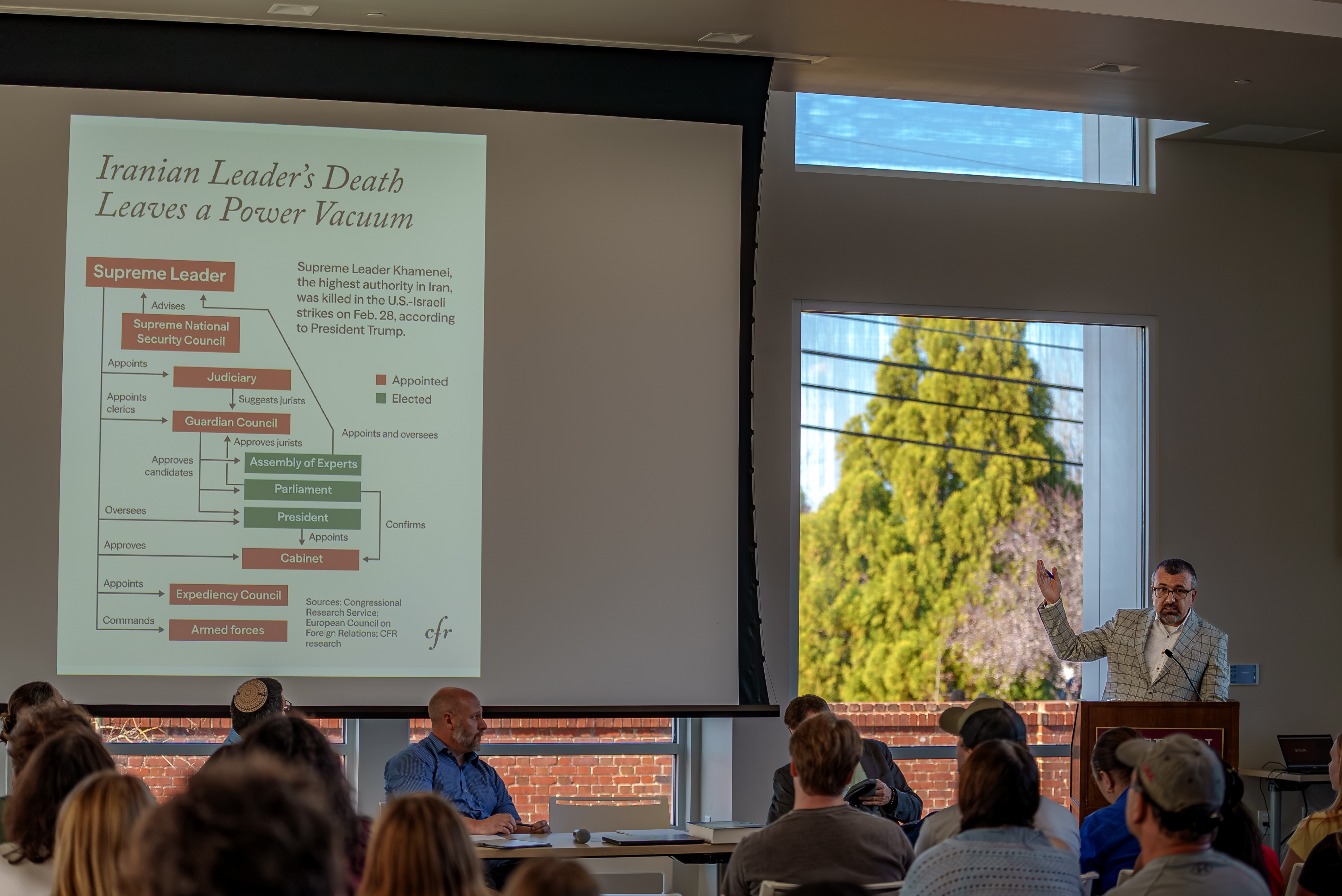
Baris Kesgin, associate professor of political science and public policy, explained the Iranian political system in which religious authority and democratic practices play a part in governing society. Using graphs that outlined the political hierarchy, Kesgin emphasized the seriousness of the death of Iran’s Supreme Leader, Ayatollah Ali Khamenei, and how Iran selected their new Supreme Leader, Mojtaba Khamenei.
“Iran is not completely a theocracy and not essentially a democracy,” Kesgin said.

Thomas Kerr, assistant teaching professor of political science and public policy, discussed the U.S. military, noting that, although the United States has the largest military in the world, it does not have unlimited resources. Regardless, Kerr explained, even with fewer available resources to defend other bases, the United States has proven in previous conflicts to beat Chinese war technology that is being used by Iran currently.
“The more we [the United States] dedicate our resources in Iran, means that less resources that we can guarantee towards our other bases in, for example, Ukraine and Taiwan,” Kerr said.
Chelsea Bediako, a political science & international and global studies major, attended the panel to learn more about the conflict outside of what she was seeing in the news media.
“I am the type of person who information comforts me, for example, having a grasp on what’s going on and having less uncertainty makes me more comfortable, so I wanted to separate fact from speculation,” Bediako said.
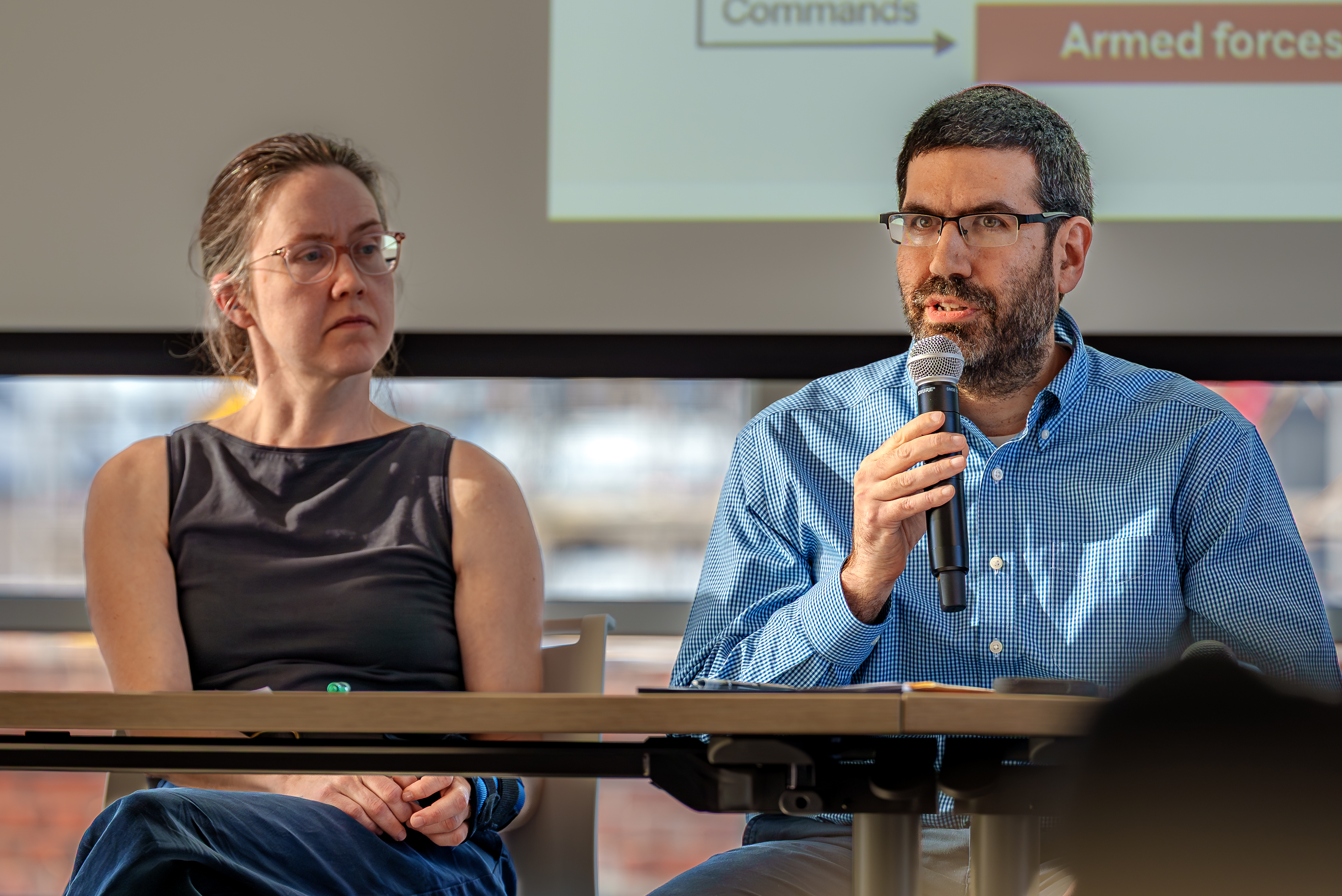
Geoffrey Claussen, professor of religious studies and the Lori and Eric Sklut professor in Jewish studies, spoke to the religious context of the war. He explained that although it is difficult to justify any war due to the human consequences, some ethicists use the criteria of the Just War Theory. This theory argues that for a war to be considered “just,” it must be a last resort (following unsuccessful non-violent solutions), have a “just” cause, must be produced from a valid authority, have a probable success, use only necessary force and must be fought fairly with minimal harm to non-combatants.
Claussen explained that the vast majority of the Israeli community supports this war, as they see Iran as an existential threat. In the U.S., Professor of Political Science and Public Policy Jason Husser noted that the American people are opposed, with recent polling showing 56% being against the war. Husser explained that these numbers can and will fluctuate as the conflict progresses, with the majority of Americans in the polls being against boots on the ground.

Ariela Marcus-Sells, associate professor of religious studies, covered the political and religious motives behind this conflict, including the unique societal view that Islam and, therefore, Iran is a threat to Western society. Marcus-Sells argued this is not a new concept, describing how in the 18th century, the idea of orientalism came from Western leaders of Europe seeing themselves as descendants of “greater society,” in comparison to the East, including people who followed Islam. This belief only grew over the years with the creation of America, the misconception of terrorists being associated with Muslims and media coverage of Islamic religious conservatism as “something strange and oppressive.”
Students were also able to ask questions of the panel. Mariama Jalloh, a public health major, came to the panel to listen to Elon’s faculty members’ opinions about the conflict and hear an academic perspective that was new to her
“I really appreciated Dr. Marcus-Sells and Dr. Kesgin explaining the landscape of the situation, both religiously and politically,” Jalloh said. “This panel gave students a platform to ask deeper questions that you wouldn’t hear on social media or the internet.”
-
Geoffrey Claussen
Professor of Religious Studies, Lori and Eric Sklut Professor in Jewish Studies and Chair of the Department of Religious Studies
-
Jason Kirk
Professor of Political Science and Public Policy
-
Jason Husser
Professor of Political Science and Public Policy and Director of the Elon Poll
-
Ariela Marcus-Sells
Associate Professor of Religious Studies
-
Baris Kesgin
Professor of Political Science and Public Policy