


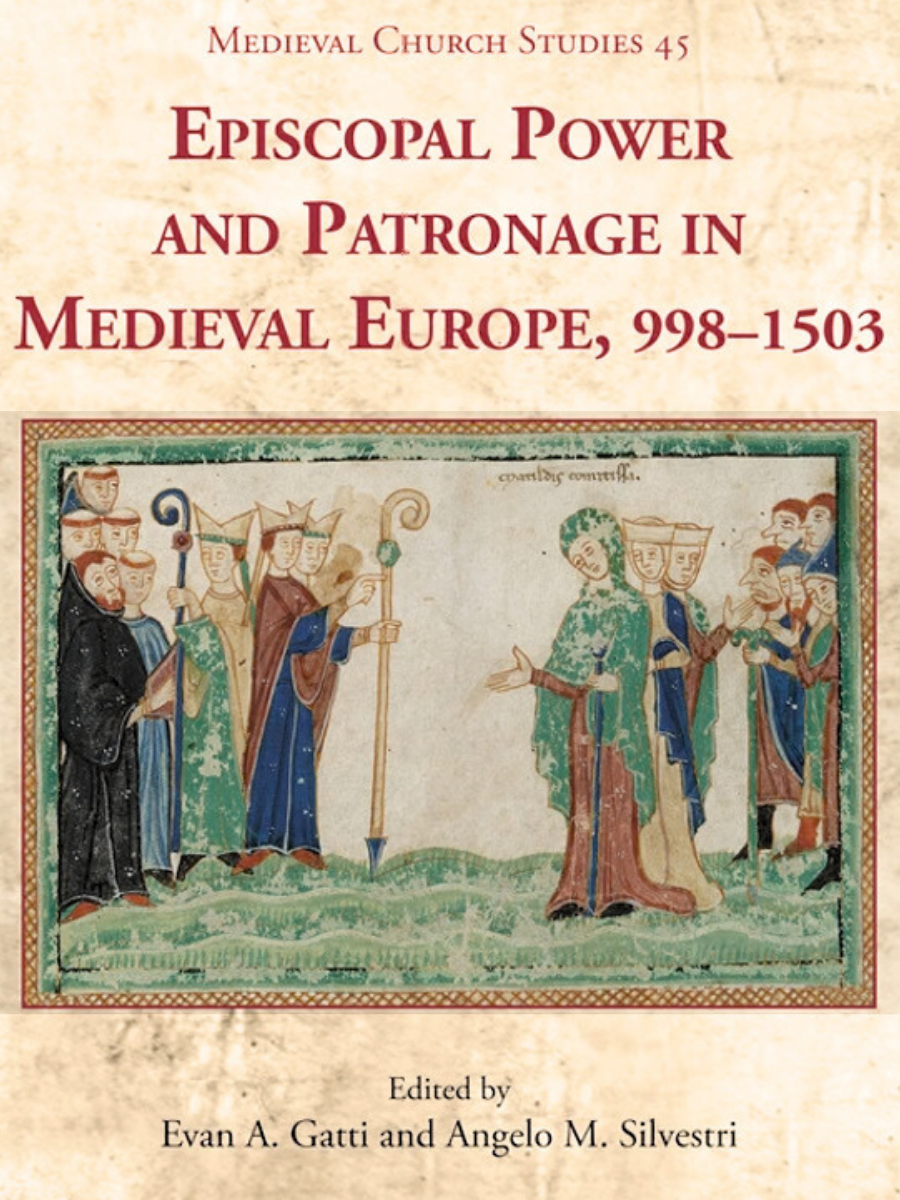
Essays selected from two conferences were edited, expanded and combined into a single volume. Together, they offer a broad overview of how relational culture defines how, why, and for whom bishops work.
Professor of Art History Evan Gatti and Angelo Silvestri, school of modern languages, Cardiff University, published Episcopal Power and Patronage in Medieval Europe, 998–1503.
Episcopal Power and Patronage in Medieval Europe, 998–1503 (Brepols, 2026) is derived from the third and fourth installations of the Power of the Bishop conference. The purpose of the conference was to examine how the bishop, one of the key characters in the administration of medieval Europe, shaped how medieval European history has been recorded and remembered. Bolstered by the sense that the bishop, as an organizing idea, matters, the inaugural conference, In the Hands of God’s Servants, sought to examine the construction, enhancement, and expression of episcopal power at a local level. Papers selected and adapted for publication appeared in Episcopal Power and Local Society 900–1400, which offers microhistories of episcopal power and authority, fracturing what we know about the bishop into episodes that represent dioceses and dependents, and the individuals that ran them. The singularity of these stories inspired the subject of the second conference on Episcopal Personalities. Papers from this conference were published in Episcopal Power and Personality in Medieval Europe (900–1480), which explored the work and responsibilities of the bishop, how a bishop’s persona shaped his approach to the episcopal office, and how a bishop’s charisma affected the way in which he was received or remembered by the communities he served.
Analysis of the bishop’s personality encouraged the organizers to mine the slippery space between the office and the man, not only for the ways this space elides differences between the episcopal personae of priest, pastor, or prince, but also because the space sheds light on from where— or from whom — a bishop’s power derived. The third conference, The Bishop as Diplomat, took up this question as its focus, turning away from the bishop as an agent for and as himself, to the bishop’s role as a representative of the power and authority of others. The papers offered at this conference examined how bishops developed the skills and tactics needed for diplomacy, as well as how and when these skills were deployed, and in what circumstances. They also explored what it meant for a bishop, who was already representing an office beyond himself, to be a diplomat, which often required the bishop to re-present someone else.
Two years later, organizers turned to a theme that had been at the edge of each of the previous conferences: the Bishop as Patron. This conference focused on visual, material and social expressions of episcopal power as well as how those expressions were managed to ensure the legitimacy or the legacy of a bishop. Papers examined traditional examples of patronage, such as those demonstrated through the construction, expansion, and renovation of buildings and the production and reception of manuscripts. The papers asked how and with whom bishops built relationships, and how those relationships were maintained (or neglected).
The essays selected from these last two conferences were edited, expanded and combined into a single volume. Together, they offer a broad overview of how relational culture defines how, why, and for whom bishops work.
Episcopal Power and Patronage in Medieval Europe, 998–1503 is divided into four parts. The introduction, authored by Gatti and Silvestri, explains how this book, the last in the “Power of the Bishop” series, responds to and expands on the usefulness of the “bishop” as a category of scholarly focus. Next, a prologue by Philippa Byrne asks, “What was Episcopal about Episcopal Patronage?” The remaining essays are divided into two sections. The first section, “Episcopal Patronage as Re/Presentation”, foregrounds the material aspects of episcopal patronage, such as churches, manuscripts, hagiographies, rites, rituals, frescoes, windows and tombs. This section includes a chapter by Gatti, “Diplomatic Gestures: Art and Ambivalence in Eleventh-Century Italy”, in which she compares visual images of the bishop to the embodied language of diplomatic gestures. The final section, “Patronizing Bishops: Clients, Diplomats, Allies, and Rivals”, examines episcopal patronage as an extension of episcopal relationships with families, kings, emperors, and clients, with predecessors and successors, as alliances and antagonisms, and between bishops and their congregations, as well as the monastic and secular clergy.
Creating a coherent collection in a field as broad and disparate as medieval studies can be challenging. In fact, the hardships experienced during the COVID-19 pandemic, prohibitions for travel, the closure of archives and libraries across the UK, Europe, and North America, as well as the crises in higher education and funding cuts for scholarly work, made completing this book particularly difficult. In fact, it was because of these challenges that a decision was made to publish papers from the 2017 and 2019 conferences together after plans for a separate volume fell through. This effort fulfilled a commitment made by the conveners to publish high-quality scholarly papers that had been selected and expanded for publication.