


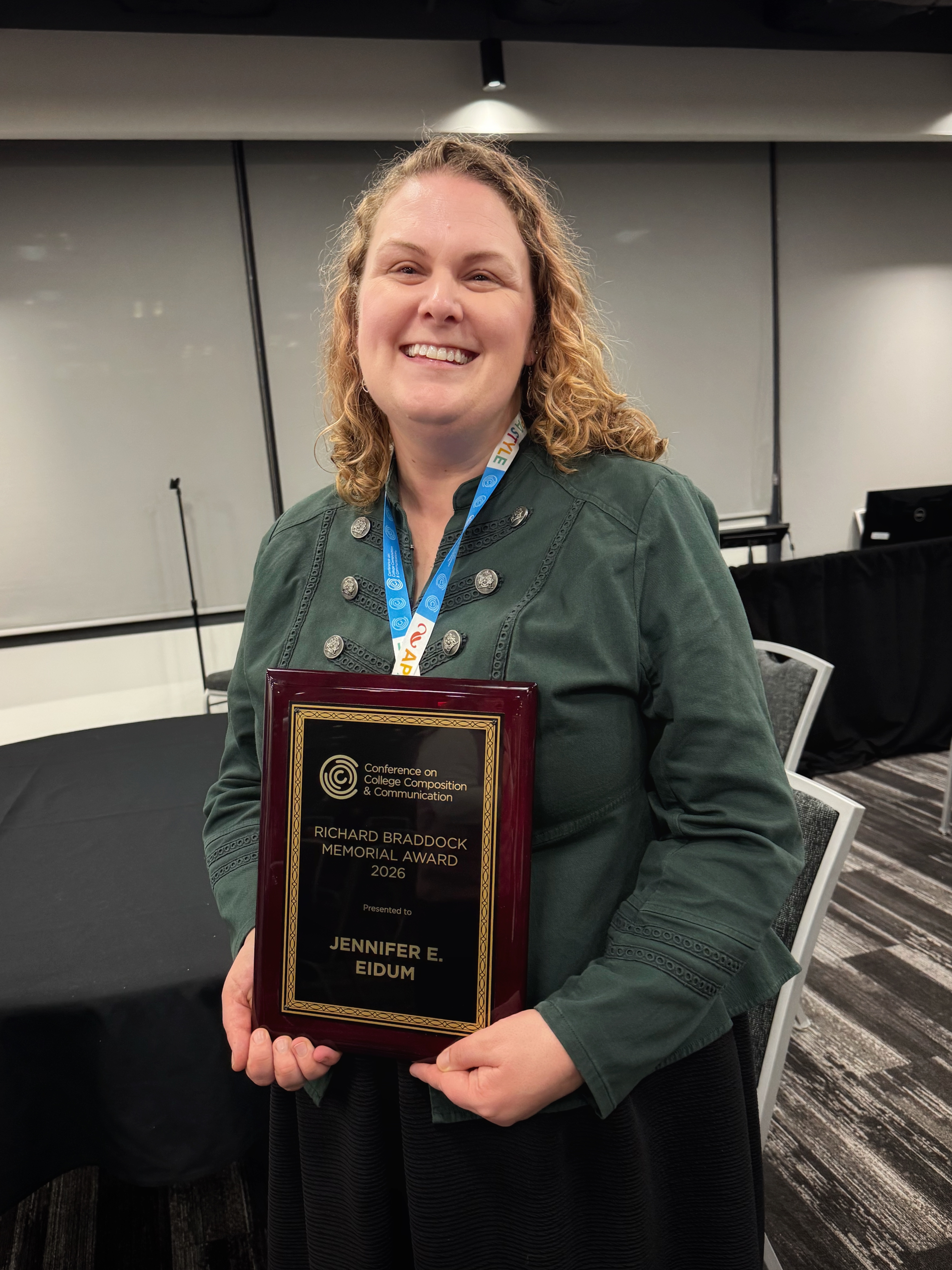
Associate Professor Jennifer Eidum in the Department of English has been recognized for her work on reflection.
The Conference on College Composition & Communication has recognized an Elon University faculty member in the Department of English with its 2026 CCCC Richard Braddock Award, presented to the author of the outstanding article on writing or the teaching of writing in the journal “College Composition and Communication” (CCC) in the prior year.
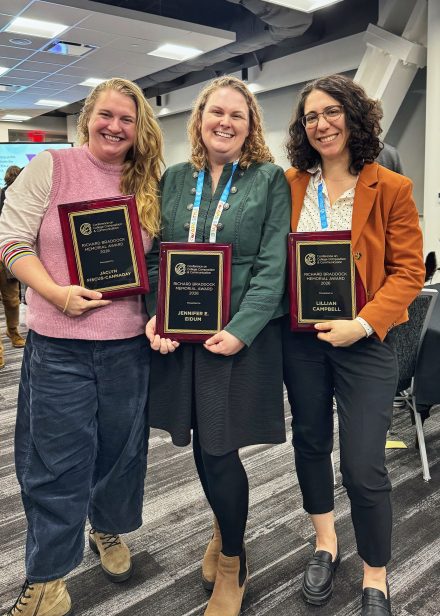
Associate professor of English Jennifer Eidum earned the award for her article, “Contextualizing Reflective Writing for Creating Change: A Cross-Institutional Case Study of First-Year Students’ Reflections,” co-authoredwith Jaclyn Fiscus-Cannaday, assistant professor of writing studies at the University of Minnesota, and Lillian Campbell, associate professor of English at Marquette University.
Eidum’s research focused on how reflection prompts and student responses exist within a larger ecosystem of reflective opportunities, including class context, writing program culture, and university missions. Their multi-institutional study analyzed patterns in student reflective writing to understand the relationship between context and student response.
“We invite writing teachers, and ultimately all teachers, to think expansively about reflection — not only as something that happens in a classroom, but as something connected to students’ civic lives, spiritual lives, and sense of self,” Eidum said. “There’s real space in reflection that prompts one to ask bigger questions, and students are already trying to answer them.”
For Eidum, reflection is an integral part of the learning process. If we are to understand what it is that we learned, we ought to understand how we changed while learning it, she explained. Her research and commitment to reflection believes this fervently.
Eidum also described that her research is never a stagnant process and how there is always some new research insight that can be pursued. She also emphasizes reflection within her courses and believes in its formative power to shape students’ involvement in their own lives.
“Reflection is bigger than the classroom,” Eidum said. “No matter how a prompt is worded, students consistently write about their lives, identities and growth beyond their academic experience. This ‘excess’ isn’t a problem — it’s a signal that students are bringing their whole selves to the page.”
Eidum described the journey of getting this research published as winding and tumultuous: they submitted the article to multiple journals over many years with several rounds of reviewer and editor feedback. This research represented a large cross section of time in Eidum’s and her colleagues’ lives.
“The research means a lot to me and my colleagues,” Eidum said. “We juggle a lot, but I think that’s part of what makes our work meaningful. Our experiences as whole people don’t stay separate from our research and teaching. If anything, living a full, complicated life is what keeps us reflective, which might be exactly why we were drawn to studying reflection in the first place.”
Eidum was surprised to hear that her research had won the award. She did not know that the article was up for the award until it had won. She was at her daughter’s doctor’s appointment when she heard about the award.
“The award felt very emblematic of the project as a whole,” Eidum said.
Eidum’s reflection on her own research shows how never-ending the process of reflection is. Just as her reflection on her award does the same.