


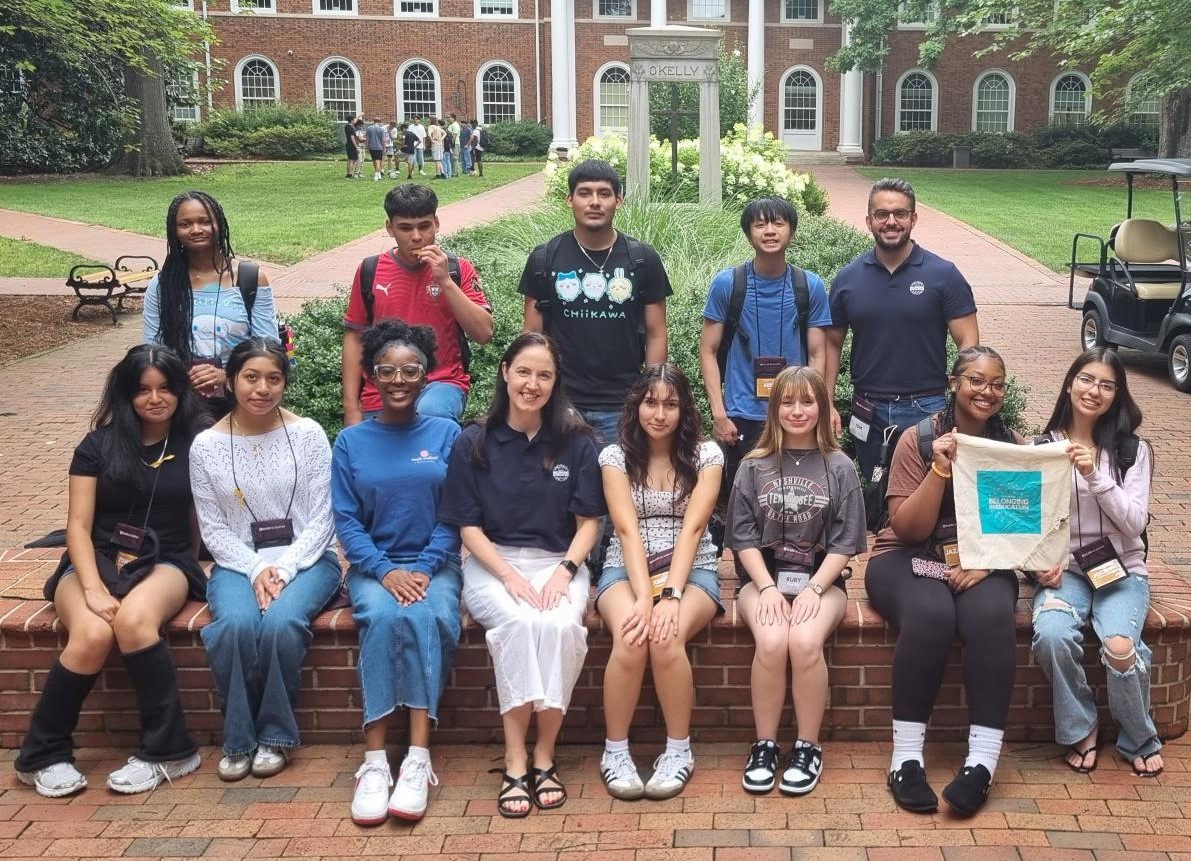
Your Place in the World: Exploring Identity, Sustainability, and AI was a three-week course taught by a transatlantic team from the US, UK and Ireland.
As Elon’s 2025–26 Fulbright Scholar in the Department of Chemistry, Tom Ritchie built a transatlantic teaching collaboration with Elon Academy, uniting colleagues from Elon, Warwick, and TUS Ireland to co-design and deliver Your Place in the World: Exploring Identity, Sustainability, and AI, a three-week course taught by a transatlantic team from the US, UK and Ireland.
The course asked scholars three of the biggest questions they’ll face heading into college and beyond.
- Who are you?
- How does the world around you work?
- Where do you belong in it?
Answering those questions meant building a team that could bring three different lenses to the room, not one guest lecturer parachuted in for an afternoon, but three weeks, three educators and one shared arc.
The design work started long before anyone boarded a flight. Jess Savage and Yanyan Li, both from Warwick, along with Aoife Prendergast from TUS Ireland, worked with Ritchie from early on to shape the course’s structure and pedagogy. Amanda Lang and Jo Kukuczka from Warwick also helped shape the wider exchange from the start, thinking through how a course like this could work across institutions with genuinely different academic cultures. Elon Assistant Teaching Professor of Wellness Evan Small, Elon Academy Director Emily Wiersma, and the Elon Academy team helped the team turn their planning into a course that actually happened, on the ground, with real scholars.
In June 2026, that design became three weeks of teaching. Savage led the first week, taking scholars outside to investigate the natural world of Elon’s campus, observing and mapping the environment and asking who shapes it and how they could begin to understand sustainability differently. Li led the second week, turning to the digital world, unpacking what AI is, whose values it carries, and how to use it with honesty and critical thought. Prendergast led the third week, joining the class from Ireland as the Centre for Belonging in Education’s first Transatlantic Teaching Fellow. She turned the lens on the scholars themselves: their story, their strengths, their future, and what belonging looked and felt like for them.
Belonging wasn’t confined to Prendergast’s week; it ran through all three, as the thread underneath the environment, the AI and the identity work alike. Scholars kept a reflective journal throughout, used photography in the first week to document their experience, and carried a logo and motto project across all three weeks: hand-drawn in Week 1, recreated with AI in Week 2 under a co-created and scholar-drafted honor code, then made personal in Week 3 as their final project, representing their own identity, values and vision for the future.
“That arc worked because an international team built it together, then taught it together, each trusting the ones before and after them to carry it forward,” said Ritchie. “So much of Fulbright’s work is about building bridges between UK and US institutions. But a bridge only matters once people walk across it, and once the people crossing it have had a hand in building it too. That’s what this collaboration set out to do: curriculum design, planning, and teaching, shared genuinely across three institutions, not handed from one to another.”