


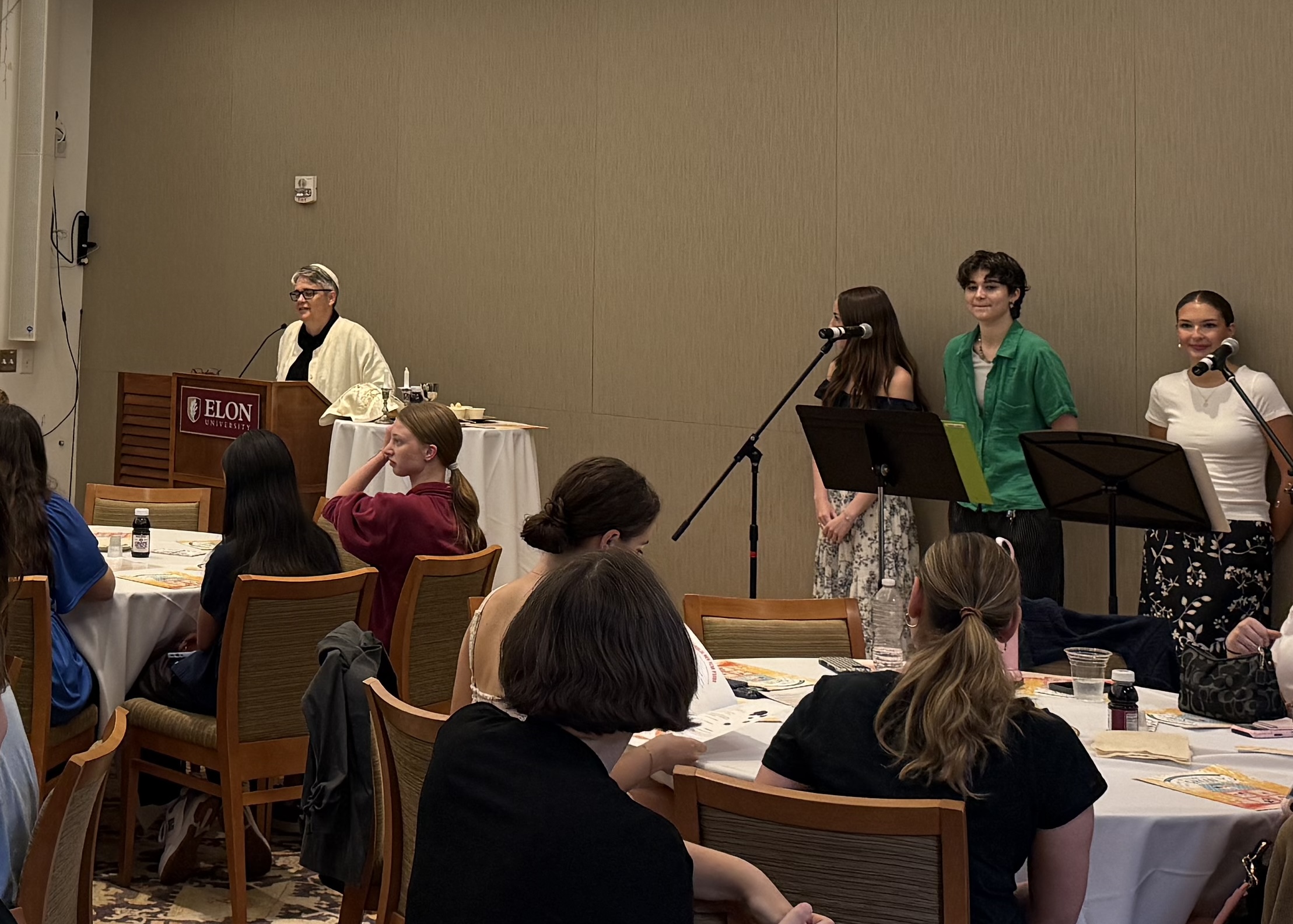
This teaching was delivered at Elon’s Rosh Hashanah Seder Service on Sept. 11, 2026. It explores the intersection of memory and shofar, core themes of the Jewish holiday of Rosh Hashanah. This year, Rosh Hashanah coincides with the 25th anniversary of September 11, 2001.
When I first heard the news that a plane had flown into a building in NYC, I was y’all’s age, headed to class in college. That news didn’t make any sense to me. Given that there was no social media back then, I quickly went over to a friend’s apartment where we watched events unfold live on television. As we watched the towers collapse, I felt a deep sense of shock, grief, and dread. We looked at each other and knew the world would never be the same.
Even now when I think of that moment – twenty-five years later – my shoulders become tense and my stomach begins to churn. I feel the emotional echo of that moment in my body. So much history has unfolded in the past twenty-five years, and yet my memories of Sept 11, 2001 still feel real. As many of y’all know, modern psychology teaches us that trauma lives in our bodies, but the body-based nature of memory can still surprise me.
One of the most potent symbols and practices of Rosh Hashanah is the blowing of the shofar. However, because of the rabbinic prohibition on blowing the shofar on Shabbat, this year most traditional communities will wait until the second day to hear the shofar. Rather than experiencing Rosh Hashanah as a day of shofar blowing (Yom HaTru’ah, Numbers 29:1), we will experience it as a day of remembering shofar blowing (Zicharon Tru’ah, Leviticus 23:24).
As anyone who has heard the shofar knows, hearing its blasts constitutes a profound embodied spiritual experience. The shofar represents birth, alarm, victory, and a demanding invitation that we wake up to the reality of our lives. When the shofar is not sounded on the first day of Rosh Hashanah, we feel its absence and we long for its return.
The spiritual invitation of a shofar-less Rosh Hashanah is to lean into memory. Just as we remember traumatic events in our bodies, so too can we remember transcendent moments, such as hearing the shofar. Because we do not have the sound of the shofar to help us direct our attention inward, we must rely on our memories. We must choose to remember so that the shofar – even in its absence – becomes a force for good in our lives.
A shofar-less Rosh Hashanah reminds us that we have choices about what we remember and how we remember it. Memories of trauma may live in our bodies, but so do memories of joy, connection, hope, and resilience. When remembering Sept 11th, 2001, I may always feel an echo of the emotional experience I felt on that day. However, rather than focusing exclusively on my grief, I can expand my awareness to include the gratitude I felt at not having to experience that moment alone. I was with my friend, and we were able to experience that difficult moment together. My heart warms at the memory.
As we move into a new Jewish year, I invite all of us to remember that we have family, friends, and communities that can be with us through hard times. Look around – many of the people in this room may be your friends (or your future friends!). Each of you has the opportunity to experience the ups and downs of college life with each other.
I know that there are many broken and unfinished parts of this world, but I am grateful that we can have partners in this journey called life. And I pray that the memory of all the lives lost on Sept 11th, 2001 may be for a blessing. May their memories inspire us to do the work of building a better future together.
Note: A different version of this piece appeared originally in The Wisdom Daily.