


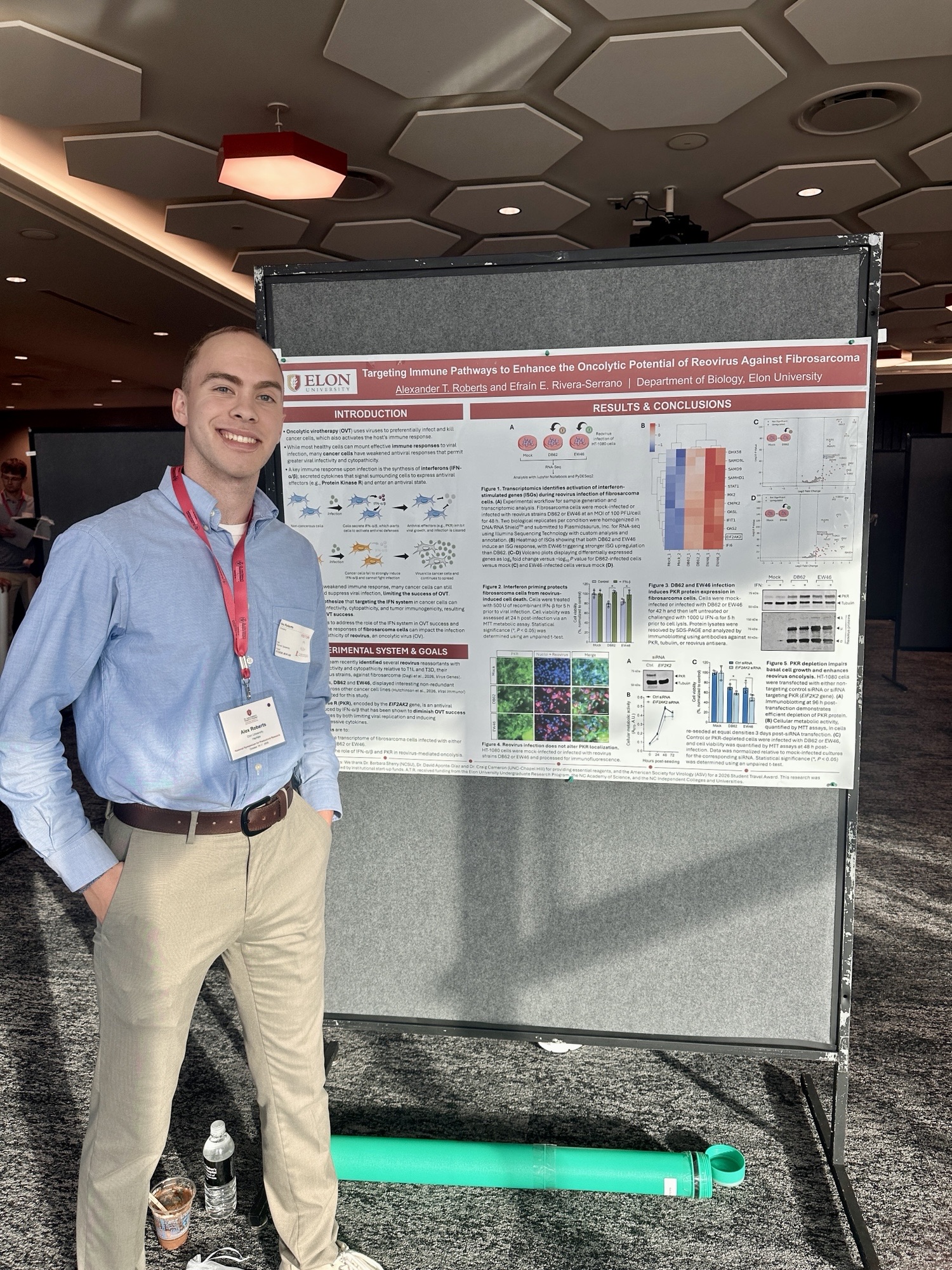
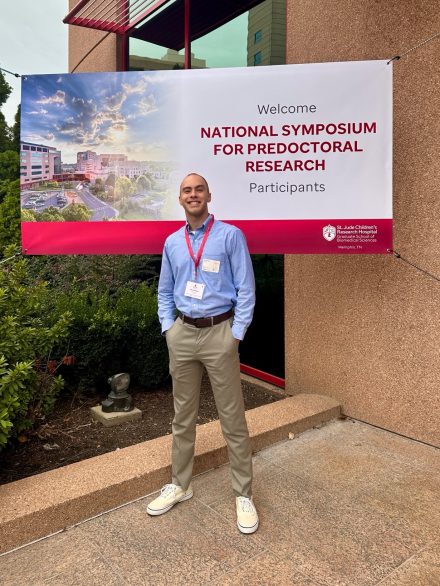
Alex Roberts ’27 was chosen to participate in the 2026 St. Jude Graduate School National Symposium for Predoctoral Research on Oct. 15-17.
Alex Roberts ’27, a biology major, was accepted to participate in the competitive National Symposium for Predoctoral Research hosted at the St. Jude Children’s Research Hospital by the Graduate School of Biomedical Sciences in Memphis, Tennessee on Oct. 15-17.
The National Symposium for Predoctoral Research program is an all-expense-paid event to inspire early-career scientists, showcase their research and provide opportunities for networking about graduate school.
“I was excited when I learned that I was accepted into this program,” Roberts said. “I had never attended a program like this before, but I knew St. Jude had a lot to offer.”
Robert’s research is on targeting immune pathways to enhance the oncolytic ability to reovirus against fibrosarcoma. His work focuses on how cancer cells respond weakly to a viral infection, which allows a virus to preferentially infect and kill those cells. Since cancer cells still have a response, research focused on how that immune response could be targeted to improve the viruses’ infectivity and the effect on cancer cells. Specifically, he looked at an immune pathway called the interferon pathway, and a product of that pathway, protein kinase R.
Assistant Professor of Biology Efrain Rivera-Serrano serves as Roberts’ research mentor.
“One of the most rewarding parts of mentoring Alex has been watching him take an idea he developed himself and turn it into a meaningful research project,” Rivera-Serrano said. “His selection for the St. Jude National Symposium is a well-deserved recognition of his scientific curiosity, independence and determination, but also of the incredible growth I have witnesses in him as a young scientist. I couldn’t be prouder of his accomplishments, and I am especially excited that this experience allowed him to share his work with the broader scientific community and explore the possibilities that lie ahead in his scientific career.”
At the symposium, Roberts participated in a poster presentation about his Summer Undergraduate Research Experience (SURE) research, graduate school panels, student panels, a campus tour, seminars and keynote presentations.
Roberts learned about the research environment at St. Jude, the difference between a master’s and Ph.D. program and how St. Jude is unique compared to other research institutions.
“Researchers at St. Jude have access to incredible technology and data, which allows them to pursue research on a large scale with ease,” Roberts said. “It was really amazing to hear from world-renowned researchers. One researcher was using 10 years of clinical cancer data with artificial intelligence to see how different treatments impacted cancer survival in patients.”
Participating in the symposium inspired Roberts as a young researcher.
“Seeing how the faculty at St. Jude are so driven by the mission of curing childhood cancer showed me the impact research can have on people,” Roberts said. “It inspired me to continue with my research and keep thinking of innovative ways I can drive it forward.”
The application process involved writing a research abstract describing his research, a personal statement about his interest in the St. Jude graduate programs and a cover letter describing his past experiences.