


During an Oct. 20 lecture, award-winning journalist Sophie Neiman shared firsthand accounts of Sudan’s humanitarian crisis and challenged audiences to consider why the conflict receives so little international attention.
Nearly 14 million people have been forced from their homes by Sudan’s civil war, creating the world’s largest displacement crisis. Yet despite the staggering human toll, the conflict has received relatively little international news coverage.
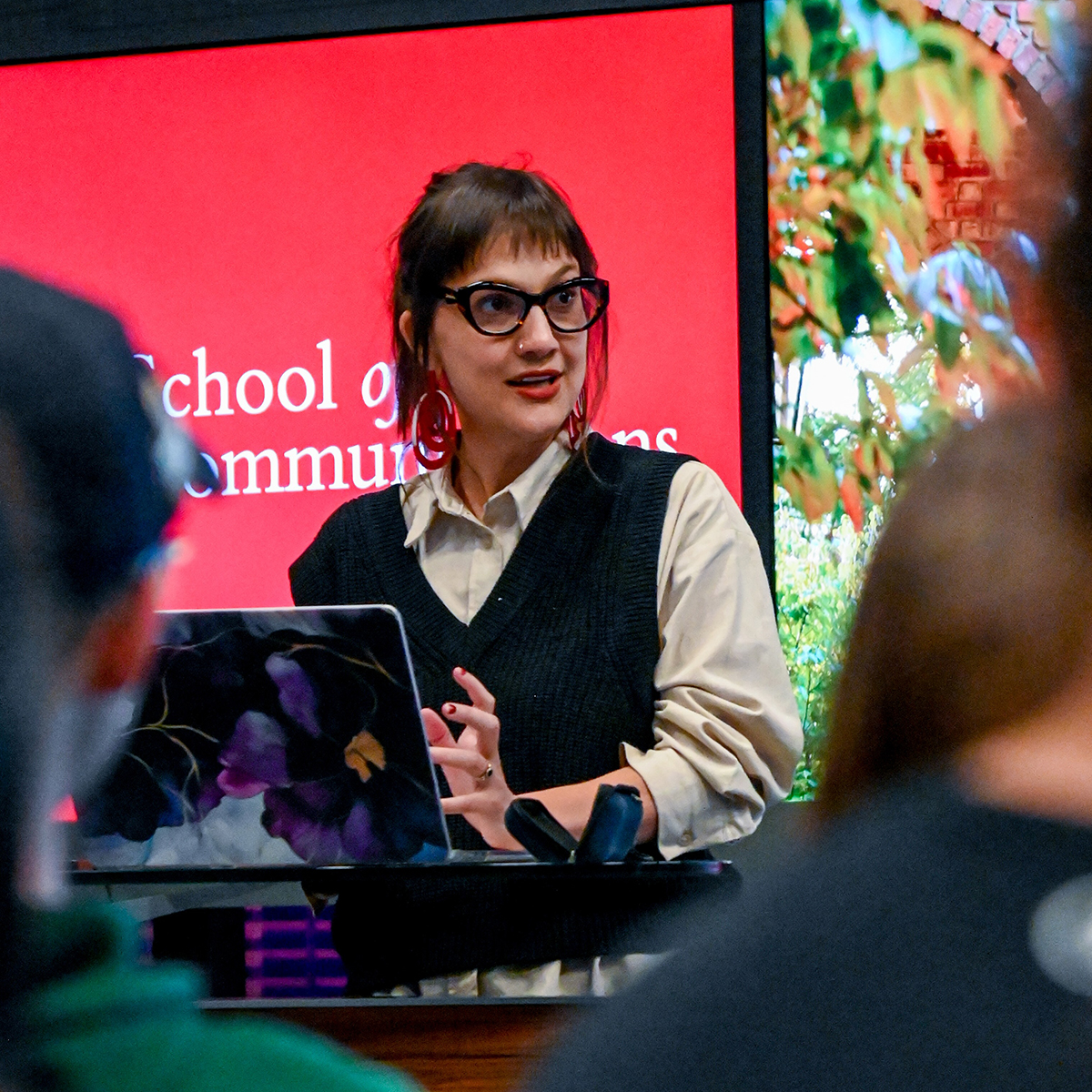
For award-winning journalist Sophie Neiman, that disconnect raises a troubling question: Why has a humanitarian catastrophe of such magnitude received so little attention?
During an Oct. 20 lecture at Elon University, Neiman shared firsthand accounts from her recent reporting trip to Sudan’s Nuba Mountains, where she documented the experiences of civilians, fighters and medical workers caught in the conflict.
“Even before my departure, I was overwhelmed, frankly, by the scale of loss in Sudan,” Neiman said. “Yet, this crisis received limited space and attention in our newspapers and television programs.”
Her lecture, “Media Matters: Covering Sudan’s Civil War,” was co-presented by the Pulitzer Center and the School of Communications. To see event photos, visit the school’s Flickr album.
Neiman explained that securing support for the reporting trip required months of persistence. Alongside photographer Guy Peterson, she spent five months pitching stories to news editors, encountering repeated rejections. Some considered the region too obscure, while others were reluctant to send journalists into dangerous territory.
“It had been aggravating to spend so much time feeling as if I was literally begging people to just care about Sudan,” Neiman said.
Once in Sudan, she encountered more stories than she could possibly tell.
Among those she interviewed was a displaced mother whose husband and teenage son were killed in a drone strike. Despite struggling to feed her surviving children, the woman had taken in two additional children orphaned by the fighting.

For Neiman, the encounter illustrated both the devastation of war and the extraordinary compassion that persists amid suffering.
Throughout her lecture, Neiman challenged students to consider journalism’s responsibility to people whose experiences and struggles often go unseen – whether in distant conflict zones or their own communities.
“What does it mean to truly bear witness? Why should we open ourselves up to the suffering of others with compassion and empathy?” she asked.
Near the conclusion of her lecture, Neiman recalled asking interview subjects what they wanted for their futures or what message they hoped to share with the world.
“Almost always, people told me simply that they wanted peace,” she said.
Lorraine Ahearn, assistant professor of journalism and Elon’s liaison to the Pulitzer Center’s Campus Consortium, welcomed attendees before the lecture. Ethan Wu ’27, a 2026 Pulitzer Center Reporting Fellow who investigated water pollution near Beijing, introduced Neiman.
Elon’s partnership with the Pulitzer Center
Elon University is a longtime member of the Pulitzer Center’s Campus Consortium, a network of colleges and universities supporting journalism on critical global issues. Through the partnership, student journalists receive mentorship and guidance throughout the reporting and publication process.