


The film series brought together students, faculty, staff and community members to experience contemporary cinema from Spain and Latin America
November marked the conclusion of “En los márgenes del hogar” or “On the Margins of Home,” a Spanish-language film series organized by faculty members Ketevan Kupatadze, Mayte de Lama and Ricky Mendoza of the Department of World Languages and Cultures. Over the course of five screenings, the series brought together students, faculty staff, and community members to experience contemporary cinema from Spain and Latin America.
One particularly well-attended screening was “Aztec Batman: Clash of Empires” (2025), which attracted more than 60 students, faculty, staff, community members and families. For students enrolled in SPN 1010, the screenings offered an early opportunity to experience cinema in another language and discover the cultures and realities of the Spanish-speaking world. Lucy Morris, an elementary education student enrolled in SPN 1010, emphasized the value of learning about the countries where these languages are spoken, noting that it was “very useful to learn about the countries where these languages are spoken, and learn Spanish when [the film] is not geared in any way towards English-speakers.”
Similarly, Emma Pemman, a double major in journalism and strategic communications and currently finishing SPN 1010, appreciated the opportunity to combine learning with enjoyment. Since she does not usually have “the opportunity to watch or hear films in a different language,” she described the experience as something enjoyable: “I’m learning and having a good time all in one.”
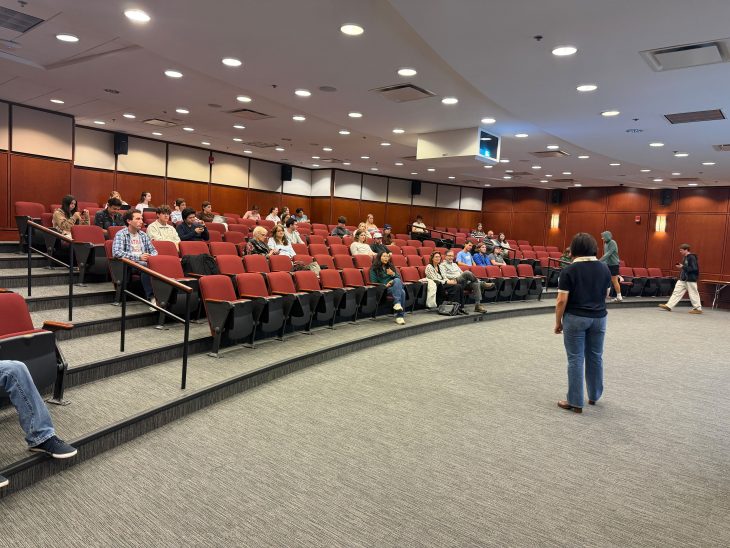
For Kjell Hagenson, an international business student also enrolled in SPN 1010, the importance of the series extended beyond language learning. He described it as “a valuable opportunity for students to grow their understanding of the world.” His reflection captures one of the series’ central goals: encouraging students to look beyond the classroom and engage with different perspectives, histories, and human experiences through cinema.
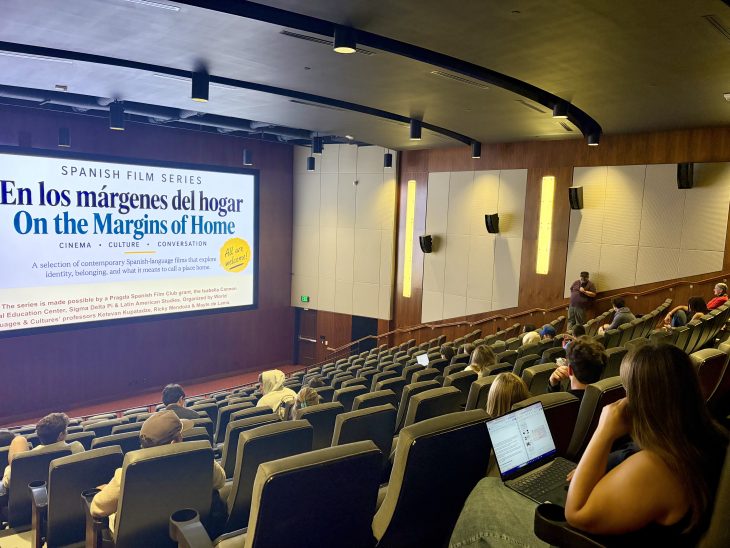
The highlight of the series occurred during the screening of “Zafari” (2024), directed by Mariana Rondón. Before the film, Pablo Celis-Castillo introduced the audience to Venezuela’s historical, political, and cultural context, providing important background from oil wealth to scarcity to understand the country’s crisis and the difficult realities that Rondón portrayed. His introduction helped situate the film within a broader conversation about Venezuela, illustrating how cinema can open doors to exploring complex and current issues.
The series also cultivated lasting connections with the wider community. Helen McLeod, a former diversity coordinator at Cone Health at Alamance Regional Hospital, attended all five screenings. Reflecting on the films, McLeod expressed how fascinated she was by “the diversity of themes and the ways in which each film explored the complexities of human nature.” She highlighted the remarkable range of stories, and I especially appreciated the depth and evolution of the characters, their struggles, contradictions, and vulnerabilities.”
As the five-film series comes to a close, the organizers extend their gratitude to everyone who attended and supported the initiative, including its funding partners: Pragda, the Isabella Cannon Global Education Center, Sigma Delta Pi, Latin American Studies and the Department of World Languages and Cultures. The enthusiasm of students eager to learn beyond the classroom, the commitment of returning community members, and the contributions of faculty members as speakers, attendees, and cultural ambassadors in their Spanish classes reaffirm the importance of bringing international stories and perspectives to the Elon community. Ultimately, as Helen beautifully summarized, “language and culture are bridges that bring us closer to our shared humanity.”