


Queens University of Charlotte student Sana Konar ’28 has earned two major honors recognizing her impact across the region.
For Sana Konar ’28, civic engagement isn’t confined to a classroom—it’s an active bridge connecting Queens University of Charlotte to the neighborhoods surrounding it. Her work links academic inquiry, housing and health care advocacy, and community partnership across Charlotte.
The biology major from Charlotte, North Carolina, was recently honored with the 2026 Community Impact Student Award (CISA) from NC Campus Engagement (NCCE) and placed second in the third annual Canopy Housing Foundation Innovation Award competition.
Reimagining affordable housing with “Plans to Porches”
Days after receiving her statewide civic recognition at the Nov. 14 Citizenship, Service, Networking & Partnerships (CSNAP) Student Conference at Elon University, Konar and teammates Andrea Almendariz ’27 and Francely Hernandez Gaspar ’28 presented their affordable housing proposal, “Plans to Porches,” to a panel of judges and a live audience on Nov. 16 as part of the Canopy Housing Foundation’s Innovation Award competition. On Nov. 20, the foundation—the charitable arm of the Canopy Realtor® Association—announced that the Queens team earned second place and a $2,500 scholarship award.
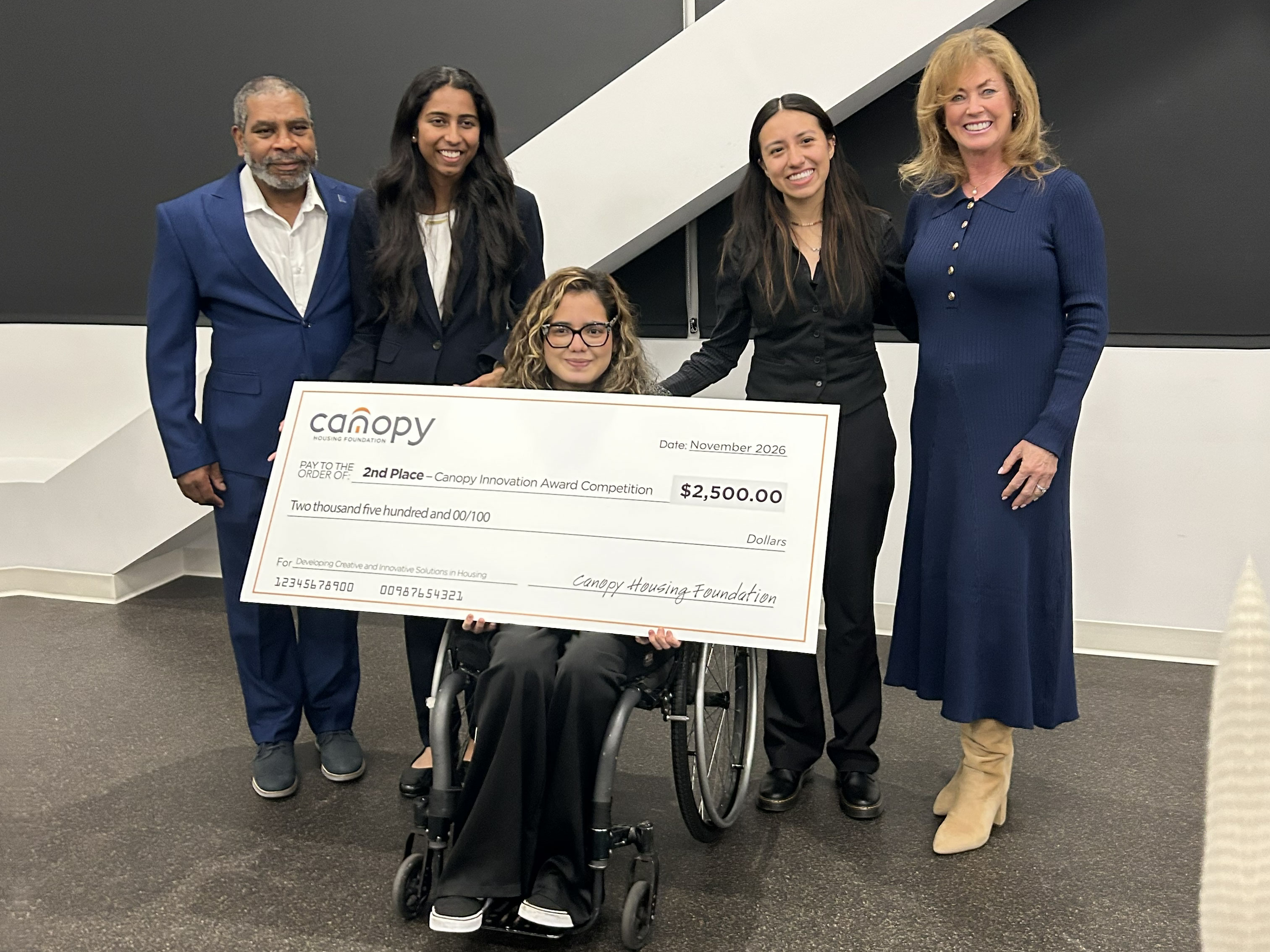
Designed as a flexible housing toolkit that connects existing resources across Charlotte into one system, “Plans to Porches” pairs a community land trust holding public and institutional land with a pre-approved plan book to speed up permitting for duplexes and townhomes, alongside a rent-to-own pathway for teachers, first responders and healthcare workers, with options for employers to invest in exchange for staff priority.
“It was an incredibly eye-opening experience for me, learning about Charlotte’s housing crisis,” Konar said. “Working alongside mentors like Kari Pell and Roy Hawkins pushed our thinking on how housing gets financed and how it connects to health care and community stability. It inspires me to keep finding ways to empower and lift up our communities.”
Advancing health equity and civic leadership across campus
Recognized by NCCE for inspiring peers and demonstrating a deep commitment to community involvement, Konar approaches public health and civic work as interconnected pillars of her future career in medicine.
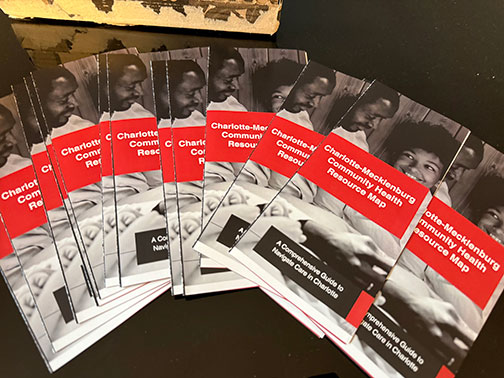
Acknowledging critical gaps in local health care access, Konar founded and serves as president of the Queens Health Equity Alliance. Through the organization, she spearheaded the creation of a health equity map for Charlotte—an interactive resource accessed via QR code that pins free and low-cost clinics, pharmacies, mental health centers and transportation options available to unsheltered residents so users can see their full path to care in one place.
Developed after piloting the tool with Roof Above, incorporating user feedback and partnering with YWCA Charlotte for distribution, the map has since been shared with community leaders including members of the Charlotte International Cabinet, an advisory board to the mayor and city council.
“Civic engagement isn’t separate from medicine for me, it’s part of the same work,” Konar said. “In my clinical experiences, I’ve seen how upstream factors like housing, transportation and food shape a patient’s health outside the exam room, and for unsheltered residents, scattered resources create gaps where people can fall out of care. As a future physician-advocate, I see this work as just the beginning of building systems that close those gaps.”
Konar’s commitment to dialogue and public life also shapes her leadership on campus. As a Deliberative Citizenship Network Deliberation Fellow, she helps facilitate structured, productive conversations among students, faculty, staff and community members on contentious societal issues. As an NC Campus Engagement Civic Impact Fellow, she designed a semester-long program to build fellow students’ civic knowledge, leadership skills and readiness for public life. She also serves as a Presidential Fellow, Noble Fellow and Davies Fellow.
“Students are far more likely to engage civically when student leaders show them both how and why,” said Maggie Commins, Shelton Professor and Faculty Fellow for Civically Engaged Learning, who nominated Konar for the NCCE honor. “Sana is approachable, hardworking and open about the power of community involvement for her own growth and others’—she explains how transformative this work can be, and her peers listen.”