


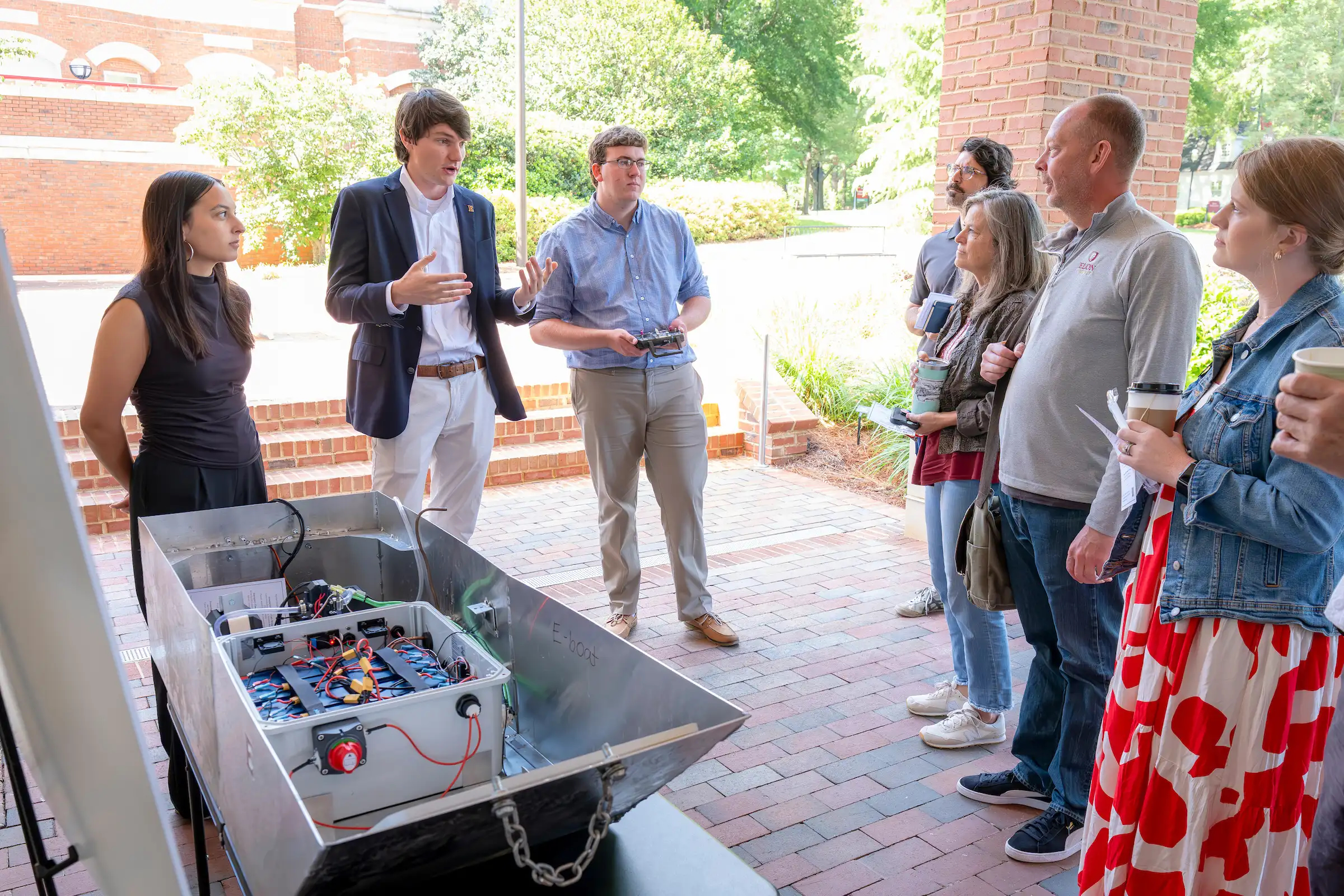
A two-semester capstone course gives engineering students the opportunity to apply the knowledge they’ve gained throughout their degree while directly serving the local Alamance County community.
Many nonprofit organizations do not employ in-house engineers; instead, they rely on hiring external professionals when problems arise, and an Elon course is working to fill that gap by allowing students to act as “hired” engineers who design and deliver solutions the organizations can implement.
EGR 4970: Senior Engineering Design is a two-semester capstone course taught by Will Pleur, assistant professor of engineering, that gives engineering students the opportunity to apply the knowledge they’ve gained throughout their degree while directly serving the local Alamance County community.
The course is divided into two phases: the first semester focuses on learning about potential community partners, identifying project goals, exploring possible solutions and developing a mock proposal for a chosen organization. The second semester brings these ideas to life as students enter the community, build functioning prototypes, test their designs and present their findings in a formal engineering report.
Even when partners do have engineers on staff, students often tackle issues those engineers haven’t had time to address. Selecting the right community partners is a months-long process that begins well before the academic year. In the six to eight months leading up to the course, engineering faculty reach out to local companies, civic groups, and nonprofits, often collaborating with Sara Beth Hardy, assistant director of community partnerships for the Kernodle Center for Civic Life. Each year, they meet with 20 to 30 organizations, narrowing that list to around 15 campus or site visits and roughly a dozen viable project ideas. By June, about six projects are confirmed, and over the summer, the faculty handle logistics, write grants and secure materials so students can begin the fall semester fully prepared.
“Engineering Senior Design is a great opportunity to see the equations and practices you learn in school as real-world applications,” said Sammy Oleson ’26. “Although my group is scattered in its engineering concentrations, mechanical, environmental, and civil, we are able to use knowledge from each discipline to aid our problem solving. Each two-week sprint, we set a goal that brings us closer to our long-term project scope, which we plan to complete over the course of two semesters.”
Altogether, EGR 4970 not only strengthens students’ technical and collaborative skills but also deepens their understanding of community-centered engineering, showing them firsthand how meaningful, practical and impactful their work can be beyond the classroom.