


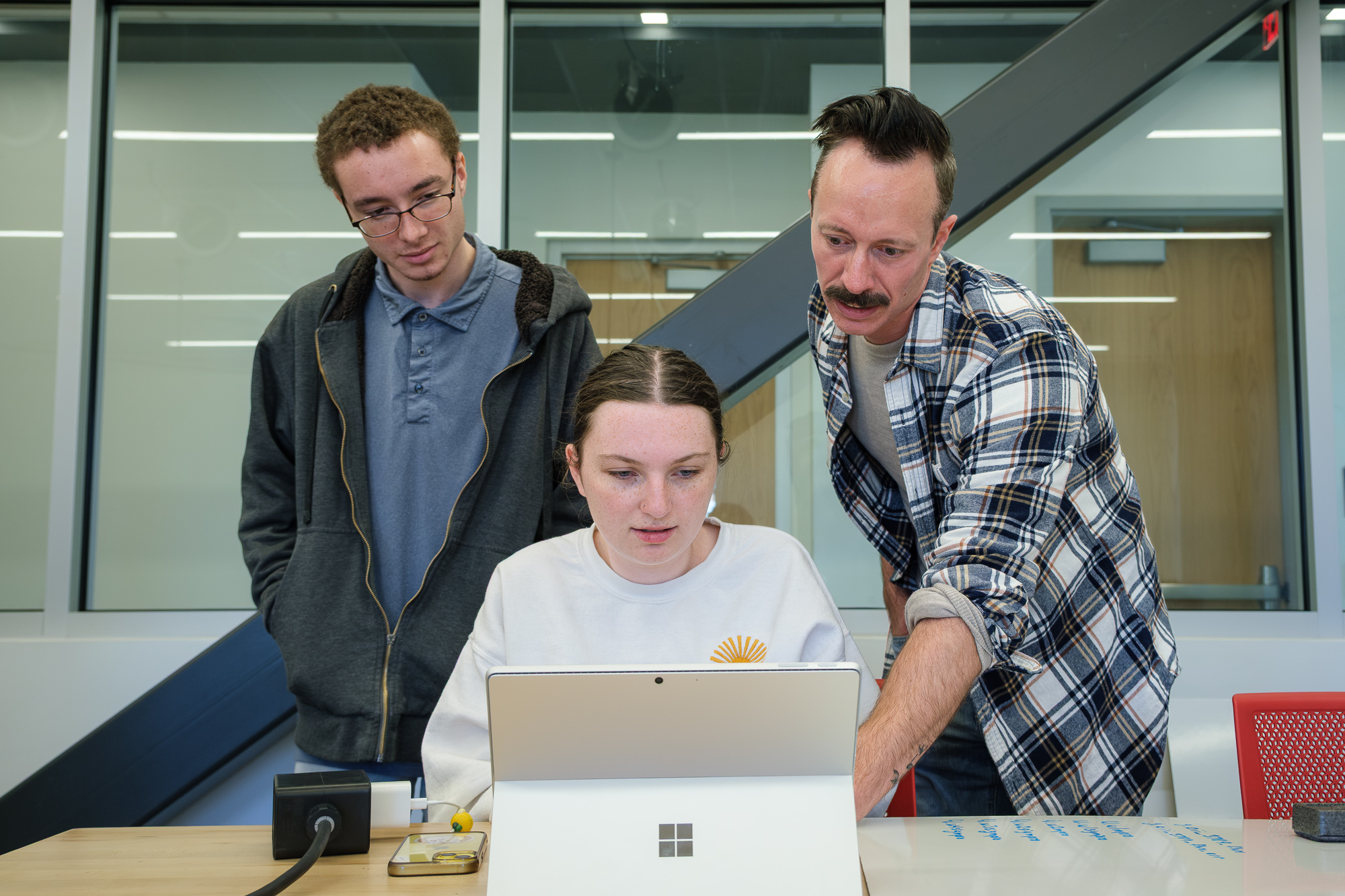
Associate Professor of Astrophysics Chris Richardson received $300,000 from the National Aeronautics and Space Administration to fund his team’s research on intermediate mass black holes in dwarf galaxies.
An Elon University faculty member has received a grant that will fund two years of astrophysics research with undergraduate student researchers working to develop methods to simulate and detect intermediate mass black holes hidden within dwarf galaxies.
The $300,000 grant as part of a NASA Research Initiation Award will help Associate Professor Chris Richardson in the Department of Physics and Astronomy to continue his ongoing scholarship into intermediate mass black holes, which fall between small and supermassive black holes.
Such black holes help astronomers gain a better sense of why supermassive black holes became supermassive. Because intermediate mass black holes are elusive and not many have been found, researchers are working on ways to detect them in smaller galaxies, called dwarf galaxies.
“Intermediate mass black holes are good for a holistic understanding of how galaxies evolve since we know that black hole – galaxy co-evolution is necessary to explain the Universe we see today,” said Richardson, who focuses his scholarship on active galactic nuclei, extreme emission line galaxies, starburst galaxies, and galaxy chemical evolution. “One of the big picture questions for NASA, at least, is how did we get here? And to answer that question, we also have to ask how the supermassive black hole at the center of the Milky Way became supermassive?”
The award will fund national and international travel for Richardson and a team that includes Elon University undergraduate researchers. The group will have the opportunity to attend astrophysics conferences and meet in person with collaborators, experiences that are often cost-prohibitive.
Richardson said that this is especially valuable for the undergraduates who will broaden their network in the field of astrophysics.
“So many of the students that are working with us in our group want to go on to graduate school, and more than ever before, graduate school is about the connections that you make,” Richardson said. “This grant will allow us to make those types of connections for each of the students and make them more competitive when they put in their applications.”
By discovering how many dwarf galaxies have intermediate mass black holes, Richardson said, he hopes the astrophysics field can make progress in solving the mystery of how the black holes at the centers of galaxies first formed in the early Universe.
Undergraduate students on the project will create new models for detecting these medium-sized black holes. Students will also have the opportunity to present results at national conferences such as the American Astronomical Society, a gathering of more than 3,000 astronomers.
“It’s a different deal to go to international or national conferences and present in front of experts,” Richardson said. “These students will be able to make fruitful connections, network and practice presenting their research. I am excited for the opportunities our undergraduate students will have through this grant and for the possibilities of what is to come next.”
Jonathan Berkson ’27, an astrophysics major and Lumen Prize scholar from Philadelphia, P.A., is conducting undergraduate research under Richardson’s mentorship.
“It’s amazing that Dr. Richardson provided us with the groundwork to explore the most fundamental question: how has the universe evolved to the point where it is today,” Berkson said. “My project is challenging me on so many different levels. I’ve also grown immensely working with friends in the research group and collaborators outside of Elon.”
Jaylem Cheek ’27, an astrophysics major, Lumen Prize scholar, Odyssey Fellow, and Elon College Fellow from Burlington, N.C., described his undergraduate work with Richardson as “one of the best decisions I have made since coming to Elon.”
“Not only have I fulfilled my dream on researching black holes in astrophysics,” Cheek said, “but Dr. Richardson is also giving me all of the tools I need to succeed in astrophysics after attending Elon.”