


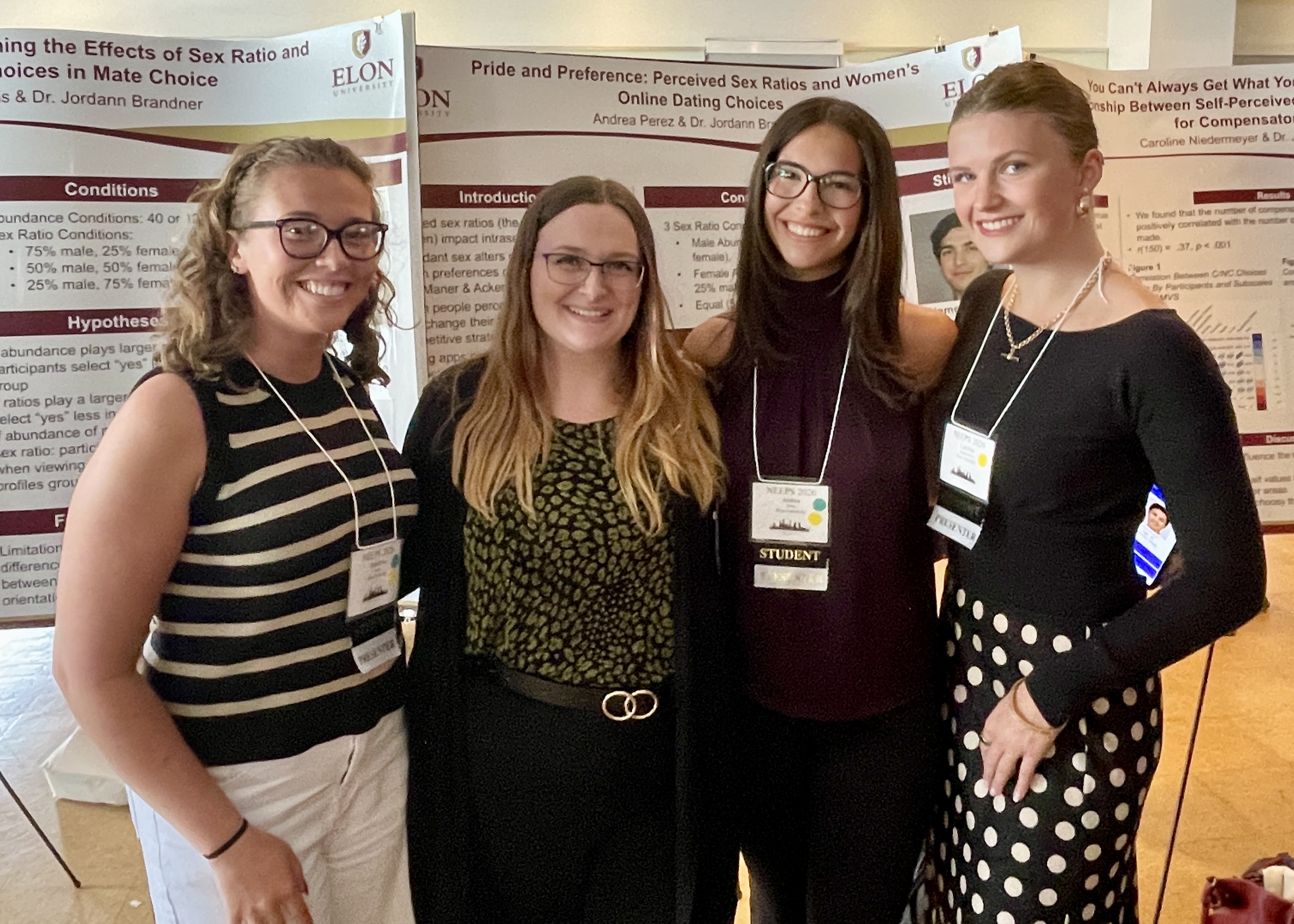
NEEPS brings together scholars and students to share research, foster collaboration, and support the development of emerging researchers in evolutionary psychology.
Students and faculty from Elon University’s Department of Psychology recently presented research at the annual meeting of the North Eastern Evolutionary Psychology Society (NEEPS), an organization dedicated to advancing research and education on human behavior from an evolutionary perspective.
Despite starting as a regional conference, NEEPS has grown to include scholars from 12 different countries and 23 different states in 2026.
Caroline Niedermeyer, Andrea Perez and Madeleine Pettis each presented individual research posters developed through collaborative research with faculty mentor Jordann Brandner, assistant professor of psychology, and with support from the Elon Undergraduate Research Program and the Sinclair Endowed Grant.
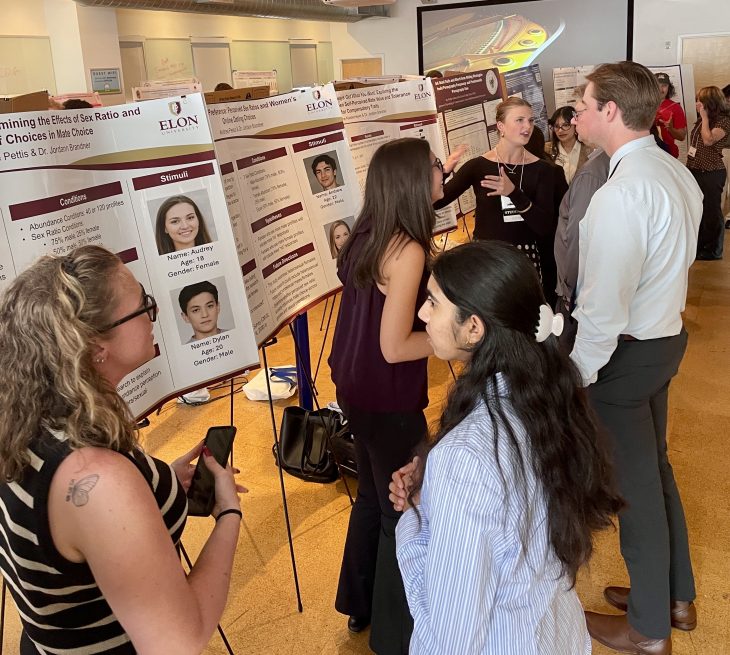
Niedermeyer presented work she completed during her 2025 Summer Undergraduate Research Experience (SURE). Her poster, titled, “You Can’t Always Get What You Want: Exploring the Relationship Between Self-Perceived Mate Value and Tolerance for Compensatory Traits,” explored how individuals navigate trade-offs in relationship partner selection. The study tested whether self-perceived mate value affects willingness to accept partners with offsetting high and low traits. Niedermeyer was awarded the Gordon Bear Best Student Poster Award, recognizing the top undergraduate or graduate student poster presentation at the conference. The award, which includes a $100 prize, is one of the meeting’s most competitive student honors and highlights the quality and impact of her research.
Perez’s poster, “Pride and Preference: Perceived Sex Ratios and Women’s Online Dating Choices,” examined how features of dating apps may shape users’ perceptions of available partners and influence women’s selectivity. Using an app that she co-developed with Pettis, the experiment tests whether different ratios of male and female profiles affect how frequently people accept or reject potential matches, contributing to understanding how modern digital environments influence mating strategies. This research was funded by a Sinclair Endowed research grant, which is awarded to student research in the social and behavioral sciences.
Pettis’ poster, “Thank You, Next: Examining the Effects of Sex Ratio and Number of Choices in Mate Choice,” investigated how the total number of available partners influences partner decisions. Using the same dating app, participants evaluate different numbers of profiles to determine whether making more choices affects a person’s pickiness. The experiment offers insight into how decision-making processes operate in online dating, where people make many choices in succession. This research was also supported by a Sinclair Endowed grant.
In addition to student presentations, Brandner led a workshop titled “Teaching a Balanced Evolutionary Social Sciences Course: A Teaching Workshop,” which focused on strategies for integrating diverse perspectives within evolutionary social science curricula. This work was funded by the Elon University Center for the Advancement of Teaching and Learning (CATL) Scholarship of Teaching and Learning Dissemination grant.
All three students will present their work again at the upcoming Spring Undergraduate Research Forum (SURF) on April 28th, 2026.