


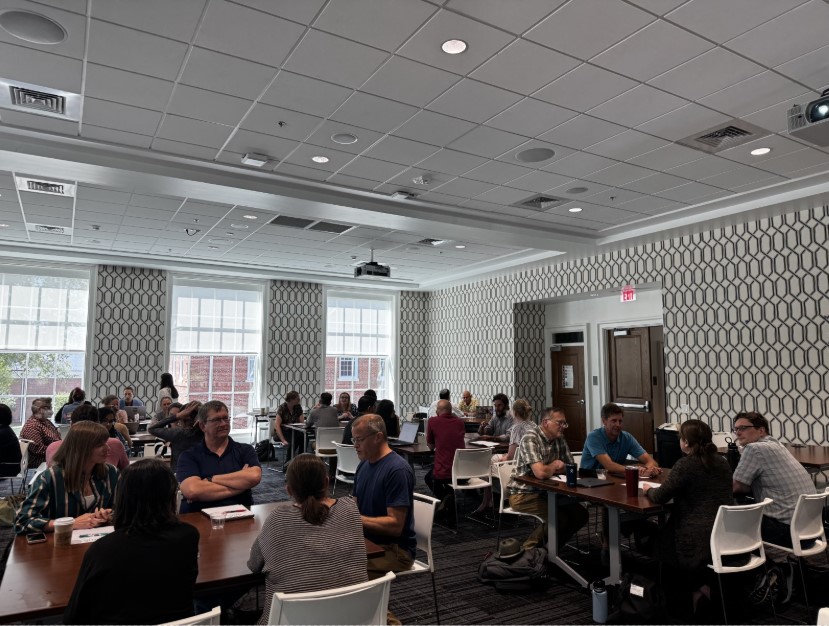
Twenty-one departmental teams and 88 faculty members kicked off the inaugural FIELDS initiative, a yearlong program supporting departments as they explore teaching and learning in the age of artificial intelligence.
Elon University’s Center for the Advancement of Teaching and Learning (CATL) welcomed faculty teams from across campus on Aug. 24 for the kick-off workshop of the Faculty Initiative for Evolving Learning at Departmental Scale (FIELDS) project, a new year-long, cohort-based initiative helping departments rethink teaching and curricula for the age of artificial intelligence.
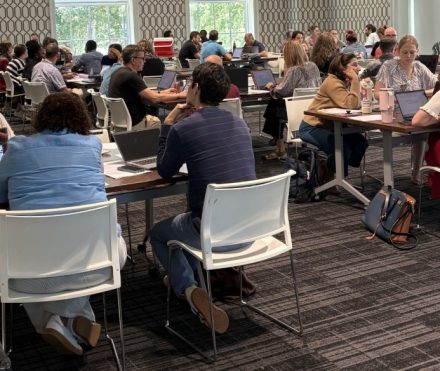
The workshop marked the official start of the program’s first cohort year and brought together 21 departmental teams and 88 individual faculty to begin the work they will carry through the 2026-27 academic year. FIELDS is co-supported by CATL, the AI Hub, the Love School of Business and the Office of the Provost, and offers an exciting opportunity of various departments and centers across the campus to create a space for deep engagement around teaching and learning in the context of AI.
“The FIELDS initiative has provided me and the department with the opportunity to consider our values as teacher-scholar-mentors in the context of new AI products,” said Emma Mossewilde, assistant professor of history. “More than anything, the dedicated time and support from CATL to pay attention to this issue has highlighted the importance of the humanities and the humans who practice them at Elon.”
Each participating department formed a team of three to five faculty members, with one member serving as the department’s FIELDS fellow for the project. Those fellows spent the summer working through preparatory readings and reflections before stepping into their leadership role this fall, and will act as a project guide, meeting monthly with CATL and other fellows while also supporting their team’s progress.
This initiative responds to a moment CATL describes as an inflection point for higher education, as AI reshapes how students learn and how knowledge is produced both inside and outside the classroom. The idea for FIELDS grew out of departmental listening sessions CATL co-facilitated last spring and fall with partners from Teaching and Learning Technologies (TLT), along with this spring’s AI Journal Club community of practice, both of which surfaced a shared desire among faculty for structured, evidence-based conversations with their own departmental colleagues.
Rather than pushing every department toward the same response to AI, FIELDS is designed to let teams define their own path. Some departments may focus on redesigning assessments and classroom activities to highlight learning that happens without technological support, while others build AI literacy into their curriculum, helping students think critically about where AI-assisted work fits, and where it falls short, within their discipline.
Brandon Sheridan, associate professor of economics and CATL Pedagogy Fellow, is leading the initiative and will facilitate monthly cohort meetings with the FIELDS Departmental Fellows throughout the year. Beyond the August kick-off, participating teams will reconvene in May 2027 for a showcase to share what they have learned, tested, and built within their departments.
“In conversations with faculty, it became clear to me that we were all thinking deeply about how AI interacts with learning, but those efforts were disconnected, leaving people feeling like they were on an island,” Sheridan said. “FIELDS was a response to give people a shared space, structure, and time to design strategies that are resilient to the evolution of AI.”
As the first FIELDS cohort begins its year of collaborative work, CATL hopes the initiative will grow into a lasting campus community, one where curriculum and classroom experiments feed into broader, department-wide approaches to teaching and learning in an AI-influenced world.
“It is clear that AI is here to stay and will necessitate ongoing learning and adaption from faculty, to ensure we are properly supporting the learning experience of our students. My hope is that this can become an ongoing initiative,” said Sheridan.
Questions and updates about FIELDS can be sent to Sheridan (bsheridan4@elon.edu) or visit CATL’s website for updates.