


Research by three faculty from the Dr. Jo Watts Williams School of Education was featured at the 2025 Annual Meeting of the American Educational Research Association.
Three faculty from the Dr. Jo Watts Williams School of Education presented their latest research and served in volunteer roles at American Educational Research Association in Denver, Colorado.
Jeff Carpenter, William S. Long Professor and professor of education, and Scott Morrison, associate professor of education, presented their project, titled, “Revisiting and Refreshing the Apprenticeship of Observation Concept.” They shared findings from their study on how future teachers develop their early ideas about teaching. They interviewed 28 pre-service teachers to explore the experiences and role models that shaped their views. Consistent with earlier research, many participants pointed to their former teachers as major influences. However, Carpenter and Morrison also found that future teachers described learning about the profession in other ways—through social media, family members who were educators and education-related experiences like volunteering and internships during their school years. Their presentation highlighted how these varied experiences shape the expectations and understandings that pre-service teachers bring into their training programs.
Further, Carpenter and colleagues from the University of Potsdam in Germany presented their research on how using Instagram can create stress for teachers. Their work received the Best Paper Award from the Technology as an Agent of Change in Teaching and Learning (TACTL) SIG. Their paper, titled, “Stressors and Stress From Instagram Use as Perceived by Teachers,” explored the challenges teachers experience when using social media for professional learning. They surveyed 304 teachers and developed new tools to measure sources of stress, such as information overload, social comparison and procrastination. Their findings showed that these stressors are linked to higher feelings of stress among teachers and vary depending on how teachers use Instagram. This work offers new insights into the hidden pressures teachers may face online and highlights important considerations for teacher educators and policymakers.

Carpenter was also one of the four invited panelists for the TACTL SIG Keynote: “20 Years of TACTL: Reflecting on Our Past and Reshaping Our Future,” and served as chair for two TACTL SIG paper sessions.
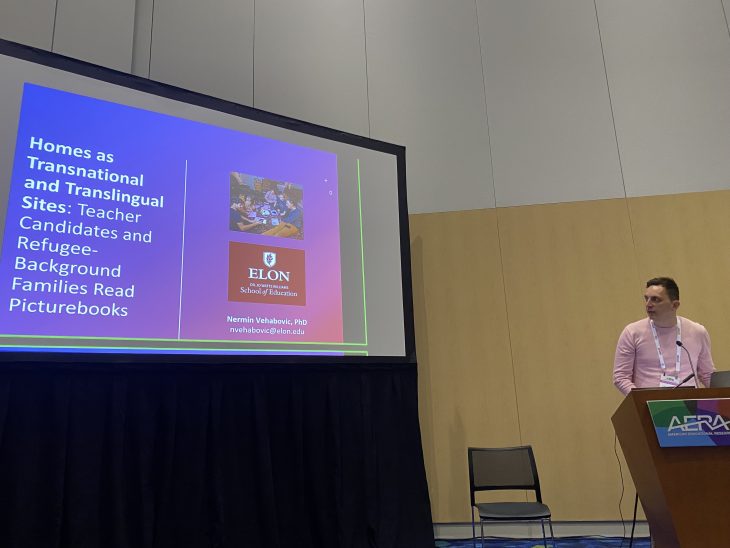
Nermin Vehabovic, assistant professor of education, presented an individual paper as part of the symposium titled “Elevating Refugee-Background Communities’ Ways of Knowing, Doing, Being, and Becoming: Canadian and U.S. Perspectives.” In a session featuring six transnational and multilingual scholars from immigrant and refugee backgrounds, Vehabovic shared findings from a qualitative multiple case study, titled, “Homes as Transnational and Translingual Sites: Pre-service Teachers and Refugee-Background Families Read Picturebooks.”
His research focused on community-based learning experiences in which Teacher Candidates visited the homes of refugee-background families to read and respond to multicultural, transnational and translingual picturebooks. Through audio recordings, artifacts like drawings and writing, impromptu interviews, and reflective memos, the study illuminated how relationships of care and dignity helped extend and revitalize languages, cultures, and stories within these homes. Vehabovic’s work highlighted how traversing borders, languages and cultures during shared reading sessions fostered deeper intercultural understanding and challenged deficit-oriented views of refugee communities. His findings advocate for more intentional educational practices that center humanity, collaborative learning and community advocacy.
In addition to presenting his research, Vehabovic served as a member of the Division C Equity and Inclusion Committee, which organizes Shark Tank—a dynamic competition, modeled after the popular TV show, where graduate students pitch equity and inclusion-focused research proposals for the opportunity to receive funding and feedback from a panel of judges.