


Elon University’s Mentoring Constellations Design Thinking workshop employs research-based strategies to help students build meaningful connections across their communities.
President Emeritus Leo Lambert recently interviewed Elon University Center for Design’s director Danielle Lake to uncover the value of the “Cultivating Mentoring Constellations” toolkit and workshop, with support from student director Aaron Chan.
The Center for Design Thinking created the mentoring constellations toolkit and educational workshop in 2022 with support from ACE Mentoring for Learner Success effort, the Center for Engaged Learning, and Relationship-Rich Education outreach efforts.
During the “Cultivating Mentoring Constellations” workshop, students are guided through the process of design thinking as a means of building and nurturing their personal and professional support constellations. Mind maps encourage students to explore how they might deepen their current mentorship relationships and design opportunities for developing new connections.
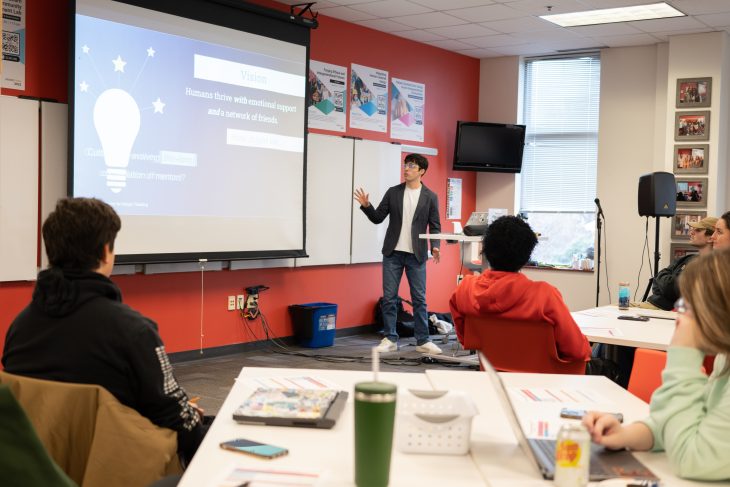
The workshop’s structure enables students to visualize their “mentoring constellation” and recognize individuals surrounding them who contribute to their experiences, such as teachers, colleagues, supervisors and figures from the community. Student leaders with the Center facilitate the workshop, sharing their own stories of mentorship and encouraging participants to realize they can play a key role in the support networks of their communities.
“I could be that mentor to somebody else that is helpful and makes a difference in their life,” Chan said “I’ve done that for a few students. I think that’s the most relatable human thing. We all have problems. We want them to be solved and to get to be a part of that for somebody. That’s the most meaningful thing in the world.”
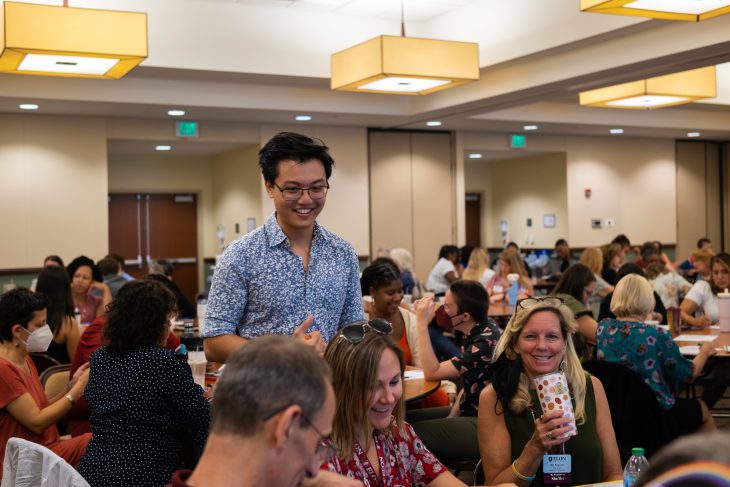
The term “constellations of mentors” was coined by U.S. Naval Academy and John Hopkins professor W. Brad Johnson. Johnson visited Elon University in 2017 to present “The Art (and Science) of Mentoring Undergraduate Students.” Designed in partnership with leaders, students, and initiatives, the workshop pushes participants to think about the role of mentorship and the research on it.
Through shared activities and small-group conversations, students sort out “glows” (positive mentorship experiences) and “grows” (avenues for improvement). They come to create manageable, actionable tasks that can help expand and deepen their network of mentorship.
As part of its Boldly Elon strategic plan launched in 2020, Elon took the next steps to implement a mentoring model in which all students learn to build meaningful mentoring constellations that include peers, staff, faculty and communities beyond the university. As written in the strategic plan, “this lifelong constellation of mentors will emerge as a hallmark of an Elon education, guiding reflection to integrate learning across students’ educational and professional trajectories and engaging all students in developing essential skills and fluencies to shape the future.”
The Center has done over 40 workshops reaching more than a thousand students, reshaping how they connect with peers, faculty, staff, and their surrounding community. Facilitators help participants shape conversations that allow making that connection easier.
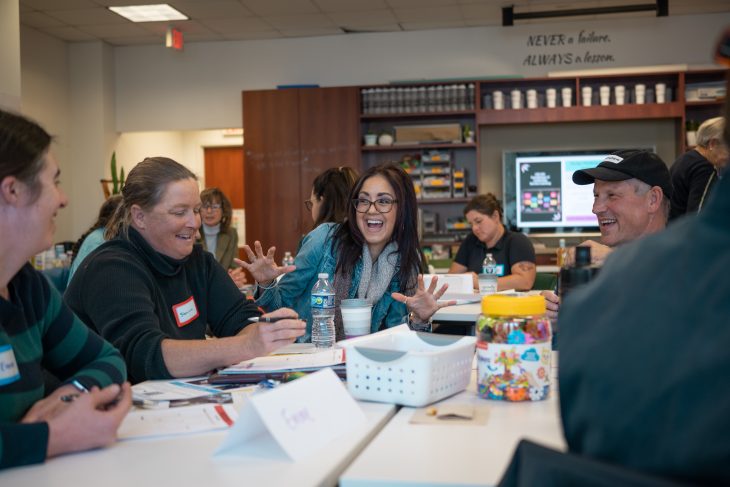
“It can be very daunting and scary to reach out to others,” Lake said. “We often assume that the person might not want to connect… thinking ‘who are we to ask something of others,’ when almost always that human wants to connect with us. We want to demystify the process of reaching out and make it easier for students to connect.”
Creating “constellations of mentorship” through mind mapping and tiny tasks allows participants to understand who in their lives are mentors and how they can continue to be open to invitations for conversations on mentorship in the future.
“Finding more mentors in your life is a complex problem,” Chan said. “It’s not one with a simple answer. It’s something that’s scary. It’s intimidating. It’s difficult to know where to start, but what I love about design thinking is that it breaks a complex problem into its smallest parts.”
The center is extremely excited to offer a mentoring constellation workshop adapted to the goals of participants. To find out more about how to request this workshop and what it entails, visit the Elon By Design website.