


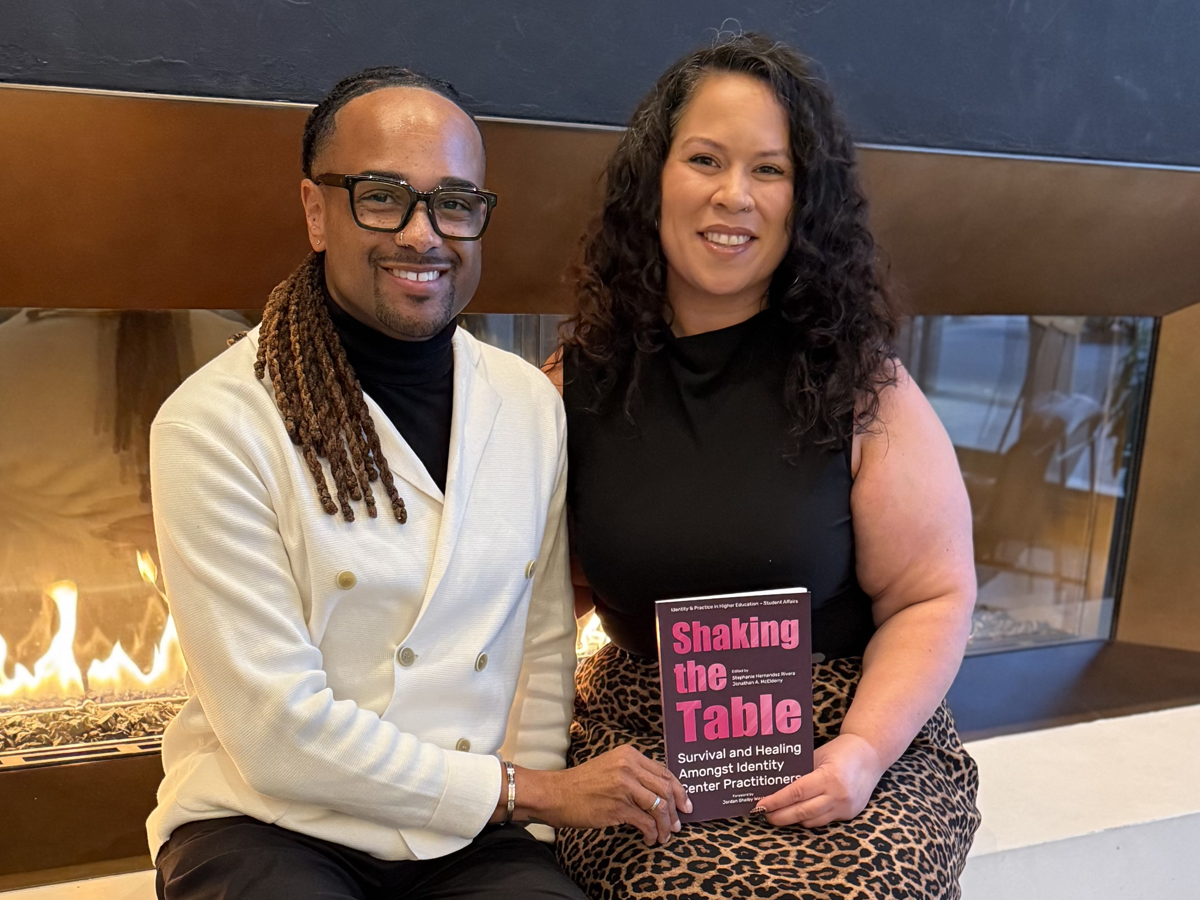
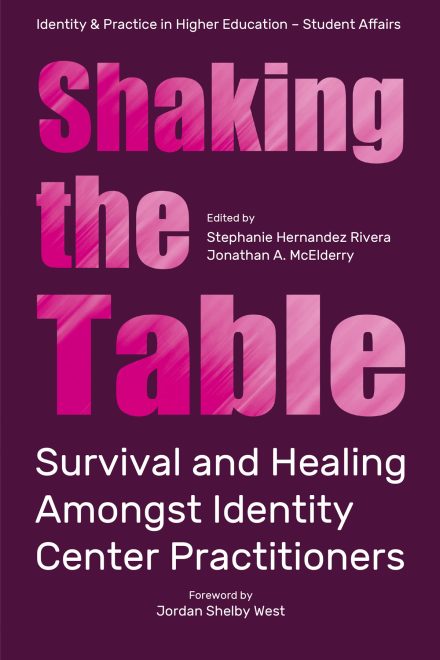
Stephanie Hernandez Rivera and Jonathan McElderry’s new edited book, “Shaking the Table: Survival and Healing Amongst Identity Center Practitioners,” gives identity center professionals space to share their stories. Available Nov. 24.
The idea for “Shaking the Table: Survival and Healing Amongst Identity Center Practitioners” began, as many inspirational ideas do, with a conversation.
In discussing the nation’s social and political climate surrounding diversity, equity and inclusion, Stephanie Hernandez Rivera, assistant professor in the Master of Higher Education Program and Dr. Jo Watts Williams School of Education Emerging Professor, and Jonathan A. McElderry, dean of Student Inclusive Excellence and assistant professor, reflected on the need for scholarship to include the testimonies of those doing the work in identity-based centers.
“One thing that’s missing from scholarship is the actual stories of people who have worked in those spaces,” McElderry said. “We’ve read about identity-based centers in scholarship, but rarely do you get to hear the actual voices of those who lived it.”
That conversation laid the foundation for the book, serving as a collection that amplifies the voices of practitioners often left out of academic narratives.
The power of collective voice
Across 18 chapters, “Shaking the Table: Survival and Healing Amongst Identity Center Practitioners” lifts the lived experiences of practitioners working across identity-based centers, including Black, Asian American, Latinx, multicultural, women’s, undocumented students, and gender and sexuality centers. Stories explore how professionals navigate grief, burnout, resistance and renewal.
 These narratives embody what McElderry calls “the power of the collective and community.”
“We can’t do this alone or in silos,” McElderry said. “The power of the collective and community is what moves the work forward. When we collaborate, students, campuses and communities all grow stronger.”
Echoing McElderry’s perspective, Hernandez Rivera expressed, “We’re part of a larger legacy of people committed to supporting the experiences of historically marginalized groups,” she said. “This project reminds us that we have our own knowledge and assets that sustain those efforts.”
That legacy runs deep for both editors, which is rooted in their shared history and the experiences that first shaped their work.
A full-circle moment
For Hernandez Rivera and McElderry, the book is deeply personal. The idea traces back to their time working together at the University of Missouri during the 2015 campus protests that brought national attention to racial justice in higher education.
“When we were at Mizzou, we didn’t have a voice or agency in what was going on,” McElderry said. “We weren’t allowed to do press or share our experiences. After I transitioned roles in 2016, we published our first article together as a way to finally give voice to what happened.”
“Shaking the Table” ensures this legacy continues and that the professionals who work in identity spaces can tell their stories.
Reflecting on that time, Hernandez Rivera described working on the book as both poetic and vindicating.
“This feels like a full-circle moment,” she said. “Maybe the space we wanted ten years ago is the space we’re now creating through this project.”
When stories become strength
While “Shaking the Table” highlights practitioners’ experiences, its deeper impact lies in what those stories make possible — connection, healing and truth through storytelling. For McElderry and Hernandez Rivera, storytelling isn’t just reflection, it’s resistance and restoration.
The book’s strength lies in the vulnerability and courage its contributors demonstrate in allowing themselves to be seen. Through storytelling, identity center professionals honor the past, affirm the present and imagine new possibilities.
“Writing this chapter was vulnerable,” Luis Garay, contributor and Elon’s director of the Gender and LGBTQIA Center, said. “I was sharing parts of my story that aren’t often talked about. That vulnerability was new for me.”
Building on that idea, Hernandez Rivera describes how connection is a driving force behind her decision to tell her story.
“One reason I write the kind of scholarship I do is to create points of connection for people who might otherwise feel isolated,” she said. “Collective storytelling reminds us that what we feel and experience is valid and valuable.”
At its heart, “Shaking the Table” is grounded in collective storytelling. Each chapter challenges silence, reclaims agency and reminds readers that using their voice is itself a radical act.
“People will see the joy and the pain. Many of those in these roles carry a lot they don’t share. The book exposes that quiet endurance. And that’s what makes it powerful.”
A legacy that continues
“Shaking the Table” continues the legacy Hernandez Rivera and McElderry began years ago, ensuring that identity center professionals are seen, heard and valued.
“It’s ironic,” McElderry said. “This book is being released 10 years to the month after the Mizzou protests. It’s a moment to stop and reflect on how much has changed — some for good, some for bad — and how far we’ve come in centering humanity in this work.”
“Shaking the Table” will be released on Nov. 24 and available for purchase online.
The work doesn’t end with the final chapter. Hernandez Rivera and McElderry have shared that a second volume is already in the works, as there are still more stories to tell. They continue to advocate for identity center professionals through ongoing scholarship, media and conversation, including an upcoming episode of the “Student Affairs Now” podcast, set to release Wednesday, Nov. 26.