


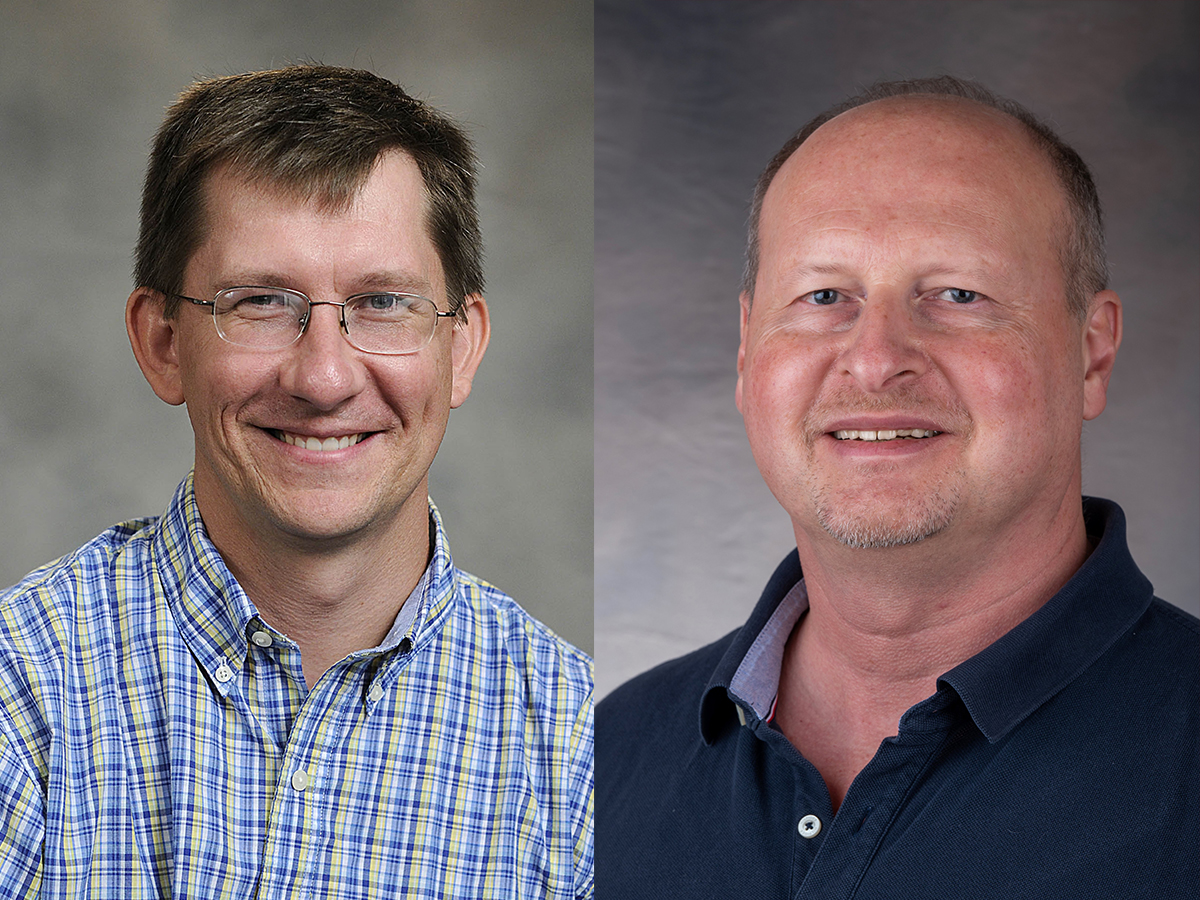
Kyle Atlmann and Martin Kamela have been named the 2026-2028 CATL Scholars for their research related to Standards-Based Grading in University Physics I and II.
Kyle Altmann, associate professor of physics, and Martin Kamela, associate professor of physics and chair of the Department of Physics, are taking on one of higher education’s oldest challenges — how to grade students in a way that truly reflects what they’ve learned. The two longtime faculty members in the Department of Physics and Astronomy have been named CATL Scholars by Elon’s Center for the Advancement of Teaching and Learning (CATL) for 2026-2028.
Their project, “Incorporating Standards-Based Grading in University Physics I and II,” seeks to replace traditional point-based grading systems with a more transparent, equitable approach that focuses on mastery and growth.
“We want assessments to be part of the learning process, not just the end of it,” said Kamela. “Students learn more deeply when they know exactly what they’re expected to master.”
Altmann and Kamela will utilize Standards-Based Grading, or SBG, which emphasizes learning goals rather than accumulated points. With SBG, instead of averaging scores from quizzes, homework, and exams, students will be evaluated on how well they’ve mastered specific skills and concepts with opportunities to reassess and improve. While SBG is not new for K-12 education (see Marsh 2023 for an overview), it is groundbreaking for college-level physics.
Over the next two years, Altmann and Kamela will refine and expand the SBG system across both of their introductory physics courses, which serve as foundational classes for majors in physics, astronomy and astrophysics. They will design comprehensive learning standards, create new assessment frameworks, and analyze outcomes using national benchmarks for conceptual understanding and problem-solving.
Altmann and Kamela have already piloted their approach to assessment in their University Physics II courses, with positive results. Rather than being discouraged by a single test score, students could see exactly which concepts they had mastered and which needed more work. Many students described this shift in assessment as motivating and confidence-building. The opportunity to reassess and demonstrate growth gave students a stronger sense of ownership over their learning and encouraged persistence in tackling challenging material.
“Traditional grading can let students ‘get by’ without true mastery,” Altmann said. “We’re building a system that makes learning the focus.”
The CATL Scholar appointment will provide course release time and research support, allowing the pair to dive deeply into their work and to share what they learn. They plan to present findings at American Association of Physics Teachers (AAPT) conferences and publish in peer-reviewed journals, contributing to the broader movement for more meaningful and equitable assessment in STEM education.
“Being a CATL Scholar is really about collaboration,” Altmann said. “It’s a chance to connect with colleagues who are also reimagining what teaching and learning can be.”
For both professors, the project builds on decades of dedication to teaching excellence. Altmann has taught at Elon for 23 years, Kamela for 26. Together, they’ve watched hundreds of students wrestle with physics’ abstract concepts. Many educators like them have seen how grading systems can either help or hinder real understanding.
“Physics is about curiosity and persistence,” Kamela reflected. “We want our grading to reward those same qualities — to make students feel that every step they take toward understanding matters.”
In all, through this work, they hope to do more than improve a single course; rather, they aim to spark conversations about how assessment shapes learning at Elon and beyond.