


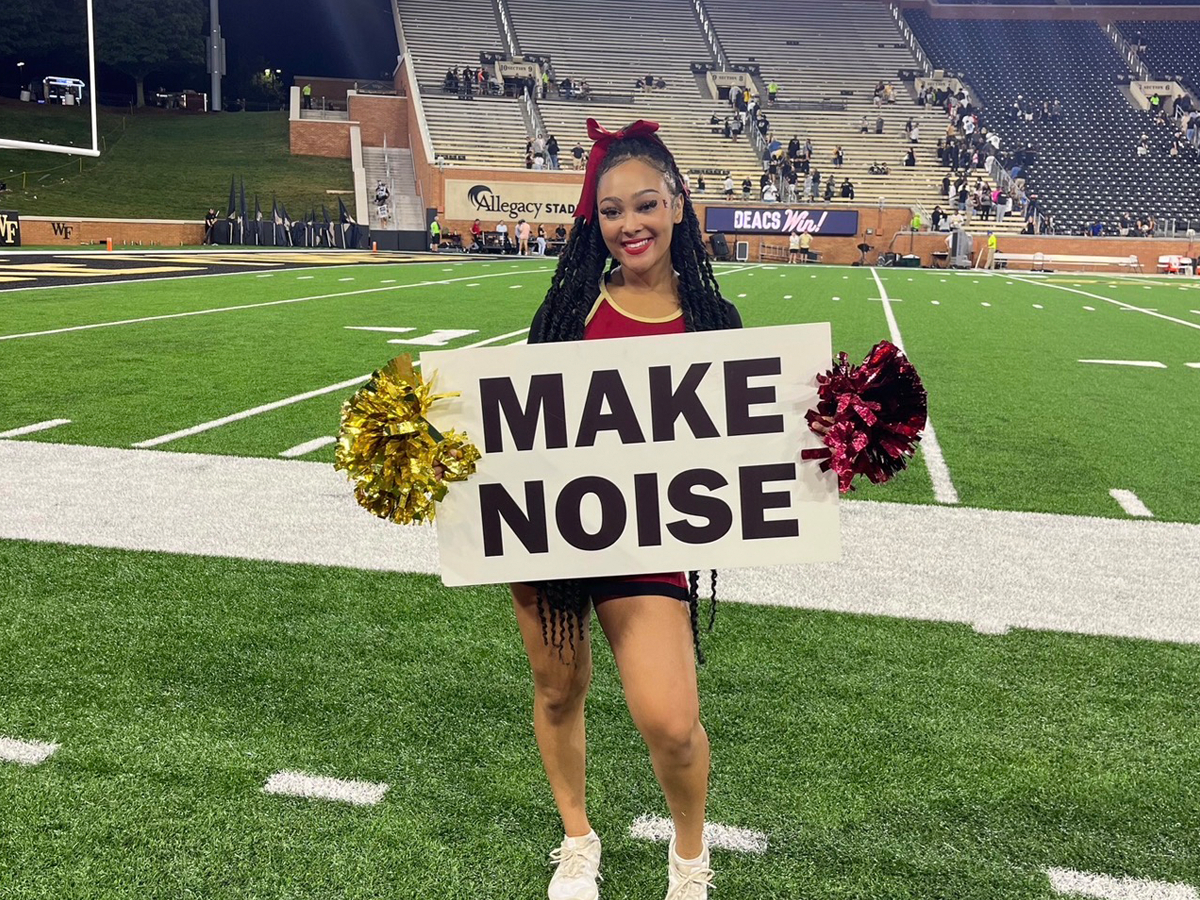
As president of the Black Student Union, Proctor has created spaces for empowerment while encouraging students to take up space unapologetically.
“I constantly have to remind myself that I am enough.”
For Maelah Proctor ’26, that reminder has shaped her path from uncertainty to leadership. Now she has become a voice for others on campus.
Her confidence did not always come naturally. Over time, she came to understand that she holds her leadership roles because her skills, perspective and voice are needed in those spaces.
Throughout her time at Elon, she has intentionally stepped into spaces where students need to be heard, amplifying voices, advocating for equity, and building community as president of the Black Student Union and as a Student Athletic Council representative for the cheerleading team.
As she reflects on her Elon journey, she points to the people who shaped her path and the purpose that continues to guide her work.
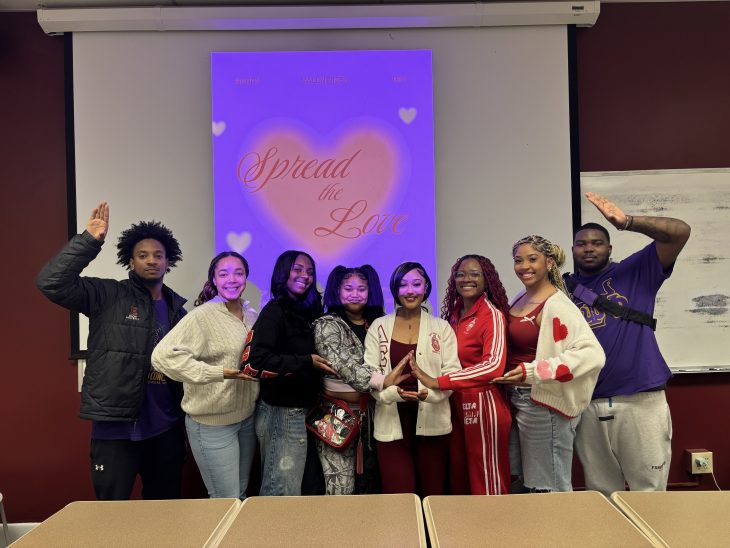
The power of community
Proctor’s confidence did not grow in isolation but through community.
What began as attendance at a Black Student Union event soon evolved into leadership, first serving as vice president for Black Excellence and now as president.
For Proctor, a political science and policy studies major from Charlotte, North Carolina, belonging is deeply connected to visibility. If you don’t see yourself in the community that you’re supposed to represent, she said, it’s hard to feel a part of that community
That understanding now shapes how she leads, ensuring other Black students can find the same affirmation and space that once grounded her. “BSU made me feel comfortable and gave me the confidence to continue here,” Proctor said. “Because sometimes going to Elon and not seeing a lot of people who look like you can be very alienating.”
In addition to finding belonging within the Black Student Union, she has also built community as a Leadership Fellow, a member of Delta Sigma Theta Sorority, Incorporated and a cheerleader.
“I’ve been able to find community in different spaces on campus, and each one has shaped me in a different way,” Proctor said.
Each role has strengthened her confidence and deepened her understanding of what it means to lead with intention.
Mentorship as momentum
Proctor recalls meeting Simone Royal ’17 G’25, associate director of the Center for Race, Ethnicity and Diversity Education, at her first BSU brunch.
“I didn’t really know anyone, so I sat with Simone because she was a staff member and it felt less intimidating,” Proctor said.

A simple conversation evolved into mentorship.“She has been someone I could go to with questions, someone who helped me navigate things when I didn’t have all the answers,” Proctor said.
Throughout their relationship, Royal has witnessed Proctor’s growth firsthand.
“She has not only stepped up to be the leader that the organization needs, but she’s learned how to extend her leadership skills to others — how to prepare other students to be the best of themselves as well,” Royal said.
Through Royal’s example, Proctor learned that leadership is not about being the loudest voice in the room, but about ensuring others feel heard.
Refusing to shrink
As Proctor deepened her leadership on campus, she became more aware of navigating hyper-visibility and invisibility.
“Sometimes it feels like you’re the only person in the room that looks different,” she said. “You’re holding a certain perspective that might be an outlier.”
She once tried to soften her presence to avoid stereotypes. Over time, she realized shrinking herself served no one. Proctor has chosen to lean into her voice.
“She is a tireless advocate for the community that she serves,” said Abdul-Malik Harrison ‘21, assistant director of the Center for Race, Ethicity and Diversity Education. “When she has a vision, she wants it enacted. She is the epitome of, ‘if you want it bad enough, you can get it done’.”
Rather than simply demanding space, Proctor works to create it.
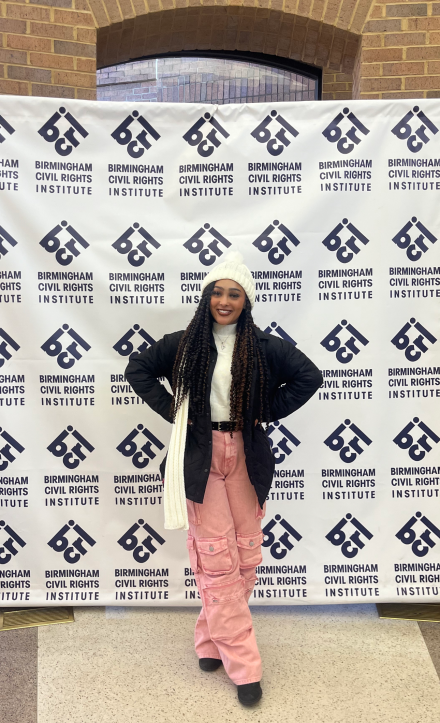
As Proctor looks ahead to law school and life beyond Elon, she hopes to continue advocating for equity and expanding access through public service and policy work. Her experiences navigating visibility, representation and leadership on campus have only deepened her desire to pursue law school as a tool for systemic change.
For now, her message remains clear: take up as much space as you want.
“Be unashamed in who you are,” she said. “The second you stop letting other people’s opinions, stereotypes or perceptions limit you is the second you’re free to pursue what you want to pursue.”
Proctor said her time at Elon serves as proof that when a student chooses to step forward, their voice does more than fill a room — it amplifies others. And that amplification, she said, is what creates lasting change.
Black History Month
As part of Black History Month, Elon University is sharing stories through Today at Elon that highlight Black students, faculty and staff who actively contribute to a campus environment where cultural histories and identities are celebrated year-round. In February, Elon is also recognizing the month through a series of events and programming.