


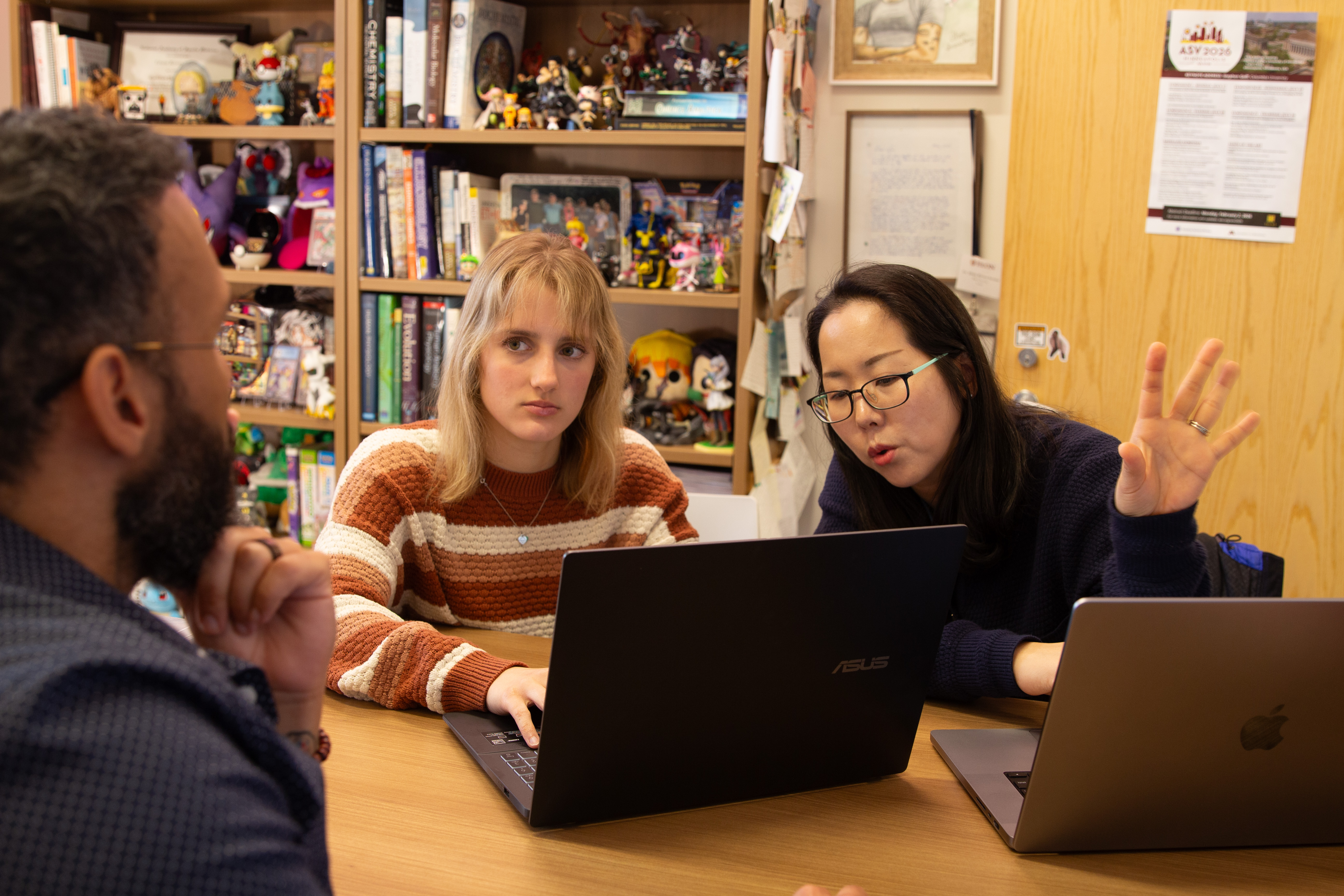
Elise Butterbach ’27 bridges biomedical engineering, mathematics and biology through interdisciplinary research on viral myocarditis.
To Elise Butterbach ’27 a biomedical engineering student, research is not contained to a single field of study, it exists at the intersection of many fields.
Butterbach’s path to research started in a cell biology course taught by Assistant Professor of Biology Efrain Rivera-Serrano, where she consistently asked questions and engaged deeply with the material. This curiosity led her to join the interdisciplinary project.
“It was a very ‘right place, right time’ circumstance,” Butterbach said. “This research was exactly the sort of thing I was looking to get involved in.”
Through her Lumen Prize, Butterbach is working alongside two faculty mentors from different fields of study, Associate Professor of Mathematics Hwayeon Ryu and Rivera-Serrano, to study viral myocarditis, or heart inflammation, that occurs during the infection of many viruses. Her research is focused on examining the pathways that lead to excessive inflammation and how inflammation can be reduced without compromising the immune system’s ability to clear the virus.
“My research focuses on creating math out of biological reactions,” Butterbach said. “Ultimately, the goal is to create a framework that helps us better understand and predict how cardiac inflammation progresses.”
Viral myocarditis occurs when inflammation damages heart tissue, sometimes leading to long-term complications or sudden cardiac failure, particularly in young, active individuals. Although inflammation is a natural immune response, Butterbach’s research is exploring what causes that response to become excessive.
Butterbach uses mathematical modeling to integrate biology and immunology into a modeling framework to identify factors that most strongly drive harmful inflammation, revealing pathways that could be therapeutically targeted.
“It’s a balancing act to use equations to model what’s happening,” Butterbach said. “If the model is too simple then it is not realistic to the human heart, but if the model is too complex, it becomes difficult to work with.”
Taking an interdisciplinary approach
This research project’s strength lies in its collaboration and intersection between mathematics, biology and engineering. Mathematics offers the language and tools to create the models, while biology provides the foundation for understanding the disease. Engineering ties it together through design, problem-solving and a systems-level mindset.
“This project works precisely because it sits at the intersection of all three areas,” Rivera-Serrano said. “Elise is especially well suited for this work because she is genuinely interested in connecting these disciplines rather than treating them as separate silos.”
Ryu echoed this statement on Butterbach’s interdisciplinary approach.
“Elise approaches research with a rare combination of intellectual curiosity, maturity and persistence, and she is genuinely committed to understanding how mathematics and biology inform one another,” Ryu said. “Her ability to engage across disciplines and contribute thoughtfully at that intersection is what makes her such a strong and promising researcher.”
Butterbach, Rivera-Serrano and Ryu meet weekly to refine their model, troubleshoot challenges and discuss literature.
“The steady back-and-forth is one of the strengths of the project,” Rivera-Serrano said.
For Butterbach, working across disciplines has shaped how she approaches problems.
“I’ve always found that when different disciplines collide, it actually becomes easier to understand complex concepts,” Butterbach said. “Working across engineering, mathematics and virology is fascinating because each discipline approaches the same problem in a completely different way. Learning to think adaptively across disciplines and translate between them has been one of the most valuable parts of this experience.”
Butterbach is motivated by the possibility of using interdisciplinary research to better understand human disease.
“The interdisciplinary nature and the way the team bring together mathematics, biology and engineering is not always easy to achieve, but Elise has embraced it fully and become an essential part of that process,” Ryu said.
Collaborating on this research has been rewarding not only for Butterbach, but for her mentors as well.
“Working with Elise has been incredibly rewarding,” Rivera-Serrano said. “She approaches a difficult project that requires her to be conversant in multiple disciplines with curiosity, maturity and persistence.”
One takeaway she learned from working in disciplines outside of her major is that discoveries in one field almost always influence others.
“By learning how to think like a biologist, a mathematician and a physicist, I have become much more comfortable applying ideas from one subject to another, even when they seem unrelated at first.”
She also values the work with her two mentors, Rivera-Serrano and Ryu, as they have helped her grow as a researcher.
“Dr. E spends a lot of time looking for resources that I can use to calculate the values of different parameters,” Butterbach said. “Similarly, Dr. Ryu works tirelessly to not just improve my mathematical skills but also teaches me how to see mathematical theory working in the real world. They’re not just dedicated to this project; they’re also thinking about what comes next for me.”
Expanding her research
Butterbach was recently selected for a competitive Physical, Engineering and Biology Research Experiences for Undergraduates program at Yale University, focused on physics, engineering and biology. Butterbach hopes to expand her research on the cardiovascular system.
“Elise’s acceptance is especially meaningful because it reflects national-level recognition of her promise as an undergraduate researcher in an interdisciplinary space,” Rivera-Serrano said.
For Butterbach, the opportunity was surprising and motivating.
“I tried not to set any grand expectations for myself, so when I received the email I was genuinely surprised to be selected for the program,” Butterbach said. “It felt incredibly validating of the hard work and dedication I’ve put into my studies.”
At Yale, the program, like her research, is interdisciplinary covering biology, physics and engineering. She will expand her experience in computational and biological modeling while working alongside researchers.
“To me, this program represents the opening of new doors,” Butterbach said. “It’s an opportunity to continue growing as a researcher, meet people working at the forefront of interdisciplinary science and explore new directions that I may not have encountered otherwise.”