


Danielle Martinelli-Taylor ’12 combines boxing with mental health techniques to help clients process trauma.
They stood poised with their hands raised, breathing steady, before their fists began to fly. Jab, cross, right hook, left upper cut.
They noticed the sensations in their body as childhood memories raced through their mind, allowing themself to feel every feeling that remained with them from a time when they didn’t have a voice. With every punch, they stepped closer to regaining their power, closer to a deeper understanding of their full self.
Danielle Martinelli-Taylor ’12 says the physical movement often allows clients to recognize and begin healing younger parts of themselves that were never fully seen or supported. “Through the movement, through fighting back against that, they were able to trust themself more.”
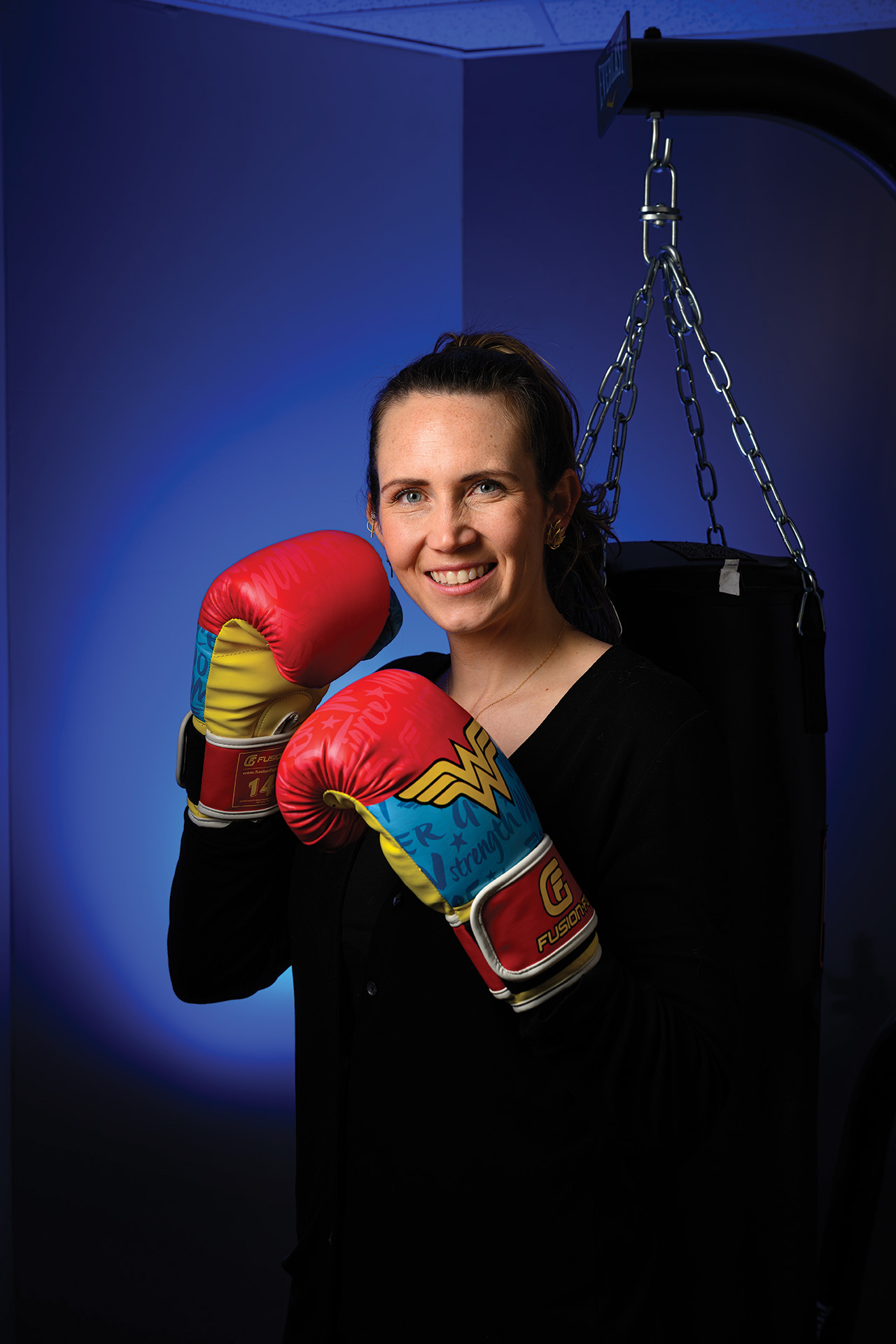
A licensed professional counselor, Martinelli-Taylor centers her Denver practice, Animo Counseling and Coaching, on healing the whole person. Among the approaches she uses is somatic boxing, a method that connects mind and body to help clients process trauma and strengthen their overall well-being.
“We’re interconnected beings,” she says. “Our bodies hold just as much of our story as our minds do, and healing happens when we learn how to listen to both.”
A Non-Linear Path
Martinelli-Taylor’s journey toward counseling wasn’t straightforward, but every step helped develop the empathy, critical thinking and global perspective that shapes her work. The Massachusetts native wasn’t familiar with Elon before stumbling upon it while touring colleges along the East Coast. She was immediately drawn to its arts and sciences foundation, small class sizes and study abroad program.
She enrolled Early Decision, planning to study education, but soon found that teaching wasn’t her passion. She did, however, have a knack for fostering strong one-on-one connections, and she found other ways to build those skills through a strategic communications major and religious studies minor.
“There’s a lot of psychology in strategic communications, learning what are people’s needs, what do they want, why do they do what they do. I loved that aspect,” Martinell-Taylor says. “Then my religious studies minor was just a window to the world of what other people believe, why they believe it and how that directs their decisions, hopes and dreams.”
But it was her semester abroad in London that influenced her most, broadening her worldview and clarifying what she did and didn’t want to pursue post-graduation. She interned for a fashion supplier on Oxford Street but didn’t feel a strong connection to the work. She loved London, though, and wanted to use her communications skills in service of something she cared about deeply.
After graduating, she returned to London for two years, working with an international mission organization that supported churches and other spiritual communities. Martinelli-Taylor spent much of her time connecting with South Asian women, children and teens and found their conversations about life and struggle deeply meaningful. On weekends, she volunteered with a nonprofit fighting human trafficking, a cause that first sparked her interest through an Elon course examining slavery in the Bible, in American history and in modern times. Again and again, she found herself drawn to work that offered support to people during some of the most difficult moments of their lives.
“I was hearing people’s trauma, hearing really difficult life journeys and feeling this pull,” Martinelli-Taylor says. “If people have gone through these really awful things, forced into things they had no control over, how do I step into that world?”
That realization ignited Martinelli-Taylor’s calling to be a counselor. She moved back to the U.S. and earned her master’s degree in clinical mental health counseling from Denver Seminary in 2019. Her communications, religious studies and study abroad experience from her time at Elon remained foundational as she forged this new path.
L.D. Russell, senior lecturer emeritus of religious studies at Elon, remembers Martinelli-Taylor as open-minded, eager to learn and deeply committed to helping others. Her unique counseling approach feels like a natural extension of that spirit. “One of the truest values of an Elon education,” he says, “is gaining a clearer sense of how others live and move through the world, and how our own gifts can be used to foster the public good.”
The Mind-Body Connection
After obtaining her master’s degree, Martinelli-Taylor again used her skills to support human trafficking victims, providing counseling to survivors with complex Post-Traumatic Stress Disorder. She later moved to a group practice, helping clients with a broader range of issues such as anxiety, depression, trauma and grief.
In graduate school, she began to learn how physical movement, education and preventative work can help set clients up for a healthier life and resiliency amid difficult challenges. That idea coupled with her own personal experience with boxing prompted her to try bilateral boxing as a technique with some clients at the group practice. “It was starting to help people break out of dissociation and get into their body,” Martinelli-Taylor says. “We used it as a tool when they felt stuck or overwhelmed with talk therapy.”
As she saw the approach resonate with more clients, Martinelli-Taylor set out to develop it further and open her own practice. Drawing on her strategic communications background, she built the foundation for her business while consulting with counselors who use somatic therapies that link breath, body and mental health. In 2024 she founded Animo Counseling and Coaching, where she offers treatments such as Accelerated Resolution Therapy, Eye Movement Desensitization and Reprocessing and her own style of somatic boxing therapy.
Animo means “mind” in Latin, “soul” and “courage” in Italian and “encouragement” in Spanish. “The practice reflects that intentionality, that purposefulness,” she says. “It represents the embodiment of the brain and body’s role in learning about yourself.”
Our bodies hold just as much of our story as our minds do, and healing happens when we learn how to listen to both. — Danielle Martinelli-Taylor ’12
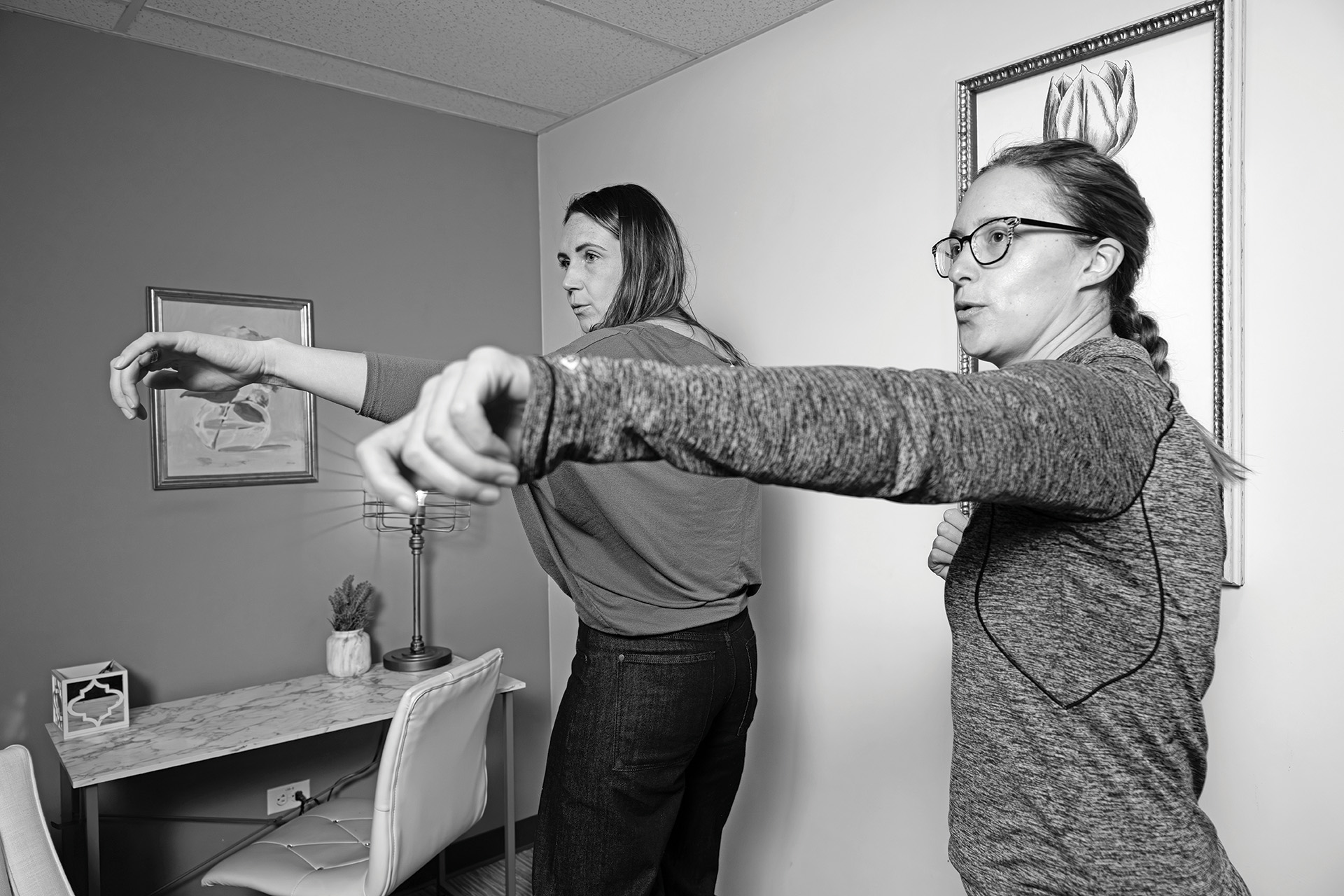
Martinelli-Taylor first teaches her clients the basics of non-contact boxing, using the bilateral movements of boxing but no sparring, just hitting boxing gloves to mitts as the whole body engages. She focuses on proper form and breathwork, guiding clients to concentrate on each motion. The practice becomes a type of moving meditation, stimulating both sides of the body and both hemispheres of the brain.
For many clients, the approach offers another avenue for healing, especially for those who may not feel ready to talk through difficult experiences right away. By focusing on the rhythm of movement and breath, clients begin to notice what their bodies and minds are holding, and shift it out.
Once clients feel comfortable with the technique, she introduces strategies for building courage, managing stress and emotions, and processing difficult memories. The approach encourages people to tune in to the physical sensations that often accompany mental health struggles, opening the door to more holistic healing. Movement and breathwork, Martinelli-Taylor says, can help move through distress, regulate mood and ground the body to allow clients to face and work through deeper challenges.
In addition to continuing to grow her practice, Martinelli-Taylor hopes to conduct larger studies on the impact of somatic boxing on mental health. And while she is there to support her clients in the “ring” when they need it, she doesn’t expect them to rely on a coach forever. Her goal is to help people build the awareness and tools to continue the work on their own — to trust their bodies, their instincts and their capacity to heal.
“I want them to feel like they’re equipped to learn and grow,” Martinelli-Taylor says. “They can take this work, try it out in the world and know that they’re resilient.”