


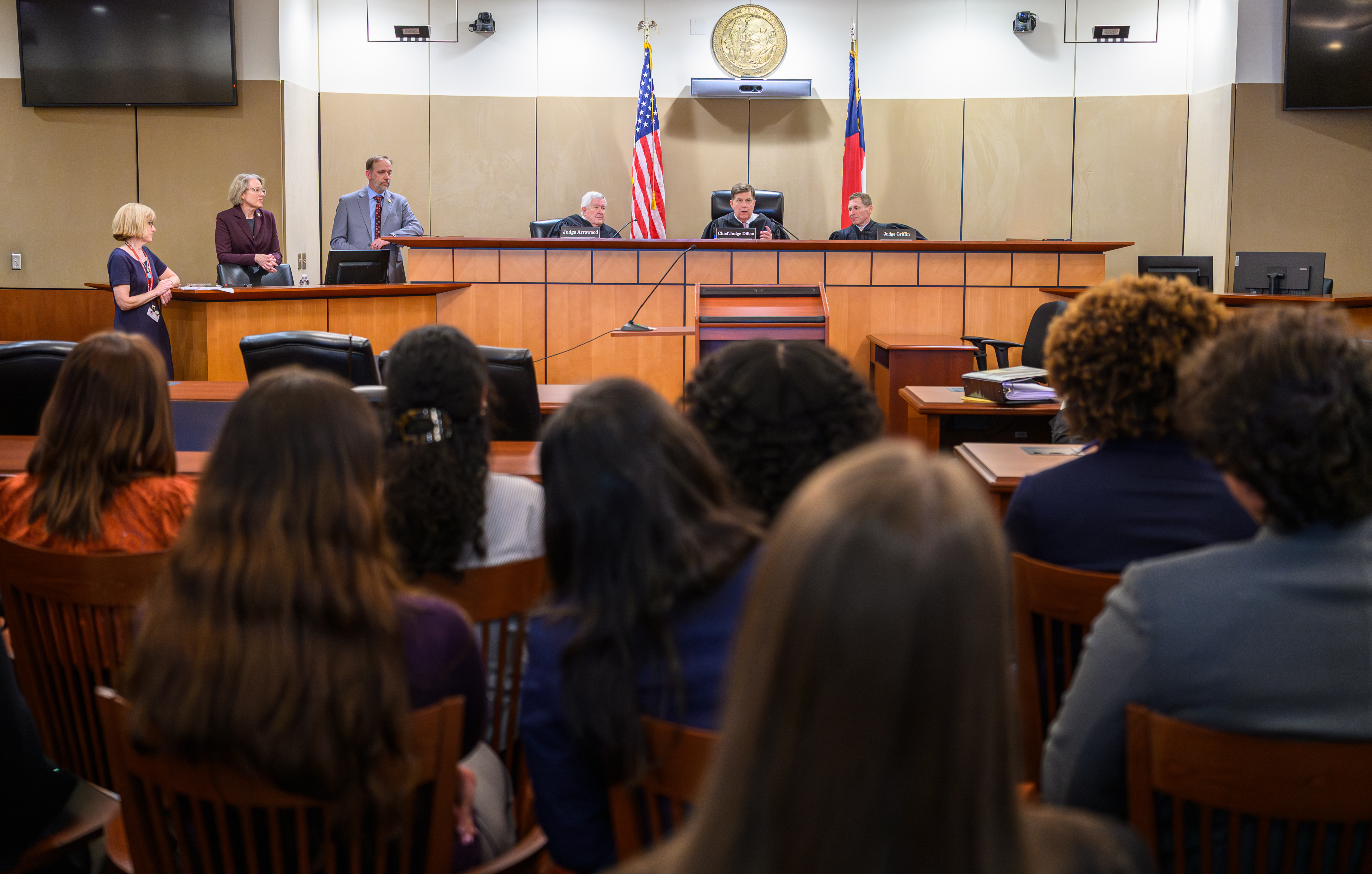
Two panels of judges with the North Carolina Court of Appeals heard arguments in Elon Law's Robert E. Long Courtroom, offering appellate insights and practical advice to students.
A visit from judges on the North Carolina Court of Appeals is an anticipated rite of spring at Elon Law, but it’s rare for students to hear from and interact with as many as they did last week.
Six judges, comprising two panels, heard oral arguments in two cases inside the law school’s Robert E. Long Courtroom on Wed., April 15. Following recess, they held an extended Q&A session with students in the courtroom where they shared lessons drawn from decades of experience on and off the bench.
Among their advice to young lawyers:
- Be willing to concede a point — then quickly move on to explain why your client still prevails.
- It’s OK to say, “I don’t know,” rather than risk your credibility. Return to your argument about why your client should win the case.
- Structure legal briefs as clear roadmaps of your argument for the Court.
- Be concise in your writing. Make your point, support it with the law and move forward.
- Use caution with AI: Verify facts and citations before submitting any work to the court. Large language models often hallucinate legal matters.
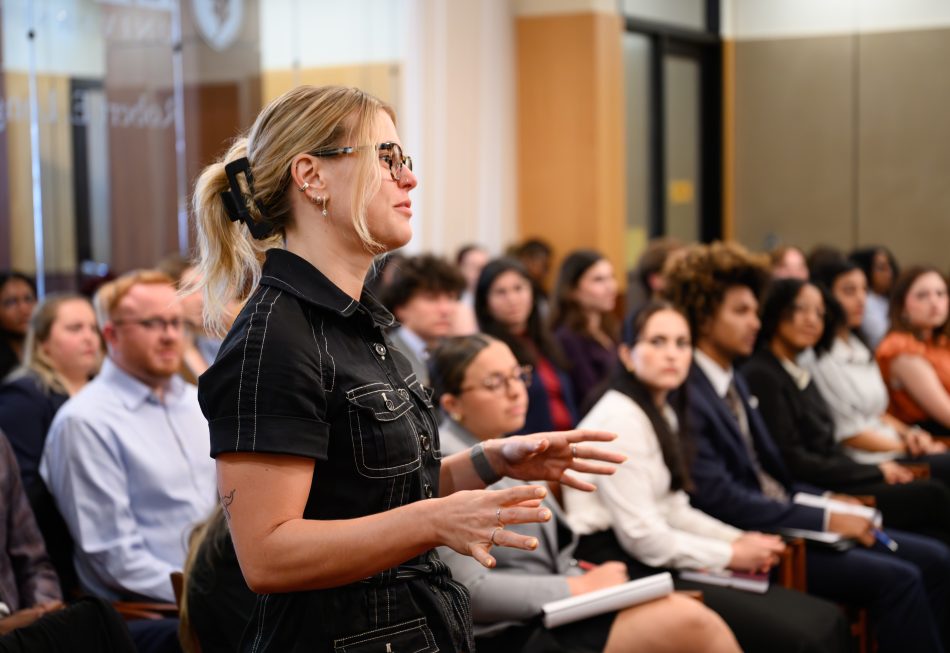
Judges hearing arguments and interacting with students were:
- The Hon. Chris Dillon, Chief Judge of the N.C. Court of Appeals
- The Hon. John Arrowood
- The Hon. Jefferson Griffin
- The Hon. Toby Hampson
- The Hon. Donna Stroud
- The Hon. John Tyson
Judges heard arguments in two very different cases.
The first, Daedalus LLC v. Mecklenburg County, centers on whether certain residential units should be classified as townhomes or duplexes under local building codes, a distinction with significant regulatory consequences — and now potential financial consequences for individual property owners.
The second case, State v. Miguel Angel Cuadra, out of Forsyth County, involves the state’s appeal of a trial court’s decision to dismiss charges after testimony referenced a prior case, raising questions about prejudice and appropriate remedies.
“It was an incredible experience for our students to observe six judges from the North Carolina Court of Appeals and four highly skilled appellate advocates in action, particularly as our first-year students prepare to present their own appellate arguments in their required Legal Method & Communication course in a few weeks,” said Alan Woodlief, vice dean and professor of law. “Several of the judges visiting today consistently welcome Elon Law students to their chambers for their Residencies-in-Practice, summer internships, or full-time clerkships after graduation. It was great to have several current Residency students accompany their judges to the oral arguments.”
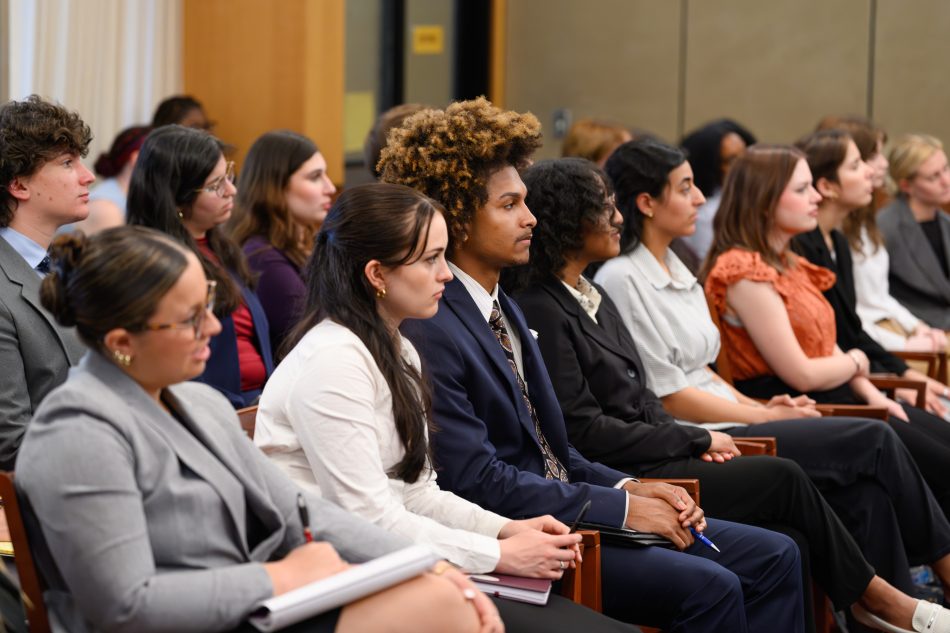
Elon Law students’ takeaways
Law students listened intently to judges’ lines of questioning, but also to the ways appellant litigators structured their arguments, responded to jurists’ questions and addressed the court.
“I was paying attention to everything. I could understand why this is such a complicated case — codes changing, proposals changing, multiple parties — and I appreciated the judges asking why it got to this point and where responsibility lies,” said Lamarie Austin-Stripling LF ’29. A student in Elon Law’s part-time Charlotte Flex Program, Austin-Stripling drove from her home in Concord, North Carolina, to hear arguments before returning to the Queen City for classes that night.
Greensboro law students were just as engaged.
- “What struck me most is how much of what I’ve already been doing — in the classroom, in residency, and in internships — showed up in these arguments. It reinforced that I’m learning the skills I’ll need to be in that position one day.” – Tyler Sesker L’26, of Upper Marlboro, Maryland, who earned her undergraduate and graduate degrees at Hollins University and the University of Virginia.
- “I was surprised by how collaborative the process is — judges discussing cases with each other and their clerks before and after arguments. It was valuable to see how the pros do it and what approaches seemed to resonate.” – Tom Desch L’27, of Cornelius, North Carolina, who earned his undergraduate degree at the University of South Carolina
- “One of the most impactful takeaways was hearing from the judges that if an attorney doesn’t know an answer, it is okay to say, ‘I don’t know.’ Being honest about the limits of your knowledge is much better than risking your credibility.” – Paulina Escobar L’27, of Ecuador, who holds a law degree from the University of the Americas in Quito, Ecuador.
Elon Law alumnus argues in his home court
For one attorney arguing before the court, the visit marked a return to where his legal career began.
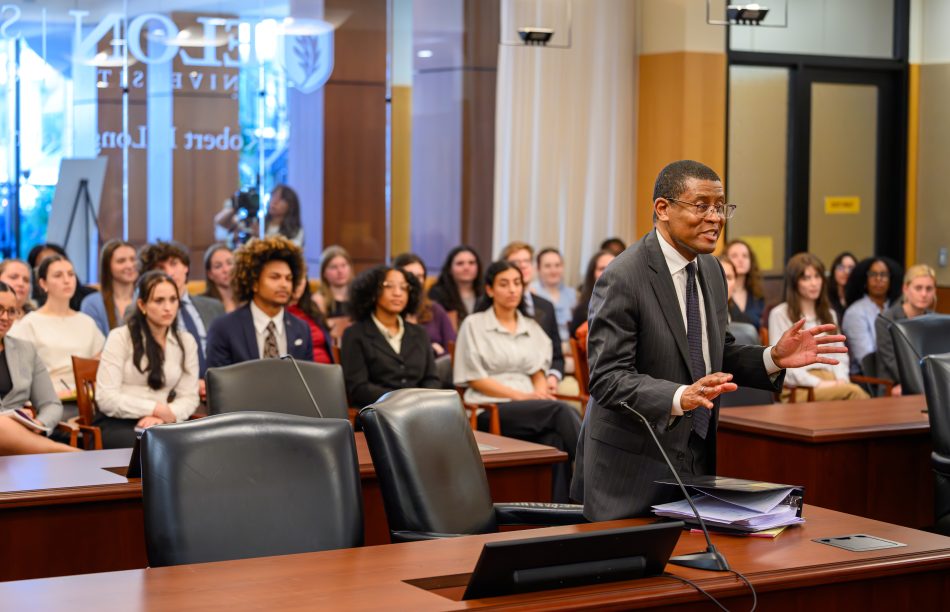
Reginaldo Williams L’11, now an attorney with the North Carolina Department of Justice, presented arguments in State v. Cuadra. His path to appellate advocacy, however, was far from certain.
“I was that person wondering, ‘Why did I do this?’” Williams said following hearings, recalling his time as a law student. “I didn’t feel like I fit as a prosecutor or a public defender. But when I did my first oral argument, I knew — this is it.”
Williams credits guidance from Professor of Law Catherine Ross Dunham with helping him stay the course at a moment when he considered leaving law school altogether. That decision ultimately led him to appellate practice, where he now represents the state in criminal appeals.
“There are a lot of students who may not feel like they’ve found their place yet,” he said. “But you will. And when you do, it makes all the difference.”