


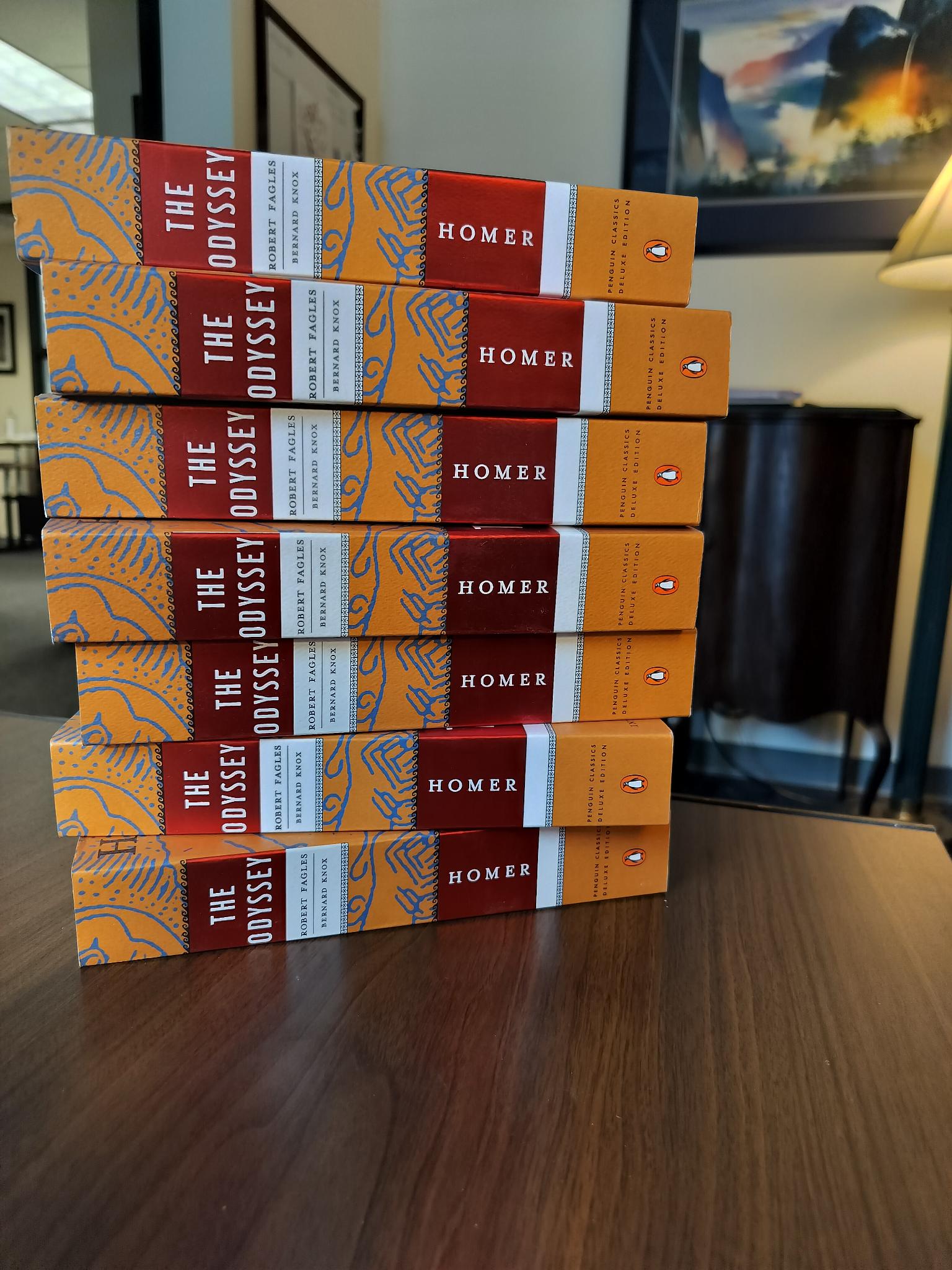
Assistant Professor of Political Science and Public Policy Matthew Young and Professor of Classical Languages Kristina Meinking are leading book clubs on Homer’s “Odyssey” and Margaret Atwood’s “Penelopiad”.
This Spring semester, two faculty-led student book clubs are being led by Assistant Professor of Political Science and Public Policy Matthew Young and Professor of Classical Languages Kristina Meinking. The novels discussed in these meetings are different, but they have similar themes.
“Odyssey” Book Club
Young’s book club is currently reading Homer’s “Odyssey”, a well-known ancient Greek epic poem about Odysseus, an Achaean warlord on a long, tumultuous journey to his home in Ithaca after plundering Troy. Over the course of a decade, Odysseus encounters both incredible and dangerous things as his ship loses its way time and time again. Young explains how the epic goes beyond detailing the many obstacles Odysseus and his crew encounter on the trip. The story also delves into the protagonist’s personal journey toward moral and intellectual self-discovery, which connects to how many of the students in Young’s book club are set to graduate from Elon at the end of the semester.
“Odysseus is changed through this journey of discovery,” Young said. “That’s the story I hope stays with my students as they set sail on their next adventures.
Young explained that this book club was started because of his students. Toward the end of fall semester, many asked if he’d like to read a book with them during the upcoming spring semester while on teaching sabbatical. Young quickly agreed.
Since many of these students had enjoyed reading Homer’s “Iliad” while taking his course, Democracy and Its Critics, “Odyssey” seemed like the perfect choice. It also coincided with student interest in Christopher Nolan’s upcoming film adaptation of the epic poem.
In addition to Young, there are nine students in the book club this semester, and the group meets every other week. While most participants are students in Elon College, the College of Arts and Sciences, Young noted that the group is not off-limits to students outside of it. He also explained that he doesn’t show up to each meeting with an agenda for students to follow, instead allowing for open discussion on any confusing or interesting segments of the epic.
“I organize our meetings, but I’m not in charge of leading the discussion to some pre-established conclusion,” Young said. “My favorite moments are those where others are talking back and forth, voices raised, and I can sort of fade into the background.”
When reflecting on all he’s gained from running this book club, Young described that he’s continuing to learn more about “Odyssey”, an epic he’s already read several times and knows very well. He appreciates the opportunity to read a book with a group of students outside of a formal classroom setting.
“I’m heartened to simply sit and read together, without the pressures of grades (for students) or grading (for me),” Young said.
Young also described the sense of community his book club has brought to participants. One student created a group chat, and many members eat dinner together after weekly meetings. Young reflected on a recent dinner and discussion event he hosted at his farm in Chatham County, explaining that he plans to invite students back for a fancy-dress dinner party at the end of the semester to celebrate their achievement.
“When I look back to my own time in college, it was those long conversations about books and ideas, over and after dinner with friends, that I cherish the most,” Young said.
Looking ahead, Young hopes to continue reading books outside of class time with students, staff, and faculty members. While he can’t confirm anything yet, classic works he’d like his book club to read next include Dante’s “Inferno” and Frederick Douglass’ “Narrative of the Life of Frederick Douglass”.
“I said earlier that the “Odyssey” is a story about a journey of discovery and growth,” Young said. “I hope that ten or fifteen years, or forty years, in the future, my students will be well on their own journeys and look back on this semester as a highlight of their time at Elon. I hope they can sense the respect and appreciation I have for each of them, and the joy I take from their love of learning.”
“The Penelopiad” Book Club
Meinking’s book club is currently reading Margaret Atwood’s “The Penelopiad”. Meinking explained that during the fall semester, her Classical Mythology course read and discussed Homer’s “Odyssey”. Because the class was working with Emily Wilson’s translated version of the epic, topics of discussion kept returning to questions of gender, translation and society.
Meinking expressed how focusing on these themes made her think even more deeply about retellings of classical myths. Upon receiving the Read On, Elon invitation to submit toward the end of fall semester, she jumped at the chance to investigate another retelling.
Wilson’s translation of “Odyssey” was also Meinking’s inspiration to choose “The Penelopiad” for her book club. This text retells the story of Penelope, Odysseus’ wife, and her slave girls, who are atrociously mistreated in “Odyssey”. Other reasons for her choice were the novel’s accessibility to non-experts and manageability for a semester-long time frame.

Meinking’s book club currently has 17 members, consisting of 15 students, one faculty member, and herself. The group is currently about halfway through the book, and discussions have circulated around Penelope’s character, comparisons to Homer’s “Odyssey”, the juxtaposition of Homer and Penelope, family structures and dynamics, how to depict the past, what ancient people would say about themselves 2,000 years later, and more.
“Our lively conversations so far have been driven by student observations, comments, and questions,” Meinking said. “I’ve been so impressed by how carefully and thoughtfully everyone has engaged with the book!”
Meetings are held once a month, and there will be four total over the course of the semester. Read On, Elon sponsored the book club, and the Classical Studies program will provide refreshments for the last meeting. While the group covers themes in classical mythology, it is open to everyone at Elon. Meinking hopes to host another bookclub during the upcoming fall semester, and encourages anyone who missed this semester to join.
Meinking also reflected on how her book club has fostered community among members, noting how it has helped both faculty and students connect with one another.
“Many of the students were in my fall course and some others are senior majors in Classical Studies,” Meinking said. “Whether or not someone is a major or minor, I think this has been a wonderful opportunity for students to get to know other students who share interests and are in different years of study at Elon.”
She describes book club meetings as ‘pretty informal’, explaining how her role is more of an organizer and occasional facilitator. She does not control where conversations go, instead allowing everyone to share their perspectives outside of a formal classroom setting.
Meinking hopes that students gain either a better understanding of or new perspective on the ancient and modern worlds.
“The chance to read “The Penelopiad” so soon after reading “Odyssey” really opens up paths of inquiry and discovery, and the camaraderie of the reading group enhances and sustains that intellectual engagement,” Meinking said.
When reflecting on all she’s gained from this experience, Meinking described how impressed she was by the students in her book club, who have spent many late Friday afternoons talking enthusiastically about the book and the ancient world. Discussing with these students has inspired her to continue hosting book clubs at least once each academic year. She also noted how her book club has given her ideas for potential courses to offer in future years.
While Meinking’s current book club will end this spring, Elon’s Classical Studies program will provide other opportunities in upcoming semesters. Looking ahead to future book clubs, many novels are strong contenders.
“Where to begin? I’m currently reading “Wake, Siren: Ovid Resung” by Nina MacLaughlin, which is amazing,” Meinking said. “A lot of students I talk with have read or are interested in reading Madeline Miller’s “Song of Achilles” or “Circe”; there’s “I, Medusa: A Novel” by Ayana Gray, Costanza Casati’s “Clytemnestra” and “Babylonia” … we’ll see what students might like to explore.”