Fall 2025: Elizabeth Flieger
The Court of Public Opinion:
How Social Media Shapes Public Perception in Defamation Trials
Elizabeth Flieger
Strategic Communications, Elon University
Submitted in partial fulfillment of the requirements in an undergraduate senior capstone course in communications
Abstract
Celebrity defamation trials no longer unfold solely in courtrooms; they play out simultaneously across social media, where millions participate in real-time judgment. On platforms like YouTube, comment sections become informal arenas of public deliberation, shaping—and often reshaping—cultural narratives about guilt, credibility, and justice. Using qualitative content analysis of three high-profile cases – Depp v. Heard, Cardi B v. Tasha K, and Favre v. Sharpe – the research explores evolving public sentiment, the factors influencing opinion formation, and the rhetorical patterns used by commenters. Framing theory serves as the foundation for understanding how narratives are constructed and reinforced in participatory media environments. Findings reveal that public opinion is heavily influenced by emotional authenticity, ethical considerations, and contextual framing rather than strict legal outcomes. Commenters not only express support or condemnation but also act as moral commentators, co-constructing the public image of each celebrity involved. The study contributes to broader conversations about media literacy, digital ethics, and the role of social platforms in shaping cultural narratives around justice and accountability.
Keywords: YouTube comments, celebrity defamation, framing theory, public opinion
Email: eflieger@elon.edu
I. Introduction
In 2022, millions of people tuned in daily to watch the defamation trial between actors Johnny Depp and Amber Heard, not through traditional media but through live-streamed court proceedings dissected across TikTok, Twitter, and YouTube. The case became a battleground of competing narratives, where public opinion, largely swayed by viral clips, memes, and influencers, seemed to matter just as much as the actual verdict. Law & Crime’s YouTube channel – where the case was primarily live-streamed – attracted nearly a billion views on content related to the trial (Penney & Associates, 2022), highlighting the immense public fascination and digital engagement.
This trial exemplifies how defamation cases involving celebrities are no longer confined to the courtroom; they unfold in the court of public opinion, where social media can amplify, distort, or redefine truth. This article will explore how public narratives evolve over the course of a celebrity defamation trial, shifting from initial assumptions to new perspectives as evidence is presented, or in some cases, remaining unchanged despite the legal outcome.
II. Literature Review
Defamation has long been a legal mechanism for individuals to seek redress against false statements that harm their reputations. Historically, defamation laws have evolved alongside changes in media, from print newspapers to television and now the internet. For celebrities, the stakes of defamation cases are particularly high, as their public image is a crucial aspect of their careers. In the digital age, social media has introduced new challenges to defamation law, enabling misinformation and rumors to spread rapidly while also providing a platform for public discourse and scrutiny of legal proceedings. The ability for narratives to shift over time, influenced by media coverage, public sentiment, and social media discourse, makes defamation cases involving celebrities especially complex.
Misinformation and Public Perception
In the digital age, misinformation spreads rapidly and complicates how the public interprets truth, especially in high-profile legal cases. Bode and Vraga (2021) show that peer correction on social media, in the context of COVID-19, are often ineffective due to ideological biases, with users rejecting information that contradicts their beliefs. This suggests misinformation about celebrity defamation trials may persist despite corrections, shaping public perception in ways that impact both the legal process and societal attitudes toward the involved parties.
Rich (2024) reinforces this in an examination of South Korean perceptions of misinformation by arguing that digital discourse turns truth into a subjective experience. When audiences interpret trials through personal and cultural filters, public narratives become difficult to shift once established. These studies highlight the enduring influence of misinformation in shaping societal attitudes and legal reputations.
The Evolution of Public Opinion
Public opinion is not static; it evolves based on how new information is introduced and interpreted through media and social discourse. Chong and Druckman (2010) argue that “the malleability of public opinion depends on source credibility and the repetition of messaging across different platforms.” This indicates that early perceptions of guilt and innocence in high-profile defamation trials may persist, even when contradictory evidence emerges, due to the reinforcement of existing bias by selective exposure to information.
Building on this, Koswatta, Wingenbach, and Leggette (2022) demonstrate that “trust in digital influencers and traditional journalists plays a decisive role in how individuals form and sustain opinions on public figures.” However, the credibility of these sources is often entangled with emotional loyalty and social identity. Einwiller and Kamins (2008) found that “consumers with high identification with a celebrity are significantly less likely to accept damaging rumors, even in the face of contradictory evidence.” This highlights how emotional investment can override rational evaluation of evidence.
Additionally, the nature of digital entertainment reporting blurs the line between fact and gossip. McNealy (2023) explains that sensational headlines and influencer commentary contribute to distorted public interpretations of legal disputes. This blending of gossip with legal narratives further establishes opinion, making it difficult for audiences to distinguish between verified information and speculative commentary. As a result, celebrity defamation cases are uniquely vulnerable to long-lasting misinformation and public polarization.
Defamation in the Digital Age
Social media has transformed how defamation cases play out publicly, complicating both legal interpretation and reputational impact. Sanders (2010) notes that the rise of digital speech challenges traditional defamation frameworks, as online discourse crosses jurisdictions and lacks clear community standards. The immediacy and reach of social media amplify public commentary, often influencing perceptions before legal outcomes are determined.
Nelson (2024), in a case study of the Depp v. Heard trial, highlights how digital platforms shaped public opinion through viral content, gendered narratives, and hashtag activism. “The courtroom was only one stage of the trial – the larger battle played out across digital platforms, where hashtags and viral content shaped societal judgments” (Nelson, 2024, p. 301). Both Sanders (2010) and Nelson (2024) emphasize the growing influence of social media on public narratives, demonstrating how online commentary can blur the line between public discourse and judicial integrity.
Existing research highlights the complexities of misinformation, public opinion shifts, rumor dynamics, and legal frameworks in the context of celebrity defamation cases. Social media serves as both an amplifier of misinformation and a battleground for competing narratives, making it a critical area of study for understanding how public perceptions evolve throughout high-profile trials. By examining YouTube comment sections and hashtags, this study will build on prior research to provide a deeper analysis of how public narratives are constructed, challenged, and sustained over time. In doing so, this research fills a critical gap in the existing literature by tracing the evolution of public sentiment over the course of celebrity defamation trials, offering insight into how the digital discourse influences legal and reputational outcomes in the modern era.
Theoretical Framework
This research is supported by Framing theory to better understand how audiences react to the information presented to them. Framing “suggests that how something is presented to the audience influences the choices people make about how to process that information” (Goffman, 1974). In the context of celebrity defamation trials, media outlets, influencers, and individual users all play a role in shaping public perception through the specific frames they use to describe the people involved, the events of the trial, and the broader social implications.
The relevance of Framing to this study lies in its ability to explain the shifting public narrative observed throughout high-profile legal cases. Social media platforms serve as digital spaces where these frames are not only consumed but also actively created, contested, and reshaped by users. By applying Framing, this research aims to unpack the mechanisms by which online discourse shapes and is shaped by cultural attitudes, biases, and shifting allegiances throughout a defamation case.
This theoretical lens supports a deeper understanding of how media frames influence public discourse in real-time and how individuals may accept, reject, or reframe narratives as trials unfold. This makes Framing a fitting and powerful tool for analyzing evolving perceptions in the digital age.
Research Questions
The research will answer the following questions:
RQ1: How do public perceptions of celebrity defamation cases evolve over time on social media, as reflected in comment sections and hashtags?
This question focuses on the temporal evolution of public sentiment, which is essential to understanding how narratives shift as trials unfold. It aims to capture the real-time effects of new evidence, viral content, and media framing on the way audiences respond to the individuals involved in each case.
RQ2: What key factors contribute to shifts in public opinion during high-profile defamation trials, and how do they compare across different cases?
This question seeks to identify the core drivers of opinion change, such as emotional testimony, media headlines, influencer commentary, or legal strategies, and to compare these dynamics across multiple cases. This comparative element is vital to reveal whether there are consistent patterns or case-specific variables that shape public opinion.
RQ3: What patterns emerge in YouTube comment sections surrounding celebrity defamation trials, and how do they reflect evolving public sentiment?
This question examines the unique communication patterns that emerge within YouTube comment sections during celebrity defamation trials, highlighting how platform-specific discourse shapes and reflects evolving public sentiment.
This research is significant because it sheds light on the evolving role of social media in shaping public opinion during high-profile legal battles, particularly defamation cases involving celebrities. Traditionally, public perception of legal disputes was shaped by mainstream media coverage, but the rise of social media has introduced a new dynamic where real-time commentary, viral content, and user interactions can rapidly shift narratives. By analyzing comment sections and hashtags across various platforms, this study will reveal how public sentiment changes, or remains consistent, over the course of a trial. Understanding these shifts can help explain the mechanisms behind public judgment and the factors that influence how audiences interpret legal proceedings outside the courtroom. This research provides insight into the platform-specific nature of public discourse. Additionally, this research is relevant to discussions about media literacy, misinformation, and the broader implications of social media influence on real-world legal and reputational outcomes.
III. Methods
For this research, the primary approach used was a qualitative thematic analysis to examine the evolution of public perception in celebrity defamation trials. By analyzing social media discourse, including hashtags and comment sections, this research aims to track how narratives shift over time in response to trial developments, media coverage, and influential online voices. This method allows for an in-depth exploration of patterns, themes, and fluctuations within digital discussions.
Three high-profile celebrity defamation cases were selected based on the following criteria: (1) the case must have received extensive media coverage, ensuring a sufficient volume of social media engagement for analysis; (2) the legal dispute must involve claims of defamation, allowing for a focused examination of reputational narratives; (3) the case must have unfolded in the digital era, where social media played a significant role in shaping public perception; and (4) there must be diversity in case characteristics, such as differences in gender dynamics, industry backgrounds, and trial outcomes, to offer a more comprehensive understanding of the factors influencing public opinion shifts.
The three cases that met these criteria and were analyzed in this study are: Depp v. Heard (2022), Cardi B v. Tasha K (2019), and Favre v. Sharpe (2024). To ensure a systematic approach, data were gathered at key milestones within each case. Depending on the case, this included elements such as opening statements, witness testimonies, major media coverage, and verdict announcements. These pivotal moments were selected to capture shifts in public sentiment as reflected in YouTube comment sections, allowing for a comprehensive understanding of how audience perspectives evolved throughout the legal proceedings.
For Depp v. Heard, data collection focused on widely circulated trial moments, such as Depp and Heard’s testimonies, which were heavily covered in the media across platforms like TikTok, Twitter, and YouTube. Hashtags such as #JusticeForJohnny and #IStandWithHeard will serve as anchor points to track sentiment evolution.
In Cardi B v. Tasha K, emphasis will be placed on Cardi B’s emotional testimony about the mental health toll of the alleged defamation, as well as the significant social media engagement via YouTube commentary. Hashtags such as #CardiBWins and #TashaK will be used to locate relevant content during key trial phases.
In Favre v. Sharpe, the analysis will focus on the public’s reaction to Brett Favre’s lawsuit against Shannon Sharpe, particularly surrounding the alleged reputational damage related to Sharpe’s televised comments about Favre’s involvement in a welfare fraud scandal. YouTube videos featuring segments from various sports commentary channels served as sources to track sentiment and narrative shifts during the case, which was dismissed by a federal district court.
YouTube is the social media platform being evaluated and will be used to source posts and comment threads from the start to the end of each trial or narrative cycle. These will be collected manually and with digital tools at regular intervals throughout the timeline of each case, ensuring comprehensive coverage of sentiment and thematic development over time.
A thematic analysis is a method for “analyzing qualitative data that entails searching across a data set to identify, analyze, and report repeated patterns” (Braun & Clarke, 2006). One will be conducted to identify recurring patterns and discourse strategies within social media discussions. Sentiment analysis tools will assist in quantifying shifts in positive, negative, and neutral sentiment throughout the trial period or narrative arc. Additionally, discourse analysis, a technique that focuses on the way language is used in various settings (Jankoxicz, 2005), will be used to assess the rhetorical strategies employed in shaping public perception, including appeals to emotion, credibility, and legal reasoning.
All data used in this study were publicly available content, ensuring compliance with ethical guidelines for social media research. No private messages or confidential information were accessed. Additionally, user identities were anonymized in the presentation of results to protect individual privacy.
IV. Results
YouTube comment sections provide a rich space for understanding how the public digests, debates, and reacts to celebrity defamation cases. Examining audience responses to the trials of Depp v. Heard, Cardi B v. Tasha K, and Favre v. Sharpe reveals three core themes: how public sentiment evolves, what drives support or condemnation, and the distinct ways commenters express emotion, outrage, or ethical reasoning. Each case sheds light on how online communities engage with celebrity defamation, not only as spectators but as moral commentators, emotional allies, and digital jurors. To visualize the core emotional and rhetorical themes present in YouTube comments across all three trials, the following thematic chart (Figure 1) illustrates the frequency of categories such as justice, empathy, credibility, and condemnation.

Figure 1
Public Support Consolidates Around the Accused as Trials Progress
Public sentiment in the Depp v. Heard case demonstrates a significant evolution as the trial progressed, particularly through YouTube comment sections. During Johnny Depp’s testimony, comments were deeply empathetic and centered on his suffering. One user wrote, “He suffered horrors didn’t he? Now just imagine she was accusing someone who didn’t have the means to defend themselves. Justice for Johnny and for all victims indecently accused by highly manipulative persons,” reflecting early sympathy and concern for false accusations. As more evidence was presented, particularly Amber Heard’s testimony, skepticism toward her increased. Viewers questioned her demeanor, saying things like, “someone with PTSD brought by an abuser doesn’t smirk at their abuser or have some sort of grin while they testify.” This shows how perceived inconsistencies and body language played a critical role in shaping opinion.
By the time of the verdict, public perception had overwhelmingly shifted in Depp’s favor. A top comment stated, “Amber told Johnny to see who believes him. As it turns out, the judge, jurors, and world believed him. I’m so happy that he’s been given his life back.” This evolution demonstrates how trial progression and key moments, like testimony and verdict, crystallized public sentiment, culminating in widespread support for Depp and condemnation of Heard.
In contrast, public opinion in Cardi B v Tasha K remained relatively consistent, with early and sustained criticism of Tasha K’s conduct. Comments on her testimony included statements like, “She deserves to be de-platformed for her testimony alone. I cannot believe she said this in a court of law,” and “Tasha K was high on her own supply. ‘I’m not backing down.’ Pride will always be the downfall.” These remarks reflect a consensus that Tasha K’s actions were irresponsible and damaging from the start.
Following Cardi B’s victory, the sentiment only intensified. A highly liked comment read, “Good for Cardi! This is going to change the YouTube atmosphere for the better! Lying on people is wicked and Tasha K got served the karma she deserves!” Many commenters supported the idea that this ruling was a turning point for social media accountability. The lack of significant sentiment change over time suggests that Tasha K’s own admissions and online persona shaped a consistently negative public perception.
Public sentiment in Favre v. Sharpe was firmly against Brett Favre from the beginning. Early comments were scathing and accusatory, with users writing, “Favre stole all that money and played victim,” and “He’s a criminal and yes he was stealing.” The comment sections under videos about the lawsuit and its dismissal demonstrated a lack of evolution in public sentiment.
After the case was dismissed, users continued to express outrage: “Not only does Favre need to be in prison but the NFL needs to strip his hall of fame status,” and “The nerve of these people. He steals money from the poor, then tried to sue someone for speaking about him and his crimes.” The consistency of condemnation highlights how external factors, such as the existing welfare scandal, shaped public opinion long before the legal outcome.
Across these cases, trial milestones acted as amplifiers rather than originators of public sentiment. When narratives were emotionally compelling, such as Depp’s vulnerable testimony, they catalyzed shifts in audience perspective. Conversely, when moral clarity was present from the outset, as in the Tasha K and Favre scenarios, viewers entered the dialogue holding a stable viewpoint that was reinforced by subsequent developments. Thus, the interplay of early testimonial framing and subsequent legal outcomes collectively shapes how public perceptions solidify or evolve over time. To summarize audience sentiment, Figure 2 captures the predominant emotional tone (positive, neutral, or negative) expressed in YouTube comments across each trial.
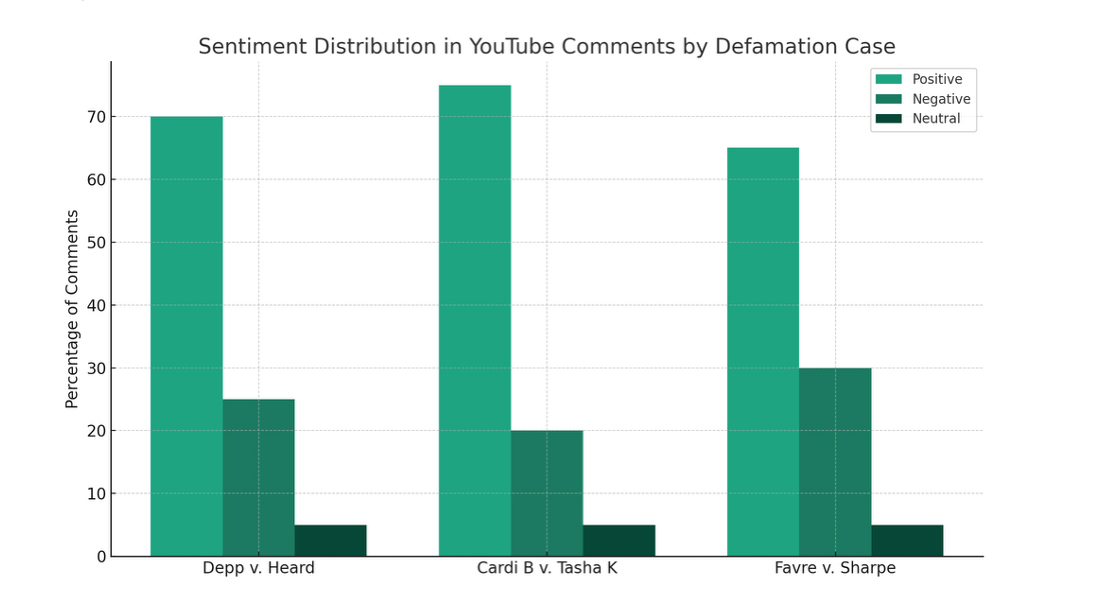
Figure 2
Emotional Testimony, Credibility, and Moral Framing Shape Audience Reactions
Emotional testimony, perceived authenticity, and viral moments were central to shifts in public opinion for Depp v. Heard. Support for Depp was built on his perceived honesty and vulnerability. Comments like, “I am a woman who has been abused by an alcoholic partner. I believe you Johnny, I hope you will get justice,” show how viewers related their personal experiences to Depp’s narrative. In contrast, Amber Heard’s perceived lack of sincerity and her courtroom demeanor were repeatedly cited as reasons for doubt. One commenter wrote, “Today AH showed her true colors… This is not an abused woman. This is a self-centered woman who will destroy anything to get to the top.”
The turning point for many was the exposure of inconsistencies in Heard’s statements and the legal rebuttals from Depp’s team. Statements such as “Camille proved Amber Heard’s perjury… it also can get her in jail and I hope that will happen” reveal how cross-examination impacted public belief. These factors collectively shifted public opinion toward Depp.
In Cardi B v. Tasha K, the main drivers of opinion were ethical considerations and factual clarity. Tasha K’s own admissions were shocking to viewers: “I am very shocked that this woman admitted to the things she testified. I’m not a Cardi B fan, but that doesn’t mean she deserved this.” These testimonies painted Tasha as unapologetic and unethical, leading to strong condemnation.
The aftermath of the trial reinforced those views. One commenter stated, “The lesson here is your words have consequences… you can’t just maliciously muddy someone’s name because you don’t like them.” Cardi B’s stance was seen as protective of not just herself but others who could be harmed by defamation, contributing to her support.
Unlike the previous cases, Favre v. Sharpe saw no notable opinion shifts. The primary factor influencing opinion was the surrounding scandal of welfare fraud. Many felt Sharpe’s commentary was justified, with one user writing, “Shannon should’ve made Brett Favre pay the lawyers’ fees and court costs.” The public viewed Favre as the defamer of his own reputation: “Favre defamed himself stealing from the poor.”
This consistency indicates that when legal disputes are embedded in broader criminal or moral issues, public sentiment is less susceptible to change. The defamation suit was perceived as an attempt to silence critics rather than seek justice, leading to a lack of public sympathy for Favre.
Emotional authenticity propelled audience alignment in Depp v. Heard, while ethical responsibility anchored perceptions in Cardi B v. Tasha K. In Favre v. Sharpe, a broader socio-ethical context overshadowed legal arguments. Together, these cases demonstrate that both visceral personal narratives and clear moral boundaries serve as powerful determinants of online judgment, reinforcing or precluding shifts in public opinion.
YouTube Comment Sections Reinforce Public Verdicts and Drive Narrative Consensus
Comment sections for Depp v. Heard were characterized by emotional investment, personal stories, and community validation. Users often referenced their own experiences with abuse, using the platform as a space for shared trauma and support. A popular comment noted, “The look on her face as the verdict was being read is, sadly, the most authentically upset face she had during the trial… she is such a narcissist she can’t stop saying it.” These emotionally charged comments reveal how deeply viewers engaged with the narrative.
There was also a high volume of interactions, with thousands of likes on top comments, indicating collective agreement and the viral nature of sentiment. The comments evolved from uncertainty to unity, creating a dominant narrative favoring Depp.
In contrast, the Cardi B case inspired comments focused on ethics, justice, and social media accountability. Many expressed concern about the broader implications for online content: “This is going to change the YouTube atmosphere for the better!” and “More celebrities need to take action like her, it’ll stop the BS publicity and lies.” The comment section functioned less as an emotional outlet and more as a platform for reflecting on digital responsibility.
Patterns also included support for Cardi B despite ambivalence about her music or persona, showing how the defamation issue transcended fandom. This illustrates how YouTube comments can act as nuanced forums for ethical judgment, beyond just celebrity allegiance.
The comments in Favre v. Sharpe were marked by sarcasm, humor, and strong moral condemnation. One highly liked comment joked, “Shannon Sharpe the first NFL player to beat the same person in both the Superbowl and a Civil lawsuit.” Humor served as a tool for expressing both solidarity with Sharpe and criticism of Favre.
There was little emotional engagement compared to the other trials. Instead, comments were blunt and accusatory: “Brett ain’t jack for stealing money for poor people.” The lack of complexity in the comment patterns suggests that some cases, especially those with clearer ethical implications, generate more uniform public sentiment.
Each trial elicited a unique commentary style aligned with its emotional and ethical dimensions. Depp v. Heard fostered communal empathy, Cardi B v. Tasha K spurred principled debate about digital accountability, and Favre v. Sharpe promoted declarative moral condemnation. These patterns underscore how YouTube’s comment sections adapt to the tone and substance of discourse surrounding each case, shaping and being shaped by platform norms and audience expectations.
These findings illustrate that YouTube comment sections are dynamic arenas where public sentiment is negotiated through personal testimony, moral evaluation, and platform-specific discourse styles. The interaction of emotional authenticity, ethical responsibility, and narrative context ultimately determines how audiences interpret and engage with celebrity defamation trials.
V. Discussion
The findings of this research illuminate how YouTube comment sections function as digital spaces for public opinion formation during celebrity defamation lawsuits. Through the lens of framing theory, which posits that the way media content is structured significantly influences audience interpretation (Entman, 1993), we can better understand how commenters construct, negotiate, and reinforce dominant narratives about celebrity behavior, justice, and ethics.
A key takeaway from the analysis is the power of testimony and emotional performance in shifting or cementing public sentiment. In the Depp v. Heard trial, commenters were emotionally invested in Depp’s narrative of victimhood, which was perceived as sincere and vulnerable. This aligns with research by Papacharissi (2015), who suggests that emotional expression on social media enables users to form “affective publics” that coalesce around shared narratives and values. In contrast, Amber Heard’s perceived lack of authenticity fractures public trust, revealing how courtroom demeanor, when filtered through the lens of social media, can be more impactful than legal evidence for many observers.
Meanwhile, in Cardi B v. Tasha K, emotional narratives were less central than ethical frameworks. Commenters were not necessarily motivated by personal identification with Cardi B but by a broader desire to see accountability in digital spaces. Tasha K’s perceived refusal to take responsibility for her defamatory content triggered a near-unanimous condemnation that transcended fandom. This pattern demonstrates how framing extends beyond traditional media and becomes rearticulated by audiences themselves, especially when the issue, like misinformation or social media ethics, is culturally resonant.
The Favre v. Sharpe case adds another dimension. Unlike the other two, it involved no significant emotional attachment to either party. Public judgment had largely been formed prior to the defamation suit due to the preexisting welfare scandal. Framing theory helps explain this: Favre had already been publicly framed by mainstream outlets as a morally compromised figure, so his attempt to reclaim narrative control through litigation was largely dismissed. Here, YouTube comments served not as spaces of evolving opinion but as arenas of moral confirmation and ridicule. This reveals that not all defamation suits garner equal attention or emotional weight. Prior reputational framing and media coverage deeply shape how such cases unfold in public forums.
Interestingly, the nature of platform-specific discourse emerges as a relevant but unexplored factor. YouTube, with its upvote system and video-driven context, may encourage performative or community-validated expressions more than platforms like Twitter (X) or Reddit. Highly liked comments often set the tone for how future viewers engage with the case, reinforcing dominant framings and discouraging dissenting opinions. This is consistent with research by Highfield & Leaver (2016), who noted that social media platforms act as curators of collective memory, privileging certain narratives through algorithmic and communal processes.
An unexpected finding is how YouTube commenters balance skepticism with support. In both the Depp and Cardi B cases, several commenters admitted to not being fans of the celebrities yet still defended them based on perceived injustice. This suggests that public discourse around defamation is not strictly tribal or celebrity-driven but can reflect deeper principles of fairness, truth, and accountability. It challenges assumptions that digital publics are solely polarized or reactive and reveals the capacity for moral reasoning even in informal online spaces.
Finally, the role of humor in moral judgment, particularly in the Favre case, opens new avenues for future research. Sarcasm and jokes served as tools of condemnation and community bonding, pointing to the complex ways people use levity to express outrage and solidarity simultaneously. This underscores how affective and moral framings often intersect in unexpected ways within online discourse.
Together, these insights show that framing theory, when applied to user-generated commentary, reveals dynamic processes of sense-making, resistance, and moral negotiation, As defamation cases become more publicly visible due to digital media, YouTube and similar platforms will continue to play a powerful role in shaping how justice is perceived by the public.
While the findings offer meaningful insights into public sentiment and discourse patterns, this study has several limitations. First, it relies solely on YouTube comment sections, which may not represent the broader public or the full spectrum of social media users. Commenters are a self-selecting group often more emotionally invested or motivated to express strong opinions, potentially skewing the data toward more extreme or polarized views. Additionally, the algorithmic nature of YouTube’s platform prioritizes popular comments, which can create an echo chamber effect, reinforcing dominant narratives while silencing dissenting voices. Finally, while sentiment and engagement were examined qualitatively, the study did not incorporate large-scale computational text analysis or sentiment scoring, which could have offered more statistical generalizability and trend validation.
VI. Conclusion
This research examined how YouTube comment sections reflect and influence public perception during celebrity defamation trials, using Depp v. Heard, Cardi B v. Tasha K, and Favre v. Sharpe as case studies. Through qualitative analysis grounded in framing theory, the study revealed that public opinion evolves not only based on legal outcomes but also through emotional storytelling, perceived authenticity, ethical frameworks, and broader cultural narratives.
The Depp v. Heard trial demonstrated how testimony and emotional resonance can dramatically reshape public sentiment, while the Cardi B v. Tasha K case highlighted the public’s emphasis on accountability and ethical responsibility in digital spaces. The Favre v. Sharpe lawsuit revealed how pre-existing public narratives and scandals can override the legal specifics of a case, leading to consistent public condemnation regardless of courtroom developments. Across all three cases, YouTube functioned as more than a platform for commentary; it became a space for moral judgment, emotional catharsis, and collective storytelling.
Future research could expand this analysis by comparing commentary across multiple platforms or examining how race, gender, and socioeconomic status influence the public framing of defamation cases. Additionally, a deeper exploration of how algorithmic amplification influences which comment narratives gain traction would be valuable. As digital spaces continue to shape public consciousness, understanding these processes will be essential for scholars, media professionals, and legal advocates alike.
Acknowledgements
I want to thank Dr. Daniel Haygood for all his guidance and support throughout the development of this research. His support and expertise greatly strengthened my work. I’m also grateful for my Great Ideas classmates for their thoughtful feedback and encouragement along the way. And of course, a big thank you to my friends and family for always cheering me on.
References
Bode, L., & Vraga, E. (2021). Value for correction: Documenting perceptions about peer correction of misinformation on social media in the context of COVID-19. Journal of Quantitative Description: Digital Media, 1. https://doi.org/10.51685/jqd.2021.016
Braun, V., & Clarke, V. (2006). Using thematic analysis in psychology. Qualitative Research in Psychology, 3(2), 77-101. https://doi.org/10.1191/1478088706qp063oa
CBS News. (2022, June 1). Judge reads verdict in Johnny Depp-Amber Heard defamation trial [Video]. YouTube. https://www.youtube.com/watch?v=pGN2-MfKg9c
Chong, D., & Druckman, J. N. (2010). Dynamic public opinion: Communication effects over time. The American Political Science Review, 104(4), 663–680. http://www.jstor.org/stable/40982891
Einwiller, S. A., & Kamins, M. A. (2008). Rumor has it: The moderating effect of identification on rumor impact and the effectiveness of rumor refutation. Journal of Applied Social Psychology, 38(9), 2248-2272. https://doi.org/10.1111/j.1559-1816.2008.00390.x
Entertainment Tonight. (2022, May 16). Johnny Depp v. Amber Heard full testimony & cross examination day 16 [Video]. YouTube. https://www.youtube.com/watch?v=4NclFGav65E
Entertainment Tonight. (2022, May 25). Johnny Depp v. Amber Heard Trial: Johnny Depp full testimony Day 22 [Video]. YouTube. https://www.youtube.com/watch?v=S-NNXrU8nNo
Entman, R.M. (1993), Framing: Toward clarification of a fractured paradigm. Journal of Communication, 43, 51-58. https://doi.org/10.1111/j.1460-2466.1993.tb01304.x
Goffman, E. (1974). Frame analysis: An essay on the organization of experience. Harvard University Press. https://doi.org/10.2307/2106908
Highfield, T., & Leaver, T. (2016). Instagrammatics and digital methods: Studying visual social media, from selfies and GIFs to memes and emoji. Communication Research and Practice, 2(1), 47–62. https://doi.org/10.1080/22041451.2016.1155332
Jankowicz, A. D. (2005). Business Research Projects (4th ed.). London: Thomson Learning.
Koswatta, T.; Wingenbach, G.; and Leggette, H. (2022). Factors influencing public perception of science. Journal of Applied Communications, 106(4). https://doi.org/10.4148/1051-0834.2442
Martin, R. (2023, November 1). Judge tosses “sleazeball” Brett Favre defamation suit against Shannon Sharpe | Roland Martin [Video]. YouTube. https://www.youtube.com/watch?v=9gG0iuGBiMU
McNealy, J. E. (2023). All the rumors are true: Verification, actual malice, and celebrity gossip. Missouri Law Review, 88(3), 751–767.
Nelson, C. (2024). “A public orgy of misogyny”: Fender, power, media, and legal spectacle in Depp v. Heard. Feminist Media Studies, 25(2), 233–249. https://doi.org/10.1080/14680777.2024.2304225
Nightcap. (2024, September 20). Shannon Sharpe reacts to defeating Brett Favre’s defamation lawsuit [Video]. YouTube. https://www.youtube.com/watch?v=N6jwwk3jKn4
Papacharissi, Z. (2015). Affective publics and structures of storytelling: Sentiment, events and mediality. Information, Communication & Society, 19(3), 307–324. https://doi.org/10.1080/1369118X.2015.1109697
Penney & Associates (2022, June 16). A defamation case to remember: Statistics from the record-breaking Depp v. Heard trial. https://www.penneylawyers.com/news/a-defamation-case-to-remember-statistics-from-the-record-breaking-depp-v-heard-trial/
Rich, T. S. (2024). South Korean perceptions of misinformation on social media: The limits of a consensus? Journal of Asian and African Studies, 59(5), 1446-1462. https://doi.org/10.1177/00219096221137662
Sanders, A. K. (2010). Defining defamation: Community in the age of the internet. Communication Law and Policy, 15(3), 231–264. https://doi.org/10.1080/10811680.2010.489845
The Brooke Ashley. (2022, January 17). Shocking transcript!! Tasha K’s full testimony…No remorse! [Video]. YouTube. https://www.youtube.com/watch?v=hxsEx-p4Z4Q
The Real Daytime. (2022, January 26). Cardi B Wins Almost $4 Million in Libel Case Against Blogger Tasha K [Video]. YouTube. https://www.youtube.com/watch?v=h4XdX34_-zw