

Immersive audio room supports research and learning
Elon College, the College of Arts and Sciences
When Elon University’s Department of Music set out to design a space that could fully showcase the rapidly growing world of immersive audio, they had one goal in mind: to create a room where sound could be truly experienced.
Now, that vision has become a reality.
A new immersive audio room in Arts West is providing students and faculty with a high-quality environment for both teaching and experimentation, particularly in Dolby Atmos, the industry-standard format for three-dimensional volumetric audio. That environment is now reshaping everything from cinematic sound to commercial music releases.
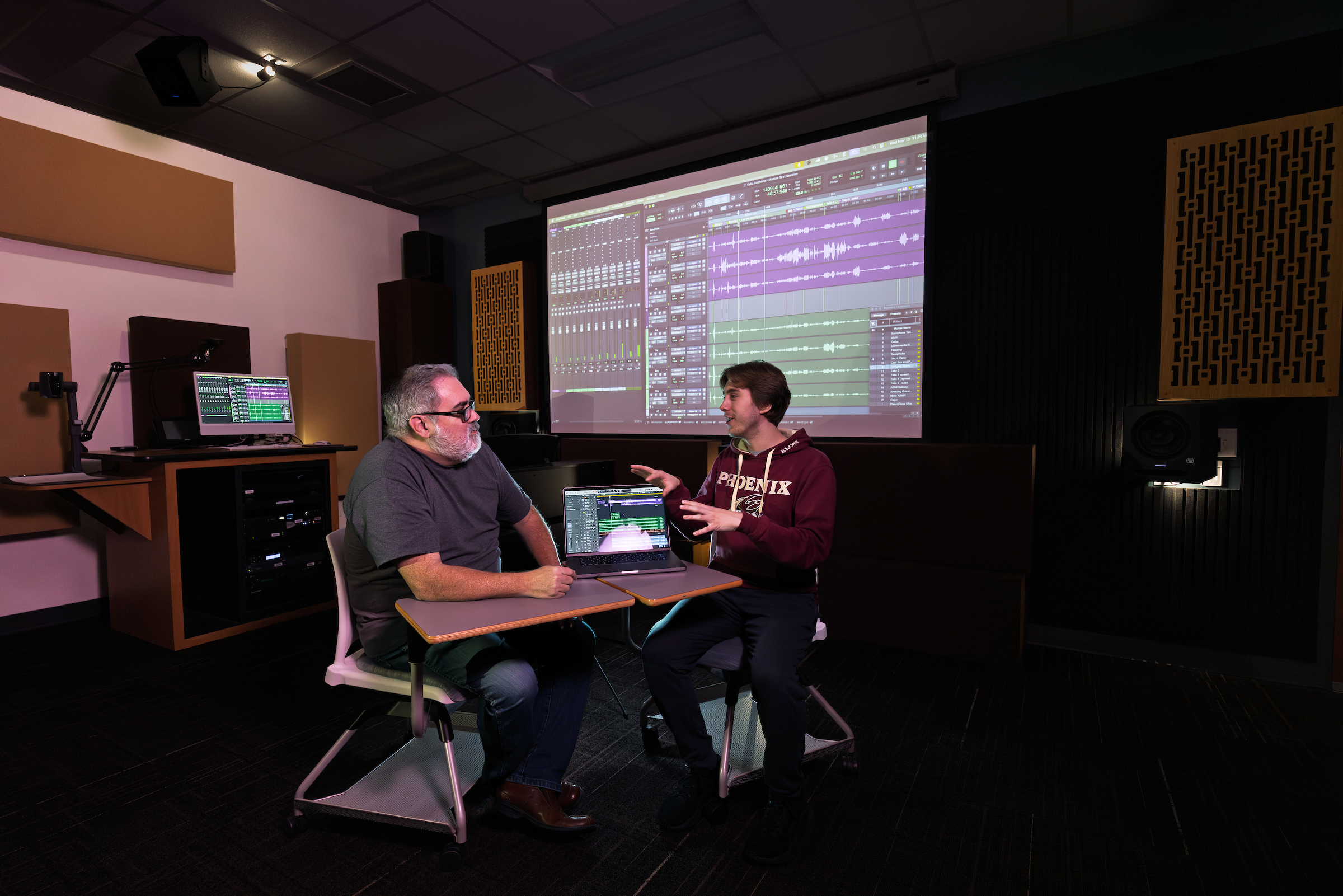
Anthony Hotakainen ’26 with Associate Professor Todd Coleman
“The music department had no dedicated listening environment that was like a classroom-sized space of high quality,” said Associate Professor Todd Coleman in the Department of Music. “We have the built-in generic AV stereo speaker set up in our classrooms and computer lab, but those rooms cannot play back audio beyond two-channel stereo recordings, and the rooms are not acoustically treated for detailed and nuanced listening, whether in stereo or surround formats.”
Originally envisioned more than a decade ago as a small theater-style room with tiered seating, the idea was shelved due to cost. When Elon added Studio D, its Dolby Atmos mixing studio, another challenge emerged: the studio only seats four people comfortably and was designed only for mixing and mastering, not large group listening sessions.
Coleman proposed converting an existing classroom into a dedicated immersive audio space capable of seating 20 listeners, a project brought to life in 2025 with guidance from an acoustics consultant who helped design the layout, sound treatment and speaker placement.
“While there were certainly some limitations due to both budget and facility constraints, through the renovation project we were able to add effective acoustic treatments, mount the 12 speakers throughout the room required for immersive audio playback, and enhance the aesthetic look and feel of the room,” Coleman said.
The finished space features a 7.1.4 Atmos setup, including seven ear-level speakers, four height speakers and a subwoofer, creating what Coleman described as a “true three-dimensional space” for audio playback.
“You can make it sound like it’s behind you to the right, behind you to the left, anywhere up or down,” he said. ”It is not just sound that surrounds, it is sound that you inhabit – sound that moves around you, above you, through you, even in you.”
While there were certainly some limitations due to both budget and facility constraints, through the renovation project we were able to add effective acoustic treatments, mount the 12 speakers throughout the room required for immersive audio playback, and enhance the aesthetic look and feel of the room.
Beyond research, the room has quickly become a valuable teaching tool. Coleman now uses it for orchestration courses, and other music faculty are using it for senior seminars and songwriting project listening sessions. There is also a new mixing class and immersive audio class that are part of the revised music production and recording arts major that will make extensive use of the new resource.
A recent graduate of Elon University, who studied music production and recording arts, used the new immersive audio room in the creation, testing, and performance of his Elon College Fellows project. The study results may be published or presented at an upcoming conference of the Audio Engineering Society.
The Department of Music also hopes the room will support expanded collaboration with the School of Communications, from screening student films to exploring immersive broadcast audio for athletics.
“It’s been great to be able to play examples and just hear them clearly,” Coleman said. “This room will be the best screening room we have on campus, both audio and video.”
KEY TAKEAWAYS
- Design innovation spaces around student use.
Elon’s immersive audio room succeeded because it was built as a collaborative teaching and research environment rather than simply a technical showcase. Institutions should prioritize flexible, classroom-scale spaces where students can actively experiment with emerging technologies. - Connect new technology investments directly to curriculum and research.
The room immediately became part of coursework, senior projects and undergraduate research. Maximize a return on innovation investments by ensuring new facilities are tied to hands-on academic programs and faculty collaboration. - Look for interdisciplinary applications when planning specialized resources.
Though spearheaded by the Department of Music, the immersive audio room is already creating opportunities with film, athletics and media production. Institutions should design innovation initiatives with cross-campus collaboration in mind to expand impact and increase long-term value.