

Mapping a flight plan for Elon’s drone courses
School of Communications
As drone technology expands across industries, Elon University is bringing the conversation into the classroom.
New courses developed by Randy Piland, an associate teaching professor in the School of Communucations, introduce students to the technical technical, ethical and societal questions surrounding drones while giving them opportunities to explore real-world applications, build drone kits and gain flight time at the controls.
These efforts grew out of Piland’s work connecting the Elon campus with the broader drone community. When he initially launched Elon Drone Day, a community educational offering back in 2021, the goal was simple: create a space where drone enthusiasts, vendors and curious community members could learn about the rapidly evolving technology. With support from a grant from the Elon Innovation Council, the event quickly built a following and attracted industry partners, public safety professionals and educators.
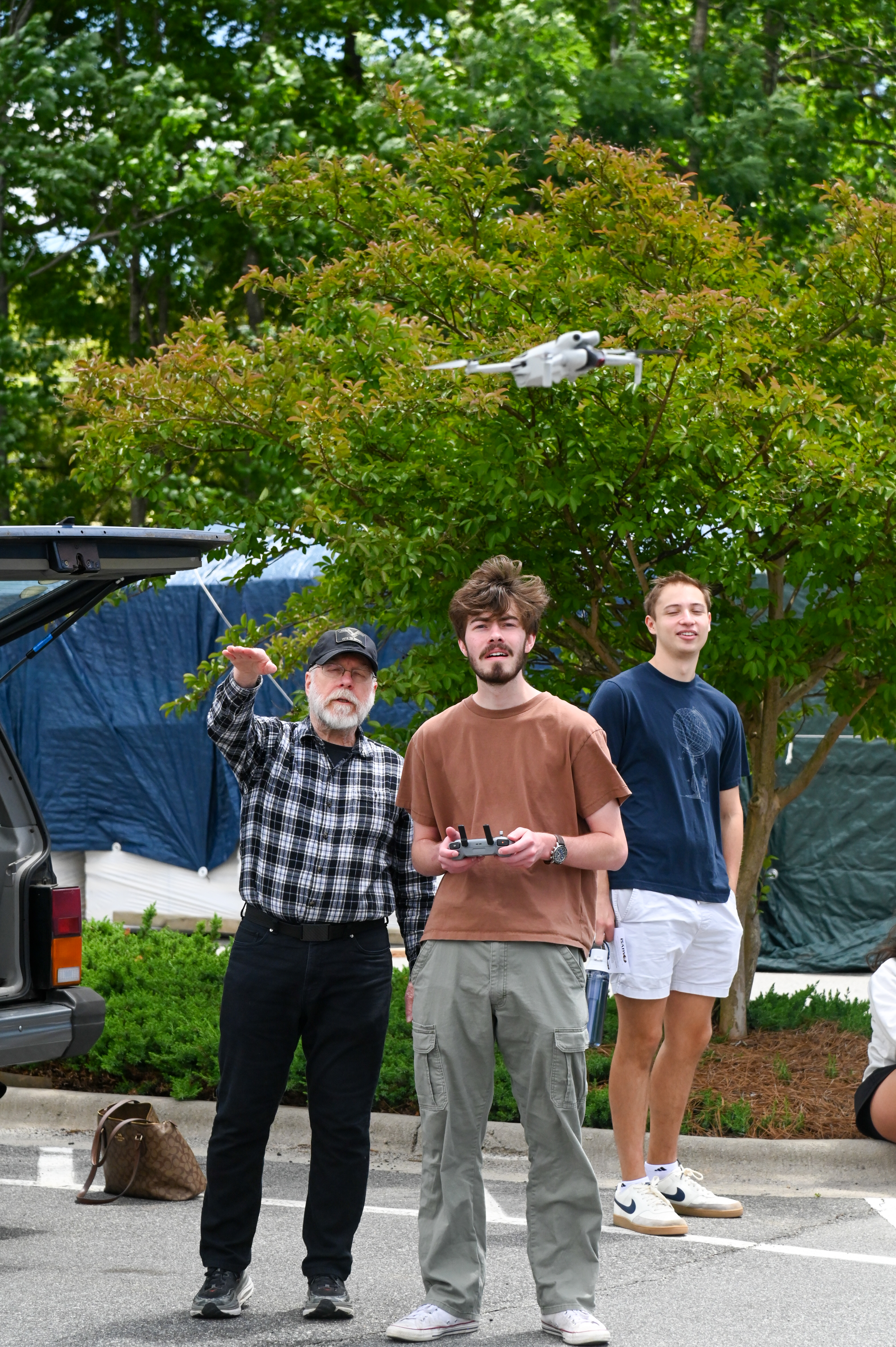
Randy Piland (left) led Elon University’s springtime “Drones 101” course.
Over time, those connections sparked a new idea — integrating drone education into Elon’s curriculum.
“Drone Day started as a way to help people understand what was happening in the industry,” Piland said. “But once you start hosting events and connecting with people in the field, you realize there’s an opportunity to bring that knowledge back to students.”
That realization led to the development of two new courses over the past year. “Drones in Society: Balancing Innovation and Accountability ” was offered first as a capstone experience in the Elon Core Curriculum and explores the ever-growing world of unmanned aerial systems from multiple angles, including history, technology, ethics and hands-on flight.
This spring, Piland launched “Drones 101: Takeoff to Career Paths,” a course designed to help communications students understand how drones operate and how the technology is shaping fields ranging from media and environmental research to emergency response.
Across both courses, students also learn about the regulatory framework governing drone operations, including the Federal Aviation Administration’s Part 107 Remote Pilot certification.
“The hands-on element really changed the energy of the class,” he said of his Drones in Society section. “Students weren’t just hearing about the technology. They were building things, flying and thinking about how drones are actually used.”
Students weren’t just hearing about the technology. They were building things, flying and thinking about how drones are actually used.
Industry relationships also played an important role in shaping the curriculum. Piland regularly attends national drone conferences such as AUVSI XPONENTIAL, where he studies emerging trends and connects with professionals using drones in fields such as agriculture, infrastructure inspection and public safety.
Those relationships helped Elon bring guest speakers into the classroom and connect instruction with a broad professional network.
At the same time, campus partnerships helped make the technical components possible. For example, flight simulation software used in Piland’s coursework was supported by Information Technology because it could also benefit other campus units, including Facilities Management and Campus Safety and Police.
Piland believes that mix of experimentation, internal partnerships and industry awareness has been key to his courses’ early success. “When you build something like this, it can’t live in just one department,” he said. “You have to look for connections — across campus and outside the university.”
As interest in drone technology continues to grow across industries, Piland hopes Elon’s approach can serve as a model for other universities exploring similar programs. “Students are excited about technologies that are emerging right now,” he said. “If you can give them a chance to explore those tools responsibly and creatively, they’ll run with it — or more appropriately, take flight.”
KEY TAKEAWAYS
- Treat drone education as interdisciplinary.
Drone technology touches many fields — communications, engineering, computer science, environmental science and public safety. Programs are stronger when courses and events involve multiple departments and perspectives. - Combine technical skills with real-world context.
Courses should balance flight training and hands-on experimentation with discussions about ethics, regulation and societal impact. This helps students understand how drones work, and why they matter. - Build programs through events and partnerships.
Community events like Elon Drone Day created industry relationships that later supported course development. Conferences, vendors and professional organizations can help educators stay current and bring practical insights into the classroom.