


The Elon graduate has been recognized nationally for her deeply reported multimedia feature, “The Autistic Experience at Elon University,” which centers the voices of autistic and neurodiverse students.
Betsy Schlehuber ’25 wasn’t chasing awards when she began reporting “The Autistic Experience at Elon University.” She was trying to fill a gap – to tell a story she felt was missing, one that reflected what it actually feels like to navigate college as an autistic student, in all its challenges, nuance and possibility.
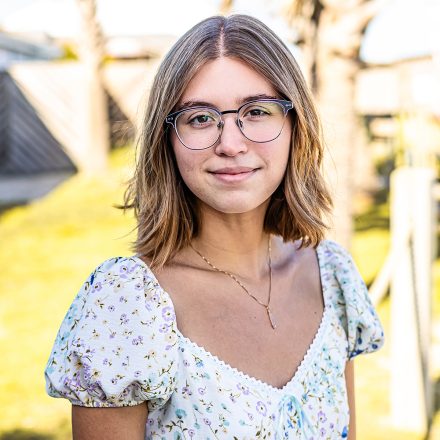
Drawing from her own experience and the voices of other neurodiverse students, Schlehuber authored a deeply reported, multimedia feature that explores where students thrive, where they need more support, and how campuses can better serve them. As she put it, “Being diagnosed autistic myself, I really just wanted to write the story I’ve always wanted to read.”
That story has now earned national recognition for a second time. The recent Elon University graduate, who majored in journalism and minored in creative writing, captured second place in the Feature Writing Competition of the 2025–2026 Hearst Journalism Awards Program, selected from a record 162 entries from 87 schools. Her runner-up finish includes a $2,000 award and places her among the top student feature writers in the country.
Schlehuber’s piece stood out for its depth, empathy and multimedia approach, combining reporting, photography, video and design to tell a layered story about autistic and neurodiverse students at Elon.
“I always wanted to tackle an in-depth, multimedia piece about how autistic people navigate college life,” Schlehuber said. “Autism is a disability frequently associated with childhood, but I wanted to show how dynamic autism can be, especially in young adulthood.”
Her reporting centers on students who shared their experiences honestly – from finding community and confidence to navigating accommodations, social spaces and academic expectations. The story is also supported by insights from disability experts and includes ideas for how universities can better support autistic students.
Schlehuber’s work on the project grew out of both personal and academic interests. She first explored the topic through a research article published in the Elon Journal before developing the full multimedia feature. That early work shaped not just what she reported, but how she approached the story. Schlehuber said it was important for the final piece to reflect how varied the autistic experience can be.
“The biggest challenge I faced while writing and reporting was working toward interviewing a diverse range of people,” Schlehuber said. “My three student subjects not only had autism, but they had other disabilities and chronic illnesses as well, so I wanted to make sure that was represented in my article.”
Finding expert voices also took persistence, as there are relatively few specialists focused specifically on autism in higher education, which limited the pool of available sources.
While autism has been part of her life since childhood, Schlehuber said the reporting process still revealed new layers of complexity. “Since I grew up with autism, I didn’t learn anything new about the disability itself that surprised me,” she said. “But it was surprising that autism is often coupled with other disabilities and mental illnesses.”
She added that this reality makes accommodations more complicated – and more important.
Above all, Schlehuber said she wants her story to shift how people think about neurodiversity in higher education. She wants readers to understand that autism accommodations should not stop after K–12 education and that colleges must not only accommodate neurodiverse students, but represent them in daily campus life. “More students are neurodiverse than you think,” she said.
Additionally, she wanted to push back on the assumption that college is always harder for autistic students.
“For a lot of autistic students, college is not always as hard on us as people think it is,” she said. “The students I spoke with had supportive – often neurodiverse – friend groups and enjoyed the flexibility and niche opportunities that come with college.”
In addition to the Hearst second-place finish, “The Autistic Experience at Elon University” won third place in the Multimedia Feature Story category from the Associated Collegiate Press in October. For Schlehuber, the continued recognition is both surprising and deeply meaningful.
“Winning second place was shocking,” she said of her Hearst recognition. “Every time I win an award for my journalism, I am blown away with how much people care about what I have to say.”
She is especially excited that her reporting on autism is reaching a wider audience.
“I am so excited for my reporting on autism to get eyes on it, especially through a massive media company like Hearst,” she said. “I hope this will open more doors for me in my career, as I plan to write for the rest of my life in any way I can.”
The Hearst Journalism Awards Program, now in its 66th year, includes competitions across writing, photo, audio, television, podcast and multimedia categories, offering up to $700,000 in scholarships, matching grants and stipends. More than 100 accredited journalism programs participate each year, making it one of the most prestigious student journalism competitions in the country.