


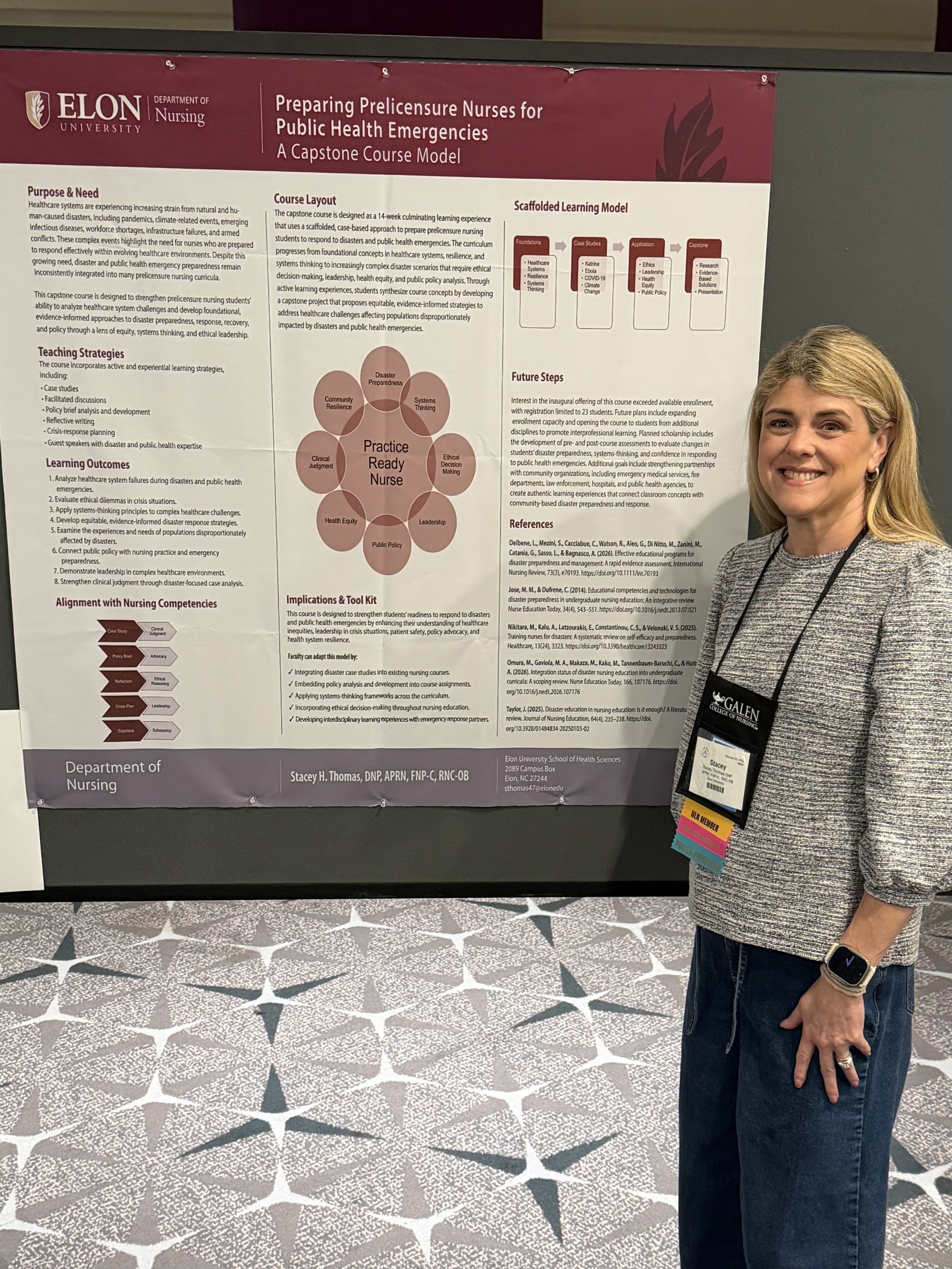
At the NLN Education Summit, Assistant Professor of Nursing Stacey Thomas shared the course's instructional framework and innovative teaching strategies with nursing educators from across the country.
Stacey Thomas, assistant professor of nursing, presented her innovative approach to disaster and public health emergency education at the 2026 National League for Nursing (NLN) Education Summit.
Her poster presentation, “Preparing Prelicensure Nurses for Public Health Emergencies: A Capstone Course Model,” highlighted Health Systems Under Pressure, an Elon Core Curriculum capstone course designed to help students examine the challenges healthcare systems face during natural and human-caused disasters.
The 14-week course uses a scaffolded, case-based approach to explore historical and contemporary healthcare crises, including Hurricane Katrina, the Ebola outbreak in West Africa and the COVID-19 pandemic. Through interactive discussions, policy analysis, reflective writing, and crisis-response planning, students examine how disasters expose vulnerabilities in healthcare infrastructure, influence public policy, and disproportionately affect certain populations. The course culminates in a research project in which students propose equitable, evidence-informed solutions to healthcare challenges.
A distinguishing feature of Health Systems Under Pressure is its interdisciplinary approach, encouraging students to examine healthcare crises through the perspectives of ethics, leadership, systems thinking, health equity, and public policy. Rather than focusing solely on emergency response, the course challenges students to consider the broader factors influencing healthcare delivery and community resilience. The inaugural offering enrolled 23 students, demonstrating interest in examining complex healthcare challenges through multiple academic perspectives.
At the NLN Education Summit, Thomas shared the course’s instructional framework and innovative teaching strategies with nursing educators from across the country. Her presentation emphasized the importance of integrating disaster preparedness and public health emergency education into undergraduate curricula to strengthen critical thinking, ethical decision-making, leadership and advocacy. The course offers a model that educators can adapt to nursing, public health, leadership, and interdisciplinary educational experiences.
Looking ahead, Thomas hopes to expand course enrollment, increase participation across academic disciplines, and strengthen partnerships with community organizations, including emergency services, hospitals, and public health agencies. Future initiatives also include evaluating students’ perceptions of disaster preparedness before and after completing the course. Through this work, Thomas hopes to contribute to the development of future healthcare professionals and community leaders who are better equipped to navigate crises, advocate for equitable solutions, and strengthen healthcare system resilience.