


The professor of visual communication collaborated with scholars across the globe on a new publication that grew out of his research as a Center for Engaged Learning Scholar.
What began as a research project through Elon University’s Center for Engaged Learning has evolved into an international scholarly collaboration and a new book examining how immersive learning experiences can transform higher education.

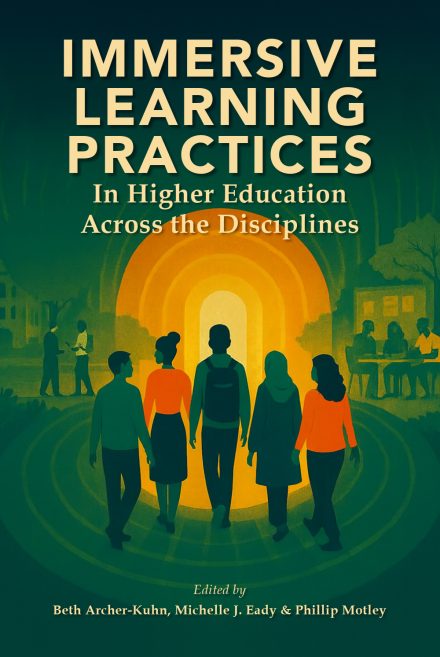
Phillip Motley, professor of visual communication, is a co-editor of “Immersive Learning Practices in Higher Education Across the Disciplines,” published by Cambridge Scholars Publishing. The book explores the principles and practices of immersive learning, offering educators a framework for creating meaningful educational experiences that extend beyond traditional classroom instruction.
The publication traces its origins to Motley’s time as one of Elon’s Center for Engaged Learning Scholars, when he focused his research on immersive learning and its role in higher education.
That work eventually led to a collaboration with six other researchers from the United States, Canada and Australia, who sought to establish a shared definition of immersive learning and identify the essential components of these educational experiences.
“My interest in immersive learning practices originated with my experiences teaching a Winter Term course in the Interactive Media graduate program at Elon,” Motley said. “The course required students to travel internationally and partner with a community organization to create a digital media project. It paired the intercultural learning component of study abroad with the community-engaged aspects of community-based learning, creating a deeply impactful learning experience for students.”
In 2024, Motley’s international research team published “Defining Immersive Learning” in the peer-reviewed journal Teaching and Learning Inquiry. The article received the journal’s Nancy Chick Article of the Year Award, recognizing the significance of the team’s contribution to the scholarship of teaching and learning.
Building on that research, Motley partnered with Beth Archer-Kuhn of the University of Calgary in Canada and Michelle J. Eady of the University of Wollongong in Australia to co-edit the new collection.
The book examines immersive learning as a collection of high-impact educational practices that challenge conventional approaches to teaching and learning. Such experiences can include study away programs, service-learning, internships, clinical practicums and work-integrated learning, all of which connect academic study with meaningful experiences beyond the classroom.
Organized into four sections, the publication begins with a foundational overview of immersive learning before examining its six defining components and their applications in higher education. Seven case studies drawn from different disciplines and international contexts illustrate how these practices take shape in educational settings.
The final section looks ahead, offering critical perspectives and forward-thinking ideas about the future of immersive learning in colleges and universities.
The collection is intended for faculty members, curriculum developers, graduate students preparing for teaching careers and others interested in the future of higher education.