


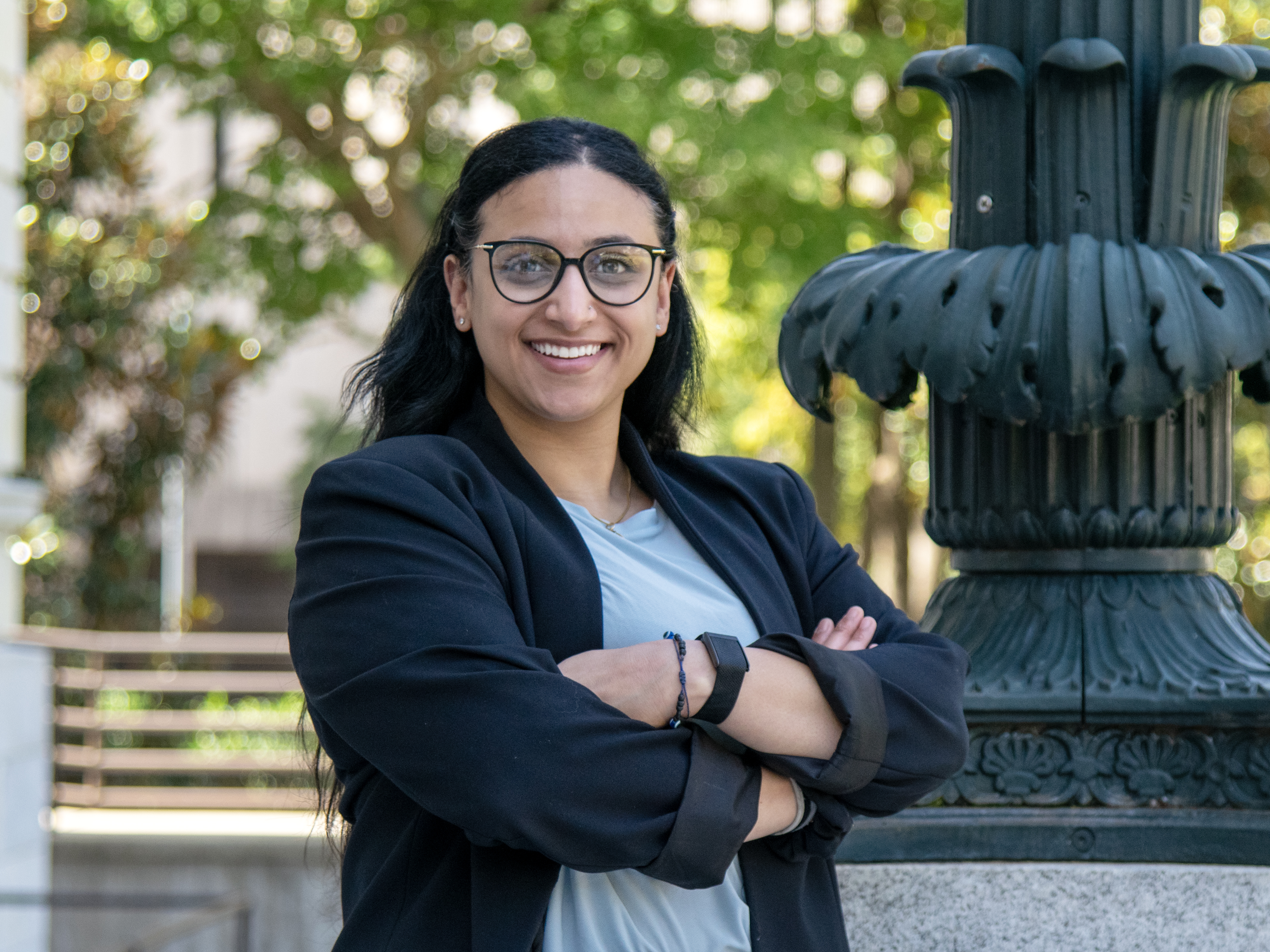
Through prosecution, defense and hands-on trial experience, Mayar Elgeyoshi L’26 is learning what it means to pursue justice without losing sight of humanity.
“It’s petrifying. It’s terrifying. I would do it again, and again and again.”
As Mayar Elgeyoshi L’26 describes trying her first criminal cases, her eyes lock in — intense, focused and flashing with amusement at the contradiction in her words.
She’s serious, but she’s having fun.
Last summer, she prosecuted two cases in a Randolph County courtroom under a student practice certificate. The first involved a driver accused of traveling nearly 30 mph over the speed limit. The second was an assault case.
“In the beginning, you’re completely stiff,” she said. “Then after a while, you start to get comfortable. You realize, ‘Oh, hey. I can do this.’”
She found herself thinking “a step — or five — ahead.” The state won both cases.
“Haven’t lost a case yet,” she said wryly.
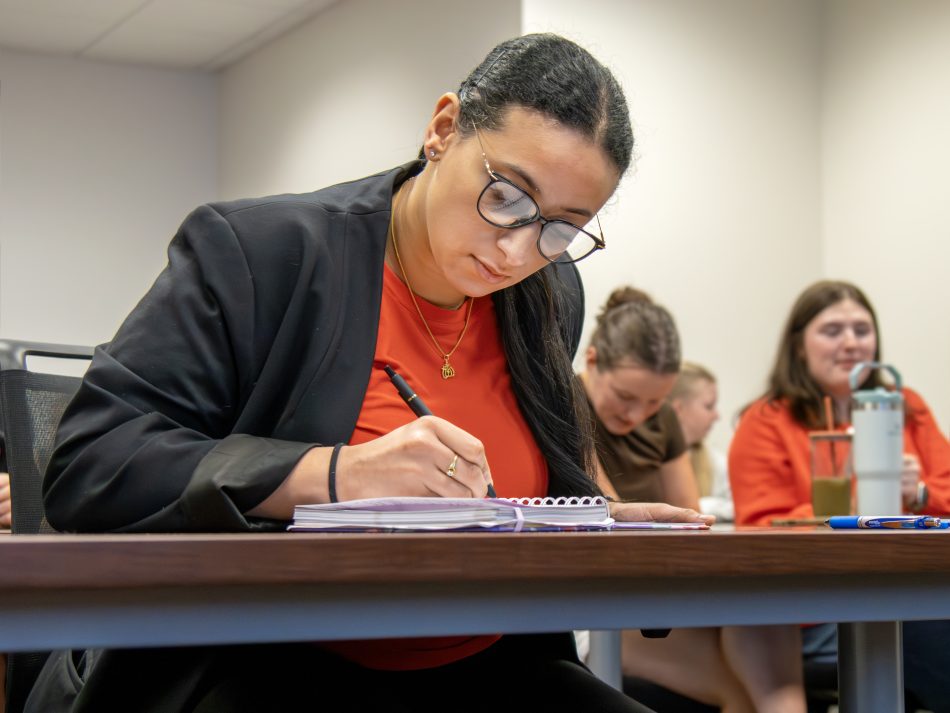
The experience confirmed what years of studying and working alongside prosecutors and public defenders made clear: She belongs in a courtroom.
“It’s just a rush that can’t be recreated.”
That rush draws Elgeyoshi to the courtroom. What first led her toward the law — an innate desire to first understand people, and then to help them — has much deeper roots.
Born in Alexandria, Egypt, Elgeyoshi came to the United States with her family at 5 years old. She grew up in Asheboro, North Carolina, the oldest of three children, watching her parents build a new life from scratch. Her mother had earned an accounting degree in Egypt. Her father’s relentless work ethic eventually led him to found Omar’s Italian Restaurant in nearby Biscoe, where Elgeyoshi has worked alongside him.
The restaurant bears her younger brother’s name. “I’m clearly not the favorite child,” she quipped.
Behind the humor is abiding respect for what her parents risked.
“It’s not easy to leave the home that you’ve owned, the only home that you’ve ever known, for a chance,” Elgeyoshi said. “It’s not even guaranteed. It’s just a chance.”
“She is incredibly good at seeing different sides of people and understanding different walks of life.”
— Barron Thompson L’09, Elon Law Advisory Board member
Their determination imbued a kind of obligation: “I want to provide for my family in the way that they’ve sacrificed everything for us.”
At UNC Greensboro, Elgeyoshi studied political science and sociology, and met the Hon. Barron Thompson L’09, a North Carolina District Court judge in nearby Randolph County who taught her Introduction to Law course as an adjunct professor.
Thompson, a member of Elon Law’s charter class and the school’s Advisory Board, remembers an inquisitive student whose curiosity made her memorable. They stayed in touch after she graduated, and he saw that curiosity paired with a drive to serve. Working as a state driver’s license examiner, Elgeyoshi saw a need among Spanish-speaking customers.
“So, she learned Spanish to better serve them,” Thompson said. “She is incredibly good at seeing different sides of people and understanding different walks of life.”
When Elgeyoshi was deciding on law school, Thompson encouraged her toward his alma mater.
Upholding the law as ‘the greatest honor’
Her first up-close experience with criminal law involved the kind of grisly reality and high stakes most law students only imagine.
After her first year at Elon Law, she interned with the Randolph County District Attorney’s Office, helping prosecutors prepare for the capital murder trial of Joel Vilchis Valdez-Beltran, accused of killing his girlfriend’s 14-month-old child.
“It doesn’t get more complex than a capital case,” said Randolph County District Attorney Andrew “Andy” Gregson.
A jury convicted Valdez-Beltran of first-degree murder in August 2025 and sentenced him to death — the county’s first death sentence since 2006. Elgeyoshi reviewed evidence, researched legal questions and organized trial materials. She also produced a video from previously admitted evidence that Chief Assistant District Attorney Walt Jones used during closing arguments.
Elgeyoshi returned the following summer with a student practice certificate and tried cases herself. Her performance led Gregson to offer her a position contingent on passing the bar exam.
“She has a great attitude, a great work ethic,” Gregson said. “She just jumped right in and was a great teammate.”
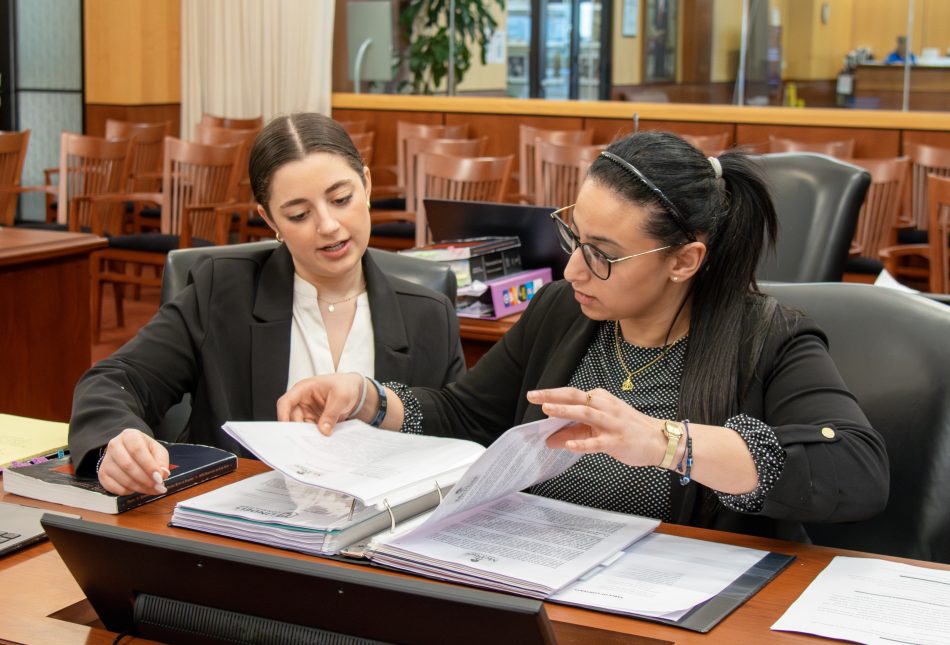
Between those summers, Elgeyoshi crossed to the other side of the courtroom.
During her full-time Residency-in-Practice with the Guilford County Public Defender’s Office, she visited clients in jail and worked alongside attorneys representing people facing criminal charges. She now externs with Greensboro defense attorney Christon Halkiotis.
She refuses to view criminal law through a single lens.
“It gives you entirely different perspectives,” Elgeyoshi said. “To uphold justice on both sides, while ensuring the Constitution is upheld, is the greatest honor.”
The lawyer she aspires to be
Associate Professor Eric Fink, Elgeyoshi’s academic adviser, watched her adjust to the unfamiliar demands of law school and become a stronger student. What drives her, he said, isn’t law as an intellectual exercise.
“She sees the law as a way to address real people’s real problems in their real lives,” Fink said.
Bob Minarcin, an adjunct professor who helps oversee Elon Law’s Mock Trial program, watched her progress from first-year witness to team member and trial advocate. Her final performance in his trial practice course, he said, was “years ahead of where most law students are at that stage.
“She’s the real deal.”
“Regardless of where I end up, I want to be the type of criminal attorney who never forgets to be human.”
— Mayar Elgeyoshi L’26
Her classmates see the same commitment. Olivia Domowitz L’26 said Elgeyoshi shows people they matter by giving them her time despite an overcrowded schedule, while Lindsay Hetzel L’26 points to her 250-plus pro bono hours and public-service work as a reminder that “serving real people is the true prize of pursuing the legal profession.”
She hasn’t decided which side of the courtroom will be hers. But her experiences have clarified something more fundamental: The attorney she wants to become.
“Laws are written by people. Crimes are committed by people. And people are those who enforce, from law enforcement to the attorneys and judges. People make people mistakes, from all ends,” Elgeyoshi said.
“Regardless of where I end up, I want to be the type of criminal attorney who never forgets to be human.”