


The most recent edition of the Elon Journal explores how media is shaping our culture and public discourse, with student-led research ranging from political narratives on TikTok to crisis communication and representation in entertainment.
The School of Communications has published the spring 2025 issue of the Elon Journal of Undergraduate Research in Communications, presenting a dynamic collection of student research at the crossroads of media, politics, sports and culture. From the online presence of college athletes to the portrayal of queer characters in post-Obergefell cinema, the latest volume highlights how Elon student scholars are analyzing timely issues with academic rigor and thoughtful inquiry.
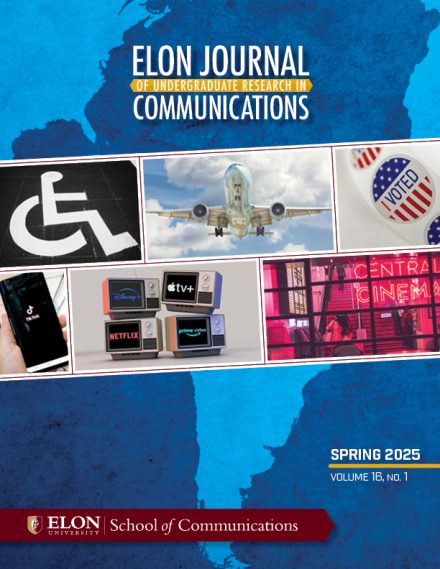
The latest edition features five research papers authored by students in the School of Communications. Among the featured studies is Cap Henneman’s investigation into how college football players navigate social media in the age of Name, Image, and Likeness (NIL). The journalism major’s research found that athletes primarily shared athletic content on Instagram and behind-the-scenes glimpses on TikTok – platform-specific strategies that drove audience engagement differently depending on the tone and presentation.
As part of her research, strategic communications major Callie Reing took a critical look at the 2024 presidential debate through the lens of TikTok. Her findings reveal that both Kamala Harris and Donald Trump’s verified accounts used the platform to frame opponents negatively, with highly produced content garnering the most attention.
Avery Simmons examined patterns in televised comedy, distinguishing between humor styles in successful and unsuccessful sitcoms. While both leaned on verbal and linguistic jokes, the strategic communications major’s research found the most effective shows employed character-driven and situational humor, whereas less successful comedies leaned more heavily on physical gags.
Strategic communications major Caitlan Hannegan explored Boeing’s public relations response to two fatal 737 MAX crashes, assessing the evolution of the company’s crisis communication. Her analysis concluded that Boeing improved its messaging after the second incident by adopting more of the industry’s best practices, but still fell short in areas such as taking responsibility and supporting victims.
Rounding out the edition, Mackenzie Smith analyzed five films released after the landmark Obergefell v. Hodges decision, exploring how Hollywood portrays queer characters. The cinema and television arts major’s research found that despite increased visibility, queer characters were often cast in roles as either villains or victims, reflecting a narrow “model queerness” acceptable to mainstream audiences.
“The scope of this edition ranges from politics to sports, from crisis communication to representation in Hollywood,” said Elon Journal editor Harlen Makemson. “In each case, undergraduate researchers – working closely with faculty mentors – turned their passions into published scholarly articles they can be very proud of.”
To assemble the spring 2025 edition, Makemson worked with an editorial board of 28 communications faculty who participated in a blind-review process to select the strongest submissions. Since launching in 2010, the Elon Journal has published 31 issues, with each research article on its own dedicated webpage.
Among more than 200 undergraduate research journals cataloged by the Council on Undergraduate Research, the Elon Journal remains one of the few focused exclusively on student work in journalism, media and communications.