


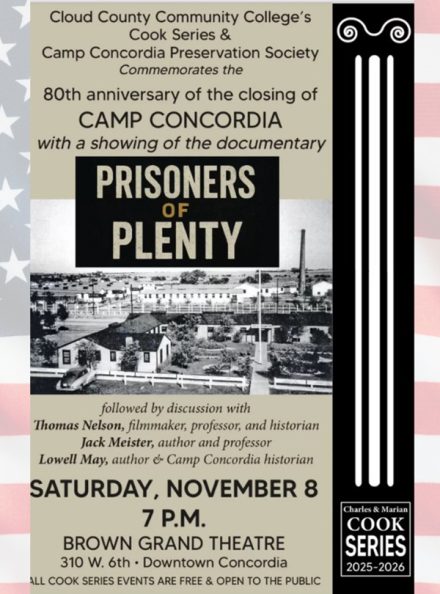
The associate professor of journalism screened his 2009 documentary “Prisoners of Plenty” at the historic Brown Grand Theatre in Concordia, Kansas, during an event commemorating the 80th anniversary of the closing of Camp Concordia.

Eighty years after the closing of Camp Concordia, one of the largest World War II prisoner of war camps in the United States, Tom Nelson returned to Kansas to help the community remember its past. On Nov. 8, the associate professor of journalism screened his 2009 documentary “Prisoners of Plenty” at the historic Brown Grand Theatre, a landmark listed on the National Register of Historic Places.

The screening was part of an event commemorating the 80th anniversary of the camp’s closing – a fitting occasion for Nelson’s documentary, which captures the human stories behind the wartime facility.
Nelson’s documentary examines life at Camp Concordia through the memories of German prisoners, local residents, and farmers who hired POWs to work on their land. The camp once held more than 4,000 German soldiers between 1943 and 1945, shaping both local and national history during the conflict’s final years.
Following the screening, Nelson joined historians Jack Meister and Lowell May for a panel discussion that explored the camp’s legacy and the personal stories behind its preservation. The evening drew an audience of more than 240 people, many of whom viewed exhibits from the Camp Concordia Preservation Society before the program began.
“It was reassuring to see that small-town American life is still vital and central to the American experience,” Nelson said.
A veteran journalist and documentary producer, Nelson has taught in Elon’s School of Communications since 1996. Before entering academia, Nelson spent seven years as reporter and news anchor at television stations in North Dakota, Pennsylvania, Maine, California and Texas, and as press secretary to a U.S. House candidate in Iowa.
The event was organized in partnership with the Camp Concordia Preservation Society, which continues to maintain the historic site and educate future generations about Kansas’ role in World War II.