



An innovative audio experience provided a hands-on learning experience for a music production and recording arts student in the Department of Performing Arts with guidance from his faculty and staff mentors.
When Elon University brought “RENT” to the McCrary Theatre stage this winter, audiences did not only see the well-known rock musical — they were surrounded by it.
The Department of Performing Art’s production from Feb. 13-15, 2026, featured an immersive sound design developed through collaboration between Associate Professor Michael Smith, Production Manager Rick Earl and music production and recording arts student Brandon Cericola ’26.
The project blends Smith’s sabbatical research in immersive audio with Cericola’s interest in sound design for film and television, where immersive sound is increasingly common. The result was a student production that expanded beyond a traditional theatrical sound system.
“The traditional audio for musicals is augmented by eight surround speakers placed in the audience, some for sound effects, others to bring the performance out into the space more, to surround the audience with vocals,” Earl said.
The production used the department’s existing equipment, along with additional loudspeakers, to create the sound effect. The show used 80 inputs and 38 outputs, with updated software to help automate immersive sound effects. While some immersive systems require major hardware investments, the team developed manual techniques to adapt the live performance within available resources.
“The nature of the show is more rock-oriented, and maybe more intimate than some musicals, and takes place in a city, which by nature is an immersive environment,” Earl said. “The stars aligned — the right student, the recent research, experiences and the desire of all of us to do something like this.”
Cericola had significant creative ownership of the design. Aside from the required elements, much of what the audience heard was his creation. Earl and Smith worked with Cericola over the summer to build a small immersive setup, allowing him to record musicians, experiment with mixing and refining before scaling the systems for McCrary Theatre.
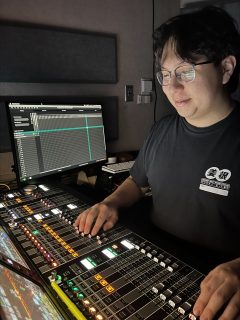
“A lot of what you hear is Brandon’s creation,” Earl said. “Large-scale system implementation like this takes strong project management skills, leadership and mentoring skills, documentation, flexibility, time management, and the ability to know when something isn’t going to work and find an alternative.
“From an audience perspective, I think it will bring them into the ‘world’ that is ‘RENT’ and enhance their experience,” Earl said.
For Cericola, the production represents the combination of the experiences he has had while at Elon.
“This has been the most challenging project I have taken on at Elon, and it is a combination of many skills I have learned here,” Cericola said. “To hear the show come to life during rehearsal was exciting and satisfying. It is evidence of my education and time at Elon.”
Cericola drew on coursework in the Music Production and Recording Arts program, leadership experiences, work study roles with the Office of Cultural and Special Programs and immersive audio research developed as an Elon College Fellow. He also attended the NAMM Show, an international music industry trade show, where he connected with manufacturers, sound designers and an engineer to discuss immersive audio approaches and set-ups.
For Smith, the production marks a full-circle moment following his sabbatical research.
“The research I did on my sabbatical was my main leaping point for trying to do immersive audio on the McCrary stage,” Smith said. “After hearing Brandon’s and Rick’s setup over the summer, I knew the next step would have to be producing a live musical with a similar setup.”
During his sabbatical, Smith built a scaled-down immersive theatre that was later expanded and installed in Roberts Studio Theatre. The 25-speaker system allows each speaker to be individually assigned and controlled, creating a unique learning space for students.
“It is the only theatre in this area that has an immersive audio system for students to do their sound design work on,” Smith said.
Earl, Smith and Cericola made decisions as a team to ensure the project remained manageable and cost-effective. They said the collaboration shows what is possible when research, creativity and student passions intersect.
“Without all three of us working together, something like this wouldn’t have been possible,” Smith said. “Now we realize what possibilities we have for future performances, not just in the Department of Performing Arts but for Cultural event programs as well.”