


To celebrate Elon University’s Spring Research Forum on April 28, Today at Elon is highlighting students presenting their research at the annual campus tradition.
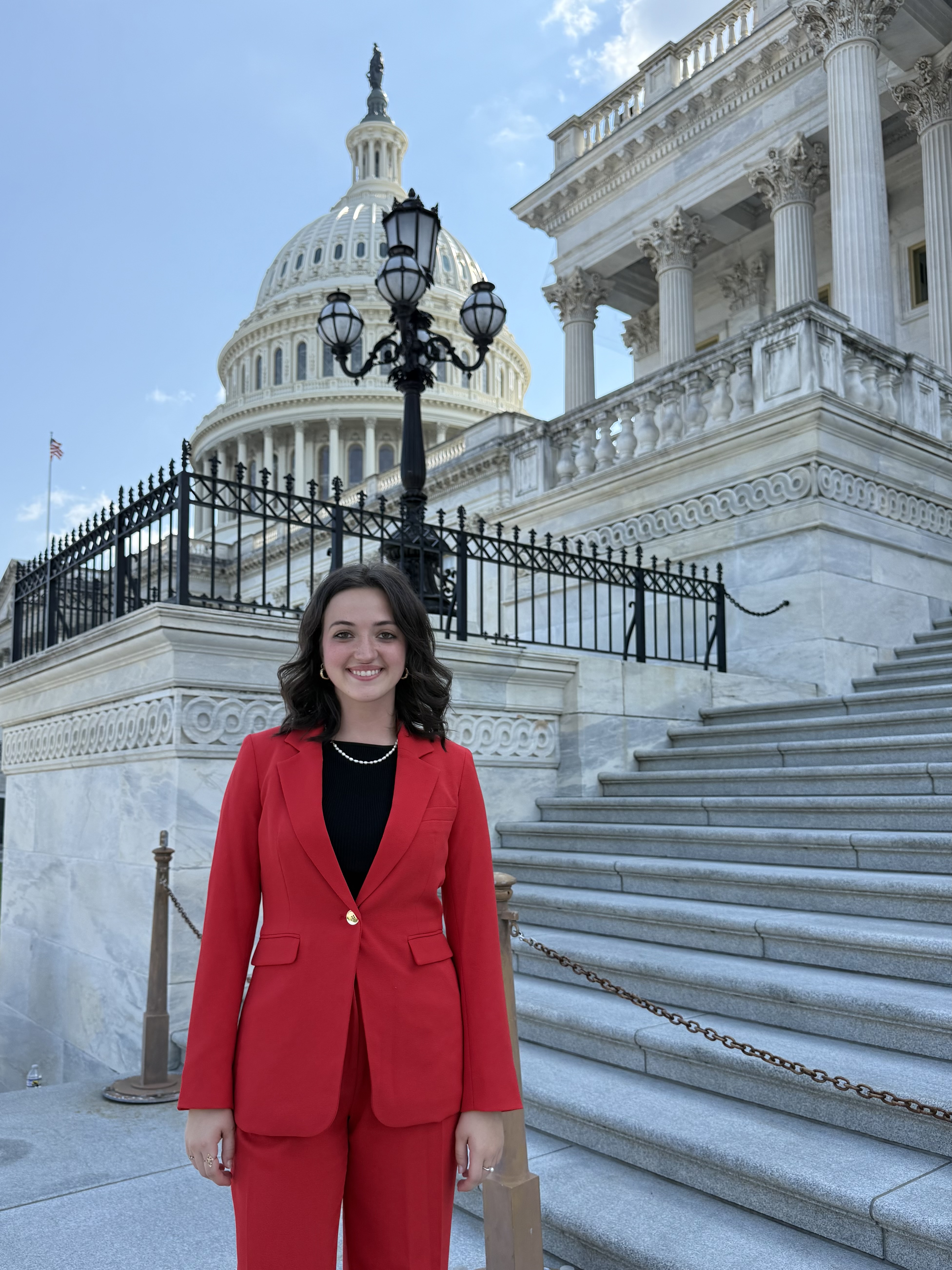
Maddie Hewgley ’26 is using her undergraduate research to explore a complex and timely question: Why are states continuing to pass Second Amendment Preservation Act laws even after courts have ruled them unconstitutional?
When Hewgley, a political science and music theatre major, Lumen Scholar and Elon College Fellow, began researching legislation from her home state of Missouri, she did not expect it to open the door to a much broader national conversation about federalism, state power and policy diffusion. She will present her findings during the Spring Undergraduate Research Forum (SURF) on April 28.
Her research project, “Bullets & Bills,” explores how and why the Second Amendment Preservation Act continues to be adopted at the state level, despite the federal court deeming it unconstitutional.
The Second Amendment Preservation Act aims to prevent states from enforcing federal gun laws that are not mirrored at the state level.
“These are laws that states are passing that attempt to nullify federal gun laws if there is not a state equivalent,’” Hewgley said. “What surprised me most is that states continue to pass them even after federal courts ruled they violate the supremacy clause of the United States Constitution. Civilians can even sue law enforcement for enforcing this federal policy.”
Missouri became the first state to pass this law in 2021, sparking similar legislation in 14 additional states. Hewgley’s research focuses on understanding what is driving these laws.
“My main question is not just what these laws are, it’s how and why they are continuing to proliferate despite legal challenges,” Hewgley said.
For Hewgley, this topic is not just academic, it’s personal.
“I lost loved ones to gun violence when I was younger,” Hewgley said. “I felt really helpless. This research feels like a way to take initiative on something that is much larger than myself.”
That experience led her to participate in gun violence activism and motivated her to conduct this research. She emphasizes that her research is not intended to advocate for one side of the debate, but to understand the mechanisms behind these laws.
Her findings show how states have adapted their strategies over time. Missouri’s original law included aggressive enforcement mechanisms and was struck down; states like South Carolina have passed revised versions with softer language or attached them to broader legislation to avoid legal scrutiny.
“States want to send a message or align themselves politically, but they are learning from earlier failures and adjusting their approach,” Hewgley said.
To analyze this trend, Hewgley has studied the theory of policy diffusion, which examines how and why policies spread between states. Her work explores whether states are motivated by emulation, learning, competition or coercion.
“I think states influence each other,” Hewgley said. “Missouri isn’t usually a policy innovator, so the fact that they were the first to pass this and others are following is really interesting.”
Her research also examines external influences, such as advocacy groups and political shifts at the national level, and how they drive some of this legislation.
Hewgley has studied documents, legislation and conducted a content analysis to build her research. One of her surprising findings was that many residents in Missouri were unaware this law existed, despite its significant implications.
“That finding made me question whether these laws are really meant to have an impact or if they are more symbolic,” Hewgley said.
Ultimately, Hewgley hopes her research encourages people to look beyond this law and consider larger questions about the balance of federalism in the United States.
“This is not just about gun rights; it’s about how states and the federal government interact and how that applies to so many other issues, from abortion to marijuana laws,” Hewgley said.
Hewgley’s research was mentored by Dillan Bono-Lunn, assistant professor of political science and public policy.
“When I met with Dr. Bono-Lunn, I knew before I left her office that she was who I wanted to be by mentor because I came to her with two research ideas, one that was pretty fleshed out and the other was a headline about Missouri’s Second Amendment Preservation Act, which I was exceptionally interested in pursuing, but I did not have a research question,” Hewgley said. “She encouraged me to pursue a research idea that I was excited about, and now three years later I am pursuing that research. She allows me to follow whatever thread I find and has taught me that a good researcher stays curious and flexible at every stage of the process.”
As she prepares to present her research, Hewgley reflected on how far she’s come.
“If you had told me as a first-year student that I’d be researching something this complex, I wouldn’t have believed you,” said. “Now, I feel like I can really contribute to the conversation and it’s made me feel like I’ve made an impact.”