Spring 2026: Jenna Moylan
Beyond the Medium:
An Analysis of Transgender Representation in Children’s Serialized Animated TV Shows in the United States
Jenna Moylan
Cinema and Television Arts, Elon University
Submitted in partial fulfillment of the requirements in an undergraduate senior capstone course in communications
Abstract
In contemporary Western media, the marginality of trans representation often sensationalizes and “oddifies” characters for cisgender audiences and leaves contemporary trans audiences searching for authenticity. For modern youth audiences, media representation often uplifts cisgender normativity, alienating trans youth. However, contemporary queer and trans showrunners have challenged that status quo. This article analyzes four contemporary animated TV shows in the United States (Dead End: Paranormal Park, The Owl House, She-Ra and the Princesses of Power, and Steven Universe Future) for trans characters’ narrative role, the centrality of transness, and the visual legibility articulated by trans characters’ designs. However, the research discourages universal application of this analysis on further trans representation and instead embraces plurality as backed by transgender studies’ scholars. The research also encourages readers to challenge complacency regarding harmful representation as content consumers. Future investigations call for a holistic international comparison that decenters Western gender constructs.
Keywords: animation, transgender, representation, storytelling, content analysis
Email: jmoylan2@elon.edu
I. Introduction
In 2014, TIME published an issue titled “The Transgender Tipping Point” discussing a new surge of transgender representation in visual media (Steinmetz, 2014). Now, over a decade later, it is nearly impossible to track the totality of transgender portrayals across visual media. One specific form of visual media contributing to this rise in visibility of transgender representation is animated TV shows—specifically, children’s animated shows influenced by Western cultural values and production practices. From creation to distribution, animation’s production process is inherently more complex than that of live action due to its cross-cultural production methods, which the study will elaborate on later.
The vitality of media transgender representation comes at a time when transgender lives are targeted for hate crimes and bombarded with anti-trans legislation; 2025 was the sixth consecutive year for increased anti-transgender bills proposed in Congress (Trans Legislation Tracker, 2025). Transgender representation is also historically misrepresented in the U.S. film and TV broadcasting industry, which is rooted in systematic biases from society that have categorized and prioritized whiteness, heteronormativity, and cisgender characters that adhere to strict gender binary norms (Scharrer et al., 2022).
As a result, queer and trans creators have sought to manifest worlds that fill that representative void. This research unpacks how a collection of children’s animated TV shows represents transgender characters and what that signifies. This concept is delineated through a qualitative content analysis that compares and contrasts trans characters’ narrative roles within their story, the centrality of their transness to their character arcs, and how character design visually embodies that representation.
II. Literature Review
To understand this analysis, one must consider animation’s role in the entertainment industry and how that industry has perpetuated representation patterns evident throughout visual entertainment media. Readers must also consider an overview of transgender representation and how trans studies extract new meanings from this representation. This literature review focuses on four areas: An explanation of animation as an expressive medium and the signification in distinguishing it from live action, an overview of representation’s impact in the entertainment industry, a discussion of transgender studies to contextualize contemporary trans lives, and an overview of transgender representation and its significance for animated children’s media.
Animation: Form and Meaning
Animation serves a plethora of functions, ranging from data visualization with animated bar graphs to fantastical, fictionalized entertainment worlds (Yang & Jasim, 2024). In the entertainment industry, animation is a subsector of film and TV broadcasting. While film and TV shows have vast, ever-evolving camera technologies to capture the likeness of reality, animation must carve out its own existence through 2D- or 3D-specific techniques and software (Saputra et al., 2021). Traditional 2D entertainment animation, before the age of streamlined digital techniques, often employed a technique called cel animation. Animators would hand-draw characters or subjects on thin plastic sheets and overlay them to imitate motion. 3D animation relies on computer animation software to create models that more closely emulate the dimensions of reality. Both visual methods of animation have their own techniques or even entirely different forms of animation (Saputra et al., 2021). For example, Claymation involves sculpting and microscopically shifting the subjects within a sequence of photographs, similar to its twin technique, stop motion.
Beyond the mechanics of animation production, the labor-intensive creation of animation, particularly Western animation produced by major studio conglomerates, is distributed across countries, as Westcott’s (2011) overview of the global animation industry indicates. The conceptualization processes—pitches, story development, scriptwriting, storyboarding, and so on—occur in the United States, yet the actual animation production usually takes place at international studios, such as in South Korea. The entire process is collaborative and often long, where the actualized version of an approved animated production (film or TV series) can take years, even decades, to create. That expansive process comes with an innate passion, or passion is encouraged to create such a feat, as contemporary animated showrunners and creators Rebecca Sugar (Savas, 2020) and Hamish Steele (Millard, 2022) have noted.
When it comes to animated media aimed at youth, there is a tendency for adult audiences to view the product as inherently childish and assume its themes and analogies lie in superficial, imaginative worlds to appeal to childlike creativity. While this is sometimes true, Halberstam (2011) points out that animated media has educational potency by fostering children’s creativity, untethered from social hierarchical structures that favor heteronormativity and strict gender roles.
Overview of Representation’s Impact in the Entertainment Industry
Visibility and representation are integral to animated media because of their links to patterns in broader entertainment media (Saputra et al., 2021). Representation is conveyed in media through specific portrayals of something (a country, a brand, a person, or people) with characterized behaviors and traits. However, representations of people in the U.S. film and TV broadcasting industry have been rooted in systematic biases within society that have categorized and prioritized whiteness, heteronormativity, and characters that align to a strict gender binary (Scharrer et al., 2022).
Disingenuous representation generates harmful falsehoods about marginalized people that rely on stereotypes rooted in racism, homophobia, transphobia, religio-centrism, and tokenism. In a similar vein, some are left out of stories altogether (Scharrer et al., 2022). For example, Native American characters in primetime TV made up 0-0.4% of characters, according to a 2017 content analysis (Scharrer et al., 2022). This absence creates a false notion that their existence is unimportant. Misrepresentations are inherently harmful for broader audience acceptance and understanding of identities beyond their own lived experiences, as well as those underrepresented in shows and movies who predominantly experience entertainment through white, heteronormative, gender-restrictive characters.
Transgender Studies and Contemporary Transness
Transgender and queer identities have paradoxical relationships to representation in U.S. media and each other. While both face similar collective victimization and bigotry for simply existing beyond a cisgender and heteronormative social schema, there are differences. The 2015 Supreme Court case Obergefell v. Hodges legalized same-sex marriage, and while it did not eradicate homophobia, it is considered a landmark case. However, 2025 was the sixth consecutive year for record-breaking anti-trans bills considered in the United States Congress (Trans Legislation Tracker, 2025). In 2024, 701 bills were considered, of which 51 were passed. In 2025, more than 1,000 pieces of anti-trans legislation were introduced, with 122 been passed into law. This examination is not to pit queer violence and adversity against transgender violence and adversity; each struggle and each find alliances with each other. However, when including transness into queer theory, transness is often assumed or overshadowed by sexuality or conflated with sexuality.
Transgender studies and queer studies often relate to a problem–a gender problem–as discussed in Judith Butler’s book, Gender Trouble (1990). In society, gender is a binary construct with norms and social behavior shaped under the assumption that there are two “natural” sexes. This conception of gender is already linked to a falsehood; sex organs and gene expression expand beyond two easily categorizable traits (Spencer, 2016). Butler’s theory proposes gender as a malleable, unfixed performance, yet it remains rooted in the conformity or deviation from society’s perception of a gender binary. As a result, queer theory marries itself to the gender binary to contextualize and empower non-heteronormative sexuality and romance (Stryker, 2004).
Susan Stryker—an American professor, historian, author, filmmaker, and theorist with a focus on gender and human sexuality—frequently writes and discusses transgender studies and its disavowal within queer theory. Transgender exclusion, or its inclusion as a supportive study instead of a primary study, generates a need for academic change where advocates emphasize radical and intellectual reshaping of perceptions of transgender experience, studies, and history (Page, 2017). Part of the problem, Page argues, is the material gatekeeping of trans history and trans studies behind paywalls, the censorship or elimination of trans material, or the general disinterest in history that deters further study. Therefore, trans individuals who might benefit from the material often lack access to it (Page, 2017). This discourse of inclusion trickles back to representation.
Transgender Representation and Its Significance for Animated Children’s Media
Transgender representation varies widely on-screen. Film and TV representations often appear in medical dramas and crime dramas, where transness is often used as a plot device for sensation. In medical dramas, trans people are often portrayed as patients whose sex attributes of their opposing gender in the gender binary interfere with or exacerbate body dysmorphia. Crime dramas often show violence or other acts of aggression towards a character’s transness (Feder, 2020). At the same time, trans representation is often characterized holistically as a trans person’s existence, rather than the character being just a person (Gossett et al., 2017). If not dramatically sensationalized, transness–paralleling queerness–can become the punchline of a joke or gag, act as a plot device to benefit the gendered binary or vilify transgender people as criminal and dangerous perpetrators (Feder, 2020). The exaggerative potential of animated media amplifies and falls into similar misrepresentation, with the expressive potential of animation used to mock or vilify transness in episodic cartoons like Looney Tunes or The Powerpuff Girls.
Animated media is primarily geared towards children, but that does not make it explicitly for children. However, regulatory changes concerning children’s programming are relevant to the current study. The 1996 Telecommunications Act imposed new structures on broadcast TV content geared toward children (Gentile et al., 2005). Often, the discourse surrounding trans and queer identities and their historical oppressions is deemed inappropriate for children’s media. Rating restrictions also provide loopholes for regulatory departments in production companies to revise, censor, and hide transness.
Trans people, queer people, and allies have sought changes they want to see in media, including in serialized animated TV shows. Rebecca Sugar, creator of Steven Universe, and ND Stevenson, showrunner of She-Ra and the Princesses of Power, spearhead this movement. In separate interviews discussing their shows, both Sugar and Stevenson described how they sought to foster shows with explicitly queer and trans characters, unlike the animated shows they watched growing up as queer and gender-nonconforming individuals and creatives (Bauza, 2023; Sands, 2016). On the animation and storytelling side, this came from working queerness in the show’s structures through story devices, like world-building. Instead of mirroring reality and reflecting the abundance of violent or reductive representation, creators like Sugar and Stevenson, and later showrunners like Dana Terrace with The Owl House, manifested inclusive worlds free of transphobia and homophobia, and instead, created narrative drama based on other character characteristics and relationships.
III. Methods
Animated media storytelling offers a broader range of stories than live-action media, contributing to animation’s role as a transformative medium for representing marginalized identities despite stigmatizing past portrayals. Yet, behind the scenes, queer and trans individuals helm the change they strive to see. This prompts the research question: How are transgender characters represented in contemporary Western serialized animated children’s TV shows?
A qualitative content analysis was best suited to the research question because unpacking representation involves breaking down the visual communication articulated by the animated medium (i.e., character design) and its implications (i.e., character relevance and narrative impact). These three analytic dimensions were determined by the following criteria:
- Narrative centrality was assessed based on when a character’s introduction occurred (first season or later), the number of episodes in which they appeared (several or one), and how their actions affected central plotlines.
- The centrality of a character’s transness was gauged by how often the main plot explored it and by how their trans identity shaped their motivations.
- Character design focused less on specifics such as clothing and accessories to avoid policing gender expression and instead noted a trans character’s juxtaposition, or lack thereof, with other characters in the show.
An analysis of embodied representation suggests potential inferences about how a young audience might interpret it: whether it is sensible, empathetic, and overall positive, or whether it perpetuates a reductive, harmful past.
Series were limited to those with explicitly transgender characters described in accordance with contemporary understanding, such as characters’ discussing their identity within the show’s narrative world, the use of gender-nonconforming pronouns, or characters’ identity confirmed and canonized by showrunners. Knowledge gained from online discussion platforms (i.e., Reddit, X, Instagram, YouTube) by posts published by creators and fans discussing animated shows involving trans characters allowed the researcher to establish the following list of shows:
- Steven Universe Future (2019)
- She-Ra and the Princesses of Power (2018-2020)
- The Owl House (2020-2023)
- Dead End: Paranormal Park (2022-2023)
Using the compiled list of shows, the researcher watched the content and noted the episode numbers and titles of the initial introductions of characters’ trans identity. This included instances in which a character self-identified as trans or used singular they/them pronouns to refer to the self. Additionally, if a character’s trans identity served as a thematic device to advance the narrative, the episode title and number were recorded, along with a description of how the narrative progressed. The researcher also tracked episodes in which established trans characters reappeared throughout the series and documented, with a qualitative description, how their presence impacted the overarching narrative.
IV. Results
Analyzing explicitly canonized trans characters in contemporary, serialized U.S. animated shows illuminates central themes involving trans representation and how it varies across the different shows. The qualitative data shows this through trans characters’ designs juxtaposed with that of other characters within the animated world, the characters’ narrative influences within their stories, and the centrality of a character’s transness (whether it is salient or irrelevant to the narrative).
Dead End: Paranormal Park
Dead End: Paranormal Park is a show whose elevator pitch, as described by its creator, Hamish Steele, is teens working at a theme park for their summer job, except there are ghosts and demons too. Barney Guttman is the protagonist of these teens (see Figure 1). He’s an independent-seeking trans teen with tenuous family dynamics who runs away from home with his pet dog, Pugsley, who later gains human speech via the park’s paranormal happenings. A notable uniqueness for Dead End: Paranormal Park is that it existed as a webcomic before Netflix adapted the story. Typical media adaptation inscribes changes into the story of the adapted media. Yet Barney’s transness remains a defining character trait, shaping his relationships within the narrative and serving as a pivotal story arc in the show. However, while the show had two full seasons, each with 10 episodes, it was canceled by Netflix in January 2023.
Figure 1: Dead End Cast (Badya, Norma, Courtney, Pugsley, Barney, Logs)
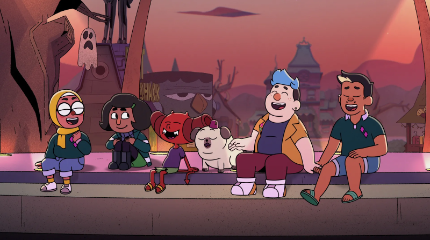
In the Dead End universe, Barney’s design parallels that of humans in the animated world, while demon designs feature inhuman traits such as sharp teeth, horns, and other monster-like qualities. Much of Season 1’s runtime focuses on demon-filled antics, establishing the show’s horror-comedy style. Yet for Barney, there’s an apparent, overarching conflict within his character, centered on his familial ties.
Season 1 Episode 1, “The Job,” introduces Barney’s conflicting relationship with his parents via an unresolved fight from a family dinner, where it is alluded that Barney’s grandmother belittled him, while his mother and father did nothing to confront the grandmother. (This plot point is later confirmed in Season 1 Episode 3, “Trust Me.”). Barney secures his theme park job at the Dead End attraction and befriends secondary protagonist and co-worker Norma, but by the end of the day, he decides to stay indefinitely at Dead End.
Trans verbiage is notably absent in the first episode. However, Season 1 Episode 2, “The Tunnel,” confirms Barney’s trans identity as he comes out to Norma after she confronts him about living at the park. Barney explains his grappling with alienation from his family and school peers, all of whom are keenly aware of his transition. But at Dead End, Barney says, “This is the first place where I’ve felt like I can truly be myself” (S1EP2, “The Tunnel”). The perceptions of his trans identity dissipate in a new environment, granting Barney the autonomy for disclosure.
The majority of Season 1 revolves around Barney’s character, who continues to internalize feeling unsupported by his family while grappling with guilt for leaving without a word to his little brother and parents (S1EP4, Night of the Living Kids). As a result, Barney further distances himself even when given the chance to amend (S1EP6, Wait Time: 22 Minutes). It is not until Barney’s forced to reflect on his actions via the show’s paranormal hijinks that he chases down his family just before they leave.
The following episode, Season 1, Episode 7, “Norma Khan: Paranormal Detective,” culminates Barney’s shifting family dynamics in an awkward family dinner as the episode’s B-plot. The interaction slowly breaks down into a verbal argument between Barney and his parents. Barney calls out their actions in favor of “keeping the peace,” only for his parents to pacify his hurt feelings by arguing that they support his transition, yet exclude the harm of their inaction. With the unresolved misunderstandings, Barney gives his parents an ultimatum; for him to return home, they must reflect that their enabling has created an unsafe atmosphere for him.
The rest of the season follows the more prominent supernatural threat to the Dead End cast. Yet the Season 1 finale, Episode 10, “Into the Fire,” sees Barney and his parents reconcile after the young protagonist survives a world-ending demonic threat. Barney’s parents promise to work on their faults and to construct a more welcoming home. Until a change arrives with the grandmother, Barney and his family arrange a new family dinner day to host catch-ups about his life and prompt general family bonding.
Season 2 decenters Barney’s transness as a narrative focal point; however, it still has a minor presence in Season 2 Episode 3, “The Trails of Barney.” Pugsley discovers Barney’s been sneaking to a demon gym rather than a less terrifying regular gym. Barney refutes this, justifying his decision with the fact that, despite the literally demonic threat to his mortality, he sees earthly gyms equally terrifying with potential judgment posed by his transness, weight, or his binder (a device used for chest compression to help with body dysmorphia).
As the show’s protagonist, Barney’s narrative role and his transness are paramount to his character development. Yet his humanistic design makes him a holistic character and subconsciously conveys the impression that he belongs in his animated world.
The Owl House
The Owl House is a three-season show by Disney Television Animation. However, Disney shortened the original runtime after Season 2, turning Season 3 into a three-episode special with longer episodes. So unlike Dead End, the creators were able to conclude the show.
The story follows Luz Noceda, an anime-loving, witch-obsessed human from a world paralleling the real world. Yet within that world, she feels like a social outcast, unable to make lasting friendships with her peers. In an instant, her world flips upside down as she finds herself in a magical and slightly demonic realm called the Boiling Isles. The realm is ruled by Emperor Belos, who is hellbent on limiting the free practice of magic by sorting the inhabitants into one of nine social groups, or covens, and sealing magic through a permit body modification called a “sigil.” Each coven has one type of permitted magic: abomination, bard, beast keeping, construction, healing, illusion, oracle, plant, and potion. If proficient and skilled in one of those magic types, witches can become a coven leader.
Within the Boiling Isles, Luz forms a found family with her mentor Eda Clawthrone, an infamous rogue and powerful witch who has refused to conform to the coven system, and Eda’s roommate King, an “adorable” demon. The show primarily focuses on Luz’s dream of becoming a witch and studying unconventional magic under Eda’s irregular guidance. As Luz grows into an innovative witch, she also uncovers the true nature of the Boiling Isles and the sinister intentions of Emperor Belos and his coven system. Season 2 advances that narrative progression and introduces new central characters, including Raine Whispers, depicted in Figure 2.
Figure 2: Owl House Character Models (Raine, Eda, and Luz)
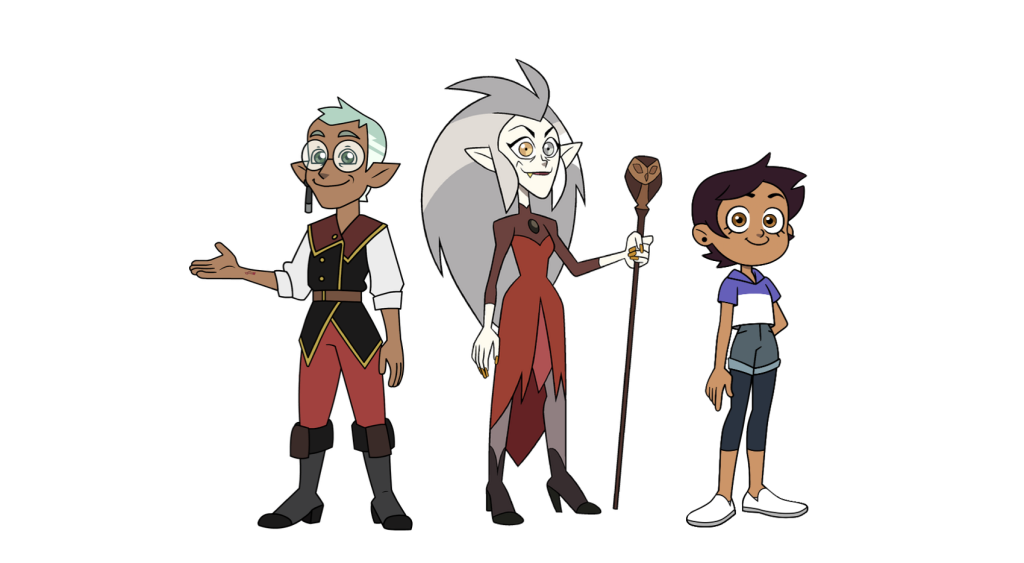
When it comes to Raine’s character design, they’re meant to blend into the fantastically diverse inhabitants of the Boiling Isles, ranging from bug, beast, or bipedal demons to notably human-like characters like Raine and Eda. However, a character’s ear shape distinguishes the inhabitants of the Boiling Isles from those of the human realm: Humans, like Luz, have rounded ears, while Boiling Isle inhabitants have pointed elvish ears.
Raine is a gender-nonconforming witch revealed to be the Head of the Bard Coven and has a mysterious, romantic past with the central character, Eda. Instead of unpacking Raine as a gender-nonconforming character, their identity is mentioned offhand while advancing the story: “So, the Head Witch of the Bard Coven likes pretending to be a rebel, too bad they’re not very good at it” (S2EP5, Eda’s Requiem). This contrasts with Barney in Dead End: Paranormal Park, where transness motivates his decisions and shapes the narrative across many episodes.
The end of Raine’s debut episode leaves viewers with an essential new development in The Emperor’s sigil system: not only do they limit magic, but they can also painfully immobilize the sigil wearer, which Raine endures at the end of the episode leaving the audience in suspense. Raine continues to have a lasting impact on the story, not just through the suspense of their well-being, but also as the narrative unpacks the past relationship between Raine and Eda and positions Raine in a pivotal role in thwarting Emperor Belos.
Steven Universe Future
The Steven Universe franchise is by far the longest show, with a total of 160 episodes in the original series, one feature-length animated movie, and a 20-episode epilogue series, Steven Universe Future. The show primarily focuses on its fantasy elements, featuring Steven, a kind-hearted half-human, half-Gem boy who lives in Beach City with the Crystal Gems: Garnet, Amethyst, and Pearl. As Steven learns to use his inherited Gem abilities, he uncovers the complex history of the Gem race and his family’s role in it, confronting powerful interstellar forces and growing into a compassionate hero who strives for understanding rather than conflict. Yet the peaceful resolution of the original series erupts in the epilogue series. With his duty as an intergalactic peacemaker in the new era of peace, Steven must confront his greatest challenge yet— himself and his self-destructive habit that prioritizes others’ well-being over his own.
Part of Steven’s mental spiral in Steven Universe Future involves the new, uncontrollable manifestations of his power. In Episode 9 of Steven Universe Future, “Little Graduation,” Steven and the friends from the original series, Sadie and Lars, all coincidentally convene in a pastry shop. Both Sadie and Lars have undergone major character development since their introductions, including a back-and-forth relationship type. Nostalgic for their past, Steven chimes in and insinuates a chance for the two to rekindle their romance, only for Lars to name-drop Shep (see Figure 3), a new character that is Sadie’s romantic partner and whose relationship was entirely unbeknown to Steven.
Figure 3: Steve Universe Character Models (Older Steven and Shep)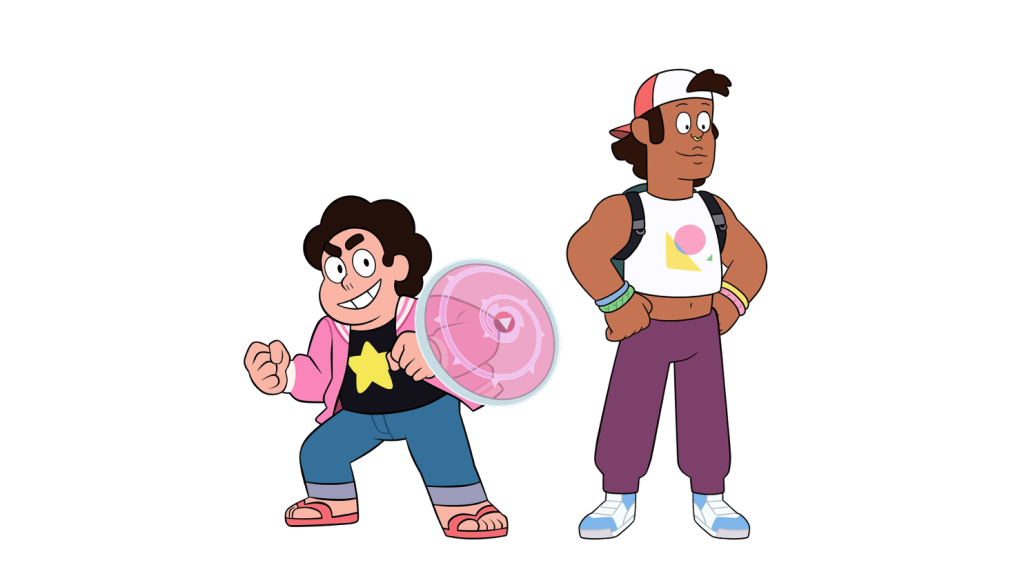
Steven’s later meeting of Shep sees him presumptuously project his dislike of Sadie and Shep’s relationship onto Lars, assuming he’d be jealous. But Steven realizes that Lars and many of his other friends are moving on with their lives, and he fears that one day, they will drift away forever. Emotionally turbulent, Steven’s haywire magical powers manifest a solution to his fear, confining all his friends under a giant magical dome. Despite Steven’s incredulousness towards them, Shep steps in and guides Steven to realize how his emotions worsen his power, allowing Steven to admit how much he’s missing his friends, which bursts the dome.
Unlike Raine and Barney, Shep is featured once in Steven Universe Future. Yet, their generally down-to-earth personality leaves an impactful mark as they’re the first to vocalize a contributing factor to Steven’s haywire powers and resolve the episode’s main conflict. Shep’s character design also underscores their humanity as it aligns them with the other human designs, much like how Raine and Barney visually fit into their respective stylized worlds.
She-Ra and the Princesses of Power
She-Ra and the Princesses of Power is a DreamWorks Animation Television series distributed by Netflix that ran for five seasons. The first season began in November 2018 and ended in May 2020, with most seasons averaging 13 episodes, aside from seasons 2 and 3. The show’s opening establishes the two central and conflicting societal forces in the sci-fi world of Etheria. One is the Rebellion, composed of magical kingdoms each helmed by a princess of a certain fantastical elemental magic or highly advanced craft, such as machinery. Their goal is to preserve and protect the natural world of Etheria. The opposite is an authoritarian state called the Horde, ruled by Hordak. As the name suggests, strict conformity oppresses its inhabitants with one goal: conquering Etheria.
The show’s central characters are Adora and Catra, childhood friends who grew up in the Horde before later becoming enemies as Adora defects from the Horde after discovering that the Horde she once believed just terrorizes innocents and decimates towns in the name of conquest, and that she has the unique power to transform into the prophetic hero, She-Ra, protector of Etheria. Season 4 continues the Rebellion and Horde power struggle and introduces a monumental character who will shift that stalemate: Double Trouble, a gender-nonconforming shapeshifter shown in Figure 4.
Figure 4: She-Ra Character Models (Double Trouble, Catra, and Adora)
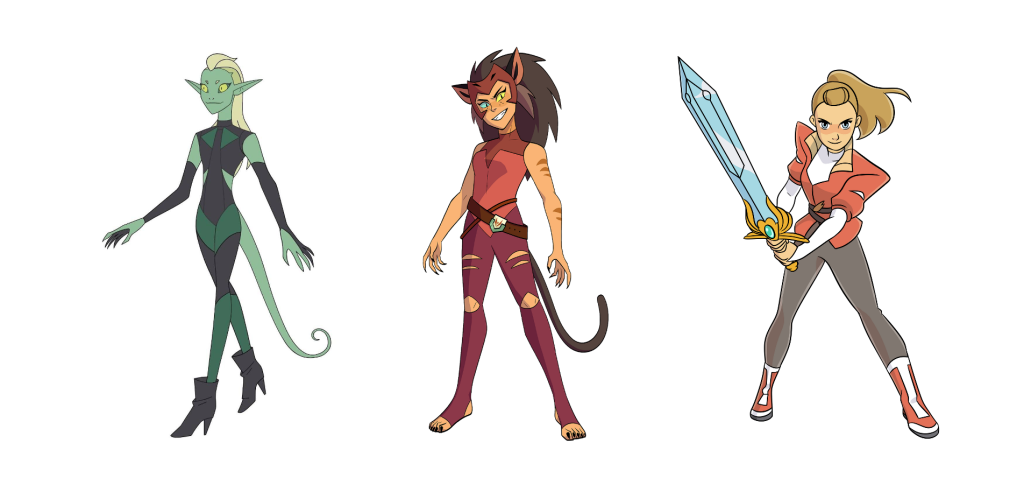
Many character designs in She-Ra and the Princesses of Power blend humanist and fantasy elements. Catra, as her name suggests, is cat-like with voluminous hair, striped patterns across her arms, claw-like hands and feet, cat-like ears, and a tail. Double Trouble has vividly green skin, like many reptiles and amphibians; a long tail; sharp fingers; and elven-like ears. Another character, Scorpia, possesses scorpion-like attributes, including pincers for arms and a scorpion tail capable of a paralyzing sting.
Double Trouble debuts in Season 4 Episode 2, “Valley of the Lost” with an immediate characterization as a mischievous, self-interested shapeshifter who offers their abilities to spy for Horde, but only for compensation in return. After a successful test run of Double Trouble’s talents, Catra, now a key leader in the Horde’s operation, hired them. Double Trouble’s presence as a Horde spy undermines the effectiveness and collaboration of the Rebellion by straining relationships between Adora and other central characters, subtly playing on the Rebellion’s characters’ fears and insecurities, allowing the Horde to gain the upper hand and conquer large sections of Etheria. Yet, Double Trouble does the same back to the Horde. The Rebellion eventually discovers Double Trouble as the Horde spy. However, the leader of the Rebellion secretly uses Double Trouble and their profit-driven motives to reenter the Horde. For Catra, their betrayal exacerbates her mental spiral that’s progressed throughout the season.
However, in Season 5, Double Trouble is only featured twice, once in Episode 7, “Perlis of Peekablue,” and in the finale, Episode 13, “Heart Part 2.” While not nearly as prevalent, Double Trouble continues to impact the overall narrative and reveal essential information about the new threat to Etheria, Horde Prime, with his ability to mind-control via sci-fi technology. After that revelation, Double Trouble disappears off-screen until one last small scene in Episode 13, where they fend off the Horde Prime’s forces in a last life-or-death stance for Etheria.
Double Trouble parallels the fantasy character design of Raine and the narrative relevance of both Raine and Barney. Additionally, similarly to Raine, Double Trouble’s pivotal role arose later in the show’s seasons, rather than having an introductory importance like Barney.
V. Discussion
The four examined series demonstrate that trans representation in serialized, contemporary Western animation embodies multiplicity through the shows’ varying forms of representation. Together, these shows reveal three core dynamics shaping modern animated trans characters: how much a character’s transness saturates the narrative, how relevant they are to that narrative, and how character design communicates, or intentionally decenters, trans legibility within fantastical worlds. Considering these dimensions allows for a more nuanced understanding of how transness’s visual representation functions within worldbuilding, salient narrative moments, and relational storytelling.
Dead End: Paranormal Park represents the clearest and sole example of transness as a central narrative force to a central narrative character. Barney’s trans identity actively shapes Season 1 story structure and conflicts: his flight from home, his feelings of betrayal by parental inaction, and the emotional reconciliation he negotiates by the season’s end. With transness so central, the narrative explicitly, and nearly indiscernible, ties his emotional arc to trans-specific experiences—family rejection, self-protective autonomy, and the search for safe spaces.
By contrast, the other series shifts transness into the background, where identity is acknowledged and respected but not narratively explanatory. Raine Whispers in The Owl House occupies a powerful secondary position where their gender-nonconforming identity is quickly introduced, yet the narrative instead invests in Raine as an essential part of a bubbling political rebellion and their relationship to an established central character. Similarly, Shep’s gender-nonconforming identity is irrelevant to the narrative stakes. Instead, Shep’s presence furthers narrative progression because of what they signify to the show’s titular character: an indication of passing time and changing relationships. Even Double Trouble in She-Ra and Princesses of Power has their nonbinary identity absorbed into the world’s norms, and whose character impact derives from their self-interested motives.
Just as narrative relevance varies, each character’s visual design conveys a uniqueness that contextualizes them within the show. While all four shows blend varying forms of fantasy elements, human trans characters that mirror reality, like Barney in Dead End and Shep in Steven Universe Future, blend seamlessly with other human characters, emphasizing that transness is socially constructed rather than visually oddity to ogle.
Fantasy-centered settings, like The Owl House’s Boiling Isles and She-Ra’s Etheria, complicate visual legibility. In The Owl House, Raine’s pointed ears signal their Boiling Isles origin, situating them among a wide array of visually diverse characters. Their nonbinary identity is neither visually marked nor symbolized; instead, the character design supports a world where bodily difference is commonplace. The viewer is thus encouraged to interpret identity through language and relational context rather than aesthetic categorization. At the far end of the spectrum lies She-Ra’s Double Trouble, whose reptilian, green-skinned, shapeshifting form expands gender nonconformity into the realm of creaturely possibility. Their nonbinary identity becomes inseparable from a world where species and morphology intentionally disrupt any fixed sense of body or gender. Non-human designs ubiquitously form the central cast, unlike the other three shows, humanism juxtaposes the demonic, intergalactic, or near-human characters. However, this liberation could raise concern about coding a trans character as non-human. Their design, contextualized by the show, could offer freedom from gendered expectations, yet revoking that context could risk indirectly equating transness with monstrousness.
What emerges across these examples is not a hierarchy but a diversification in representation. These divergences allow animated series aimed at youth audiences to see trans characters participate in multiple narrative roles. From main protagonists whose identities shape emotional arcs to romantic partners (past or present) who contextualize transness in relationships, rather than being ostracized bodies. They experience stories where real-world trans conflicts permeate the narrative, and whose characters’ embodiment of that struggle offers validation and visibility. The human-to-fantasy traits in character designs further a message to embrace uniqueness and authenticity. These series distribute trans characters across genres, aesthetic choices, and plot functions, creating space for a plurality of trans experiences to exist in animated form.
Limitations
This research was conducted in a short time, potentially hindering a more in-depth analysis of the episodes. Ideally, coding the shows would involve an initial watch-through, followed by another rewatch to confirm coding themes and develop further evidence. The researcher for this study also had actively engaged with The Owl House, She-Ra and the Princesses of Power, and Steven Universe Future well before conducting the research, potentially skewing perspective versus someone who was a first-time watcher. The time limitation also accounts for the lack of comparison between cultural differences in transgender representation, which could have illuminated a well-rounded perspective about divergent gender constructions and roles associated with those constructs in different societies.
Additional limitations come from the fact that this research is rooted in identity politics. Partaking in identity politics reveals an inherent stance for the research. The research believes and relies on the notion that transness exists and has always permeated social lives, whether in times of major oppression or celebration.
VI. Conclusion
As the research suggests, there is no universal portrayal for transgender characters in children’s animated TV shows, nor should there be. Universalizing any form of representation could prompt sweeping generalizations that impose a new binary about the correctness or wrongness of embodied transness, leading to alienation of trans lives engaging with the material and perpetuating a history of misrepresentation. Instead, this research should encourage creators to build a complex understanding of transgender lives and to embrace the multiplicity and fluidity of trans experiences.
However, the role of the creator should not be the sole challenger to a systemic cycle of misrepresentative characters. Readers of this research should consider their role, whether they are actively pursuing trans content or settling for reductive portrayals. While creators actualize, the ultimate success in the entertainment media industry is consumer appeal: Will audiences watch the content, or will they gloss over it? Acknowledging the power of the individual can catalyze change through collective action.
Challenging one’s comfort level with cisgender norms and their perpetuation allows room to question the standards and interests of adults behind the scenes who impose their imaginative subjectivity as truth on younger audiences (Halberstam, 2022). Youth-targeted animation, as discussed with the four animated children’s shows in this research, illuminates how catering to children’s wonder and interests beyond that of adults builds complexity and empathetic transgender representation. Do so celebrates and contextualizes characters’ triumphs within the narrative as vital and respectable.
Acknowledgements
The researcher extends the utmost gratitude to Dr. Jessalynn Strauss; this paper would not have been possible without her mentorship through numerous after-class discussions. Additional appreciation goes to Dr. Kirstin Ringelberg, whose teachings in ARH 3780: Queer & Trans Art Histories informed many of the documents used in this research.
References
Bauza, E. [StayToonedTV] (2023, February 3). ND Stevenson on queerness in cartoons | Stay Tooned [Video]. YouTube. https://youtu.be/2uJInLujoHk?si=f0_IyfGjOuqeKTUu
Feder, S. (Director). (2020). Disclosure [Film]. Field of Vision; Bow and Arrow Entertainment; Level Forward
Gentile, D. A., Humphrey, J., & Walsh, D. A. (2005). Media ratings for movies, music, video games, and television: a review of the research and recommendations for improvements. Adolescent Medicine Clinics, 16(2), 432. https://doi.org/10.1016/j.admecli.2005.02.006
Gossett, R., Stanley, A.E., Burton, J. (2017). Known unknowns: An introduction to trap door. JCMS: Journal of Cinema and Media Studies, 58(4), xv-xxvi. https://dx.doi.org/10.1353/cj.2019.0052
Halberstam, J. (2011). Animation revolt and revolting animation. In The queer art of failure (pp. 27–30). Duke University Press.
Millard, J. [Movikarma] (2022, June 8). Hamish Steele and Zach Barack: DEAD END: PARANORMAL PARK and queer storytelling [Video]. YouTube. https://youtu.be/5y81ilkMZs0?si=3FNrDywUZ0UCXW6t
Page, M. M. (2017). One from the vaults: Gossip, access, and trans-history-telling. JCMS: Journal of Cinema and Media Studies, 58(4), 135-146. https://dx.doi.org/10.1353/cj.2019.0052
Sands, R. [Society of Illustrators] (2016, May 5). Rebecca Sugar Q & A [Video]. YouTube. https://youtu.be/bohZZZ8t_uc?si=CQw5DkOC0JqHHXEy
Saputra, D. I. S., Manongga, D., & Hendry, H (Eds.). (2021). Animation as a creative industry: State of the art (pp. 6–11). 2021 IEEE 5th International Conference on Information Technology, Information Systems and Electrical Engineering (ICITISEE). https://doi.org/10.1109/ICITISEE53823.2021.9655839
Savas, K. [Film.Music.Media]. (2020, March 1). All access: Rebecca Sugar [Video]. YouTube. https://www.youtube.com/watch?v=imMsszmCdr4
Scharrer, E., Ramasubramanian, S., & Banjo, O. (2022). Media, diversity, and representation in the U.S.: A review of the quantitative research literature on media content and effects. Journal of Broadcasting & Electronic Media, 66(4), 723–749. https://doi.org/10.1080/08838151.2022.2138890
Spencer, L. G. (2016). Intersex: Considerations for language and invitations to further research. Women & Language, 39(1), 19–32. https://www.researchgate.net/publication/309525665_Intersex_Considerations_for_Language_and_Invitations_to_Further_Research
Steele, H. (Executive Producer). (2022). Dead End: Paranormal Park [TV series]. Blind Industries; Netflix Animation.
Steinmetz, K. (2014, May 29). The transgender tipping point. Time. https://time.com/135480/transgender-tipping-point/
Stevenson, ND. (Executive Producer) (2018-2020). She-Ra and the Princesses of Power [TV series]. DreamWorks Animation Television.
Sugar, R. (Executive Producer) (2012-2019). Steven Universe [TV series]. Cartoon Network.
Sugar, R. (Executive Producer) (2019-2020). Steven Universe Future [TV series]. Cartoon Network.
Stryker, S. (2004). Transgender studies: Queer theory’s evil twin. GLQ: A Journal of Lesbian and Gay Studies, 10(2), 212-215. https://muse.jhu.edu/article/54599
Terrace, D. (Executive Producer) (2020-2023). The Owl House [TV series]. Disney Television Animation.
Trans Legislation Tracker. (2025). 2025 anti-trans bills tracker. Trans Legislation Tracker: 2025 Anti-Trans Bills. Retrieved October 17, 2025, from https://translegislation.com/
Yang, V. & Jasim, M. (2024). Animating the narrative: A review of animation styles in narrative visualization. 2024 IEEE Visualization and Visual Analytics (VIS), 321–325. https://doi.org/10.1109/VIS55277.2024.00074
Westcott, T. (2011). An overview of the global animation industry. Creative Industries Journal, 3(3), 253–259. https://doi.org/10.1386/cij.3.3.253_1