Spring 2026: Delaney Guidi
Only a Sith Deals in Absolutes: Rhetorical Division as a Marketing Strategy in Pop Culture Merchandising
Delaney Guidi
Communication Design, Elon University
Submitted in partial fulfillment of the requirements in an undergraduate senior capstone course in communications
Abstract
The most influential and popular movie franchises of our time—Star Wars, Harry Potter, and the Marvel Cinematic Universe—owe much of their success to their merchandising campaigns. Applying theories of communication and brand community to fandom studies, this research examines how the visual designs of pop culture merchandise use psychological and rhetorical strategies to create long-term identification with consumers. Quantitative content analysis was used to identify the visual and typographical elements of 135 official and unofficial apparel designs and categorize them based on rhetorical strategies. Results suggest that these popular film franchises borrow principles from sports merchandising to create team identification with in-universe categories (including Jedi and Sith, Hogwarts Houses, and superhero teams); however, the appearance of neutrality may carry an implicit division. The data suggests that the strategies of fan-made merchandise may differ in their attempt to create a sense of authenticity and capture their audience’s multifaceted identities.
Keywords: fandom, merchandise design, rhetoric, identity, Burke
Email: dguidi@elon.edu
I. Introduction
The Star Wars film franchise currently holds the record for most successful film merchandise campaign, having grossed over $17 billion since its inception in 1977 (Guinness World Records, 2015). Not far behind in the top ten are Harry Potter with $7.3 billion and Avengers with $1 billion, in fourth and eighth place respectively (Franco, 2023; Walker, 2024). These iconic pop culture franchises are well-known for their merchandise catalogs, theme park attractions, and loyal fanbases. Their success as both films and brands, however, are often blanketly attributed to their “merchandising campaigns” with little exploration or definition about what makes their campaigns work (Walker, 2024).
To align a brand’s identity with a consumer’s identity necessitates a purposeful, rhetorical design in which a consumer is meant to see some aspect of themselves or who they want to be reflected in the brand (Jakob et al., 2019). Merchandise, at its core, is a symbol of shared consumption that represents interest, self-expression, and group belonging (Belk, 1988; Bhattacharjee et al., 2014; Dwisanto, 2025). Film and fandom become areas of heightened interest when seeking out examples of strong consumer-brand identification as a result. As Raw (2020) says, “Rather than solely appreciating these media objects in the cinema… we fans take them home with us” (p.3).
The success of a brand’s identification can be measured by its merchandise sales, but to understand why their identification is successful, it becomes necessary to examine how their merchandise is designed. This research aims to understand what visual rhetorical strategies are used in merchandise design to create identification and division among consumers and fans of iconic pop culture film franchises. The findings of this research will contribute to a deeper understanding of consumer identity formation, material significance, and rhetorical marketing strategies for large-scale brands.
II. Literature Review
It has been said before that the clothes make the man—and as the link between merchandise and consumer identity has been explored, it appears to be truer than ever. People put together their identities in much the same way they put together an outfit, visually signifying their values, interests, or morals using symbols that can be recognized by others. This literature review will explore the relationship between self or group identity and merchandise consumption through the lens of fandom studies by examining the rhetorical roots of successful film merchandise campaigns. It will then expand that relationship and generate new insights by applying methods of thinking typically reserved for commercial marketing, consumer behavior, and sport management to fandom studies.
Symbolic Interactionism & Rhetorical Identification
Symbolic interactionism, coined by Herbert Blumer in the 1930s, is a theory of communications that places the burden of meaning-making on an individual’s subjective response to a stimulus rather than the intended message of that stimulus (Rosenberry & Vicker, 2021). It proposes that people develop their realities by “interacting and giving meaning to the world around them through reading and interpreting symbolic communication” (Rosenberry & Vicker, 2021, p.134). According to Blumer’s theory, social behaviors like forming groups, purchasing products, and selecting clothing are shaped by personal responses to symbols like written words or visual graphics. In this regard, symbolic communications have the power to shape behavior, create social identities, and define personal ideologies (Burke 1999; Althusser 1970/2001).
Rhetoric as a field of study is dedicated to understanding and assessing how symbolic communications are used to persuade audiences and influence particular social behaviors. Rhetorical devices or strategies like personification, hyperbole, metaphor, or analogy (for textual communication) and composition, font choice, symbolism and image choice (for visual communication) are often the subject of study in advanced high school English courses, resulting in a surface-level awareness of rhetoric among students (Visual Rhetoric, 2025). Advanced scholarship on the topic has culminated in several philosophical theories—including but not limited to Michel Foucault’s decentered subject, Louis Althusser’s interpellation, and Kenneth Burke’s identification—that assess how rhetorical strategies present in external communications are used to construct and control the self or society (Foucault, 1983; Althusser, 1970/2001; Burke, 1999).
Kenneth Burke, an American rhetorician who stressed the role of communications in constructing reality and the self, can be considered a symbolic interactionist. In his essay Identification and “Consubstantiality,” Burke (1999) describes a rhetorical strategy, identification, that he believes is most effective in persuasion:
A is not identical with his colleague, B. But insofar as their interests are joined, A is identified with B. Or he may identify himself with B even when their interests are not joined, if he assumes that they are, or is persuaded to believe so. (p. 20)
This type of identification differs from psychological or behavioral definitions insofar as it describes a process that occurs as a result of textual features that are intended to create identification—the implication being that individuals can be persuaded to think alike or act alike if they accept a perceived sense of similarity (Cohen, 2009; Burke, 1999; Thompson & Malaviya, 2013). As a result, the most persuasive use of symbolic communication is one that manufactures and ritually reinforces its audience’s sense of shared ideals, interests, and ideologies (Burke, 1999; Foucault, 1983; Thompson & Malaviya, 2013). After successfully creating identification through symbolic communication, one can also reasonably predict the responses their audience will have to their messages under the assumption that a group will behave in a similar fashion upon exposure to the same symbol due to their aligned ideals, interests, and ideologies (Burke, 1999; Carlson et al. 2025).
Fandom as Brand Community
A prime example of identification can be found in fandom. While fans are people who actively engage with or show appreciation for a text, object, or media, a fandom is the community or subculture created around a shared interest in that text or object (Hellekson, 2015, p. 153). A fandom is often based on a sense of consubstantiality among its members that is sustained through “dull, daily reinforcement” and repeated engagement with the source material (Burke, 1999, p. 26). Typical attributes of fandom include engagement on specific platforms, a sense of belonging within the fandom, and collections of shared rituals or fan-affiliated vocabularies that differentiate them from other groups (Raw, 2020; Knudsen et al., 2023). In its most basic terms, a fandom can simply be described as a non-geographically constrained group of individuals who rally together around a mutual appreciation for a textual object—a description that aligns with Muniz and O’Guinn’s (2001) notion of the brand community, especially when popular fandoms like Star Wars, Harry Potter and the Marvel Cinematic Universe (MCU) have been elevated to global brand identities.
In their landmark research, Muniz and O’Guinn (2001) studied user groups and subcommunities in a midwestern neighborhood, focusing on Saab car owners and MacIntosh computer users that provided substantial evidence towards the existence of brand communities. These communities were demarcated mainly by their sense of perceived similarity, or “we-ness” (Muniz & O’Guinn, 2001). That perceived similarity, or identification, was due in large part to their shared consumptive acts; after all, “the shared consciousness of brand communities is also informed by an explicitly commercial and competitive marketplace ethos” (Muniz & O’Guinn, 2001). Considering that The X-Files and Star Trek were among the listed brand communities observed in the study, the authors had some notion that fandom had the potential to be synonymous with brand community.
Merchandise as an Indicator of Identity
It should come as no surprise that consumption through merchandise or clothing is considered a key indicator of a person’s identity or social group affiliations (Belk, 1988; Carlson et al., 2025; Kwon et al., 2022). Even in his original essay on identification, Burke (1999) asserted that “such identification is frequently by property in the most materialistic sense of the term” (pp. 23–24). French rhetorician Louis Althusser, expanding Burke’s theory of rhetorical identification, coined the term interpellation, the phenomenon by which ideologies signal existing members using symbolic communication, typically achieved through visual indicators of a person’s identification that are displayed for others to witness (Althusser, 1970/2001). For example, a Star Wars fan may wear a “Sith Happens” T-shirt to serve multiple rhetorical purposes: to signal their identification with other fans, to hail potential members into the fandom, or to reinforce their own identity as someone with a proclivity for the Dark Side.
Shared consumption symbols, often in the form of merchandise, are some of the most common ways to express and define group membership (Belk, 1988). This is often seen in sports, with superfans of collegiate or professional teams wearing jerseys or logo-emblazoned merchandise to display their affiliations (Carlson et al., 2025; Dwisanto, 2025; Kwon et al., 2022; Stroebel et al., 2021). The relationship between merchandise and consumer is often reflexive: group members purchase merchandise to show their affiliation, and the act of purchasing strengthens their identification with the group (Stroebel et al., 2021). Symbols of consumption can be used to signal a person’s sense of self and a sense of belonging to a group simultaneously, especially considering most groups carry with them some implicit ideology that extends beyond a surface-level interest in a textual object (Belk, 1988). For example, a person who chooses to wear a Hufflepuff scarf shows not only an identification with Harry Potter media, but also an adherence to a set of shared values like hard work or fair play and several associated personality traits, including agreeableness or emotional stability (Jakob et al., 2019).
While the effects of merchandise consumption on identity formation have been studied in sport management and marketing, the methodology has rarely been applied to fandom studies and entertainment media marketing strategies. Applying a similar framework to fandom studies may offer valuable insights into the success of some of the most lucrative film merchandising campaigns of all time, especially considering that part of their success may be due to the same rhetorical framing present in sports: competition and team rivalry.
Opposing Identities and Competition
According to Burke (1999), “to begin with ‘identification’ is, by the same token, though roundabout, to confront the implications of division” (p. 22). Implicit in every choice of option A is a purposeful avoidance of option B. One major reason why sports fans use merchandise and branded apparel is not necessarily to define their own personalities, but rather to differentiate themselves from “others”—a phenomenon known in sports as tribalism (Belk, 1988; Stroebel et al., 2021). Fandoms like Star Wars, Harry Potter and the MCU have global reach, and membership within overly large groups can create a struggle for distinctiveness in a person’s self-concept (Carlson et al., 2025). A method of alleviation can be using competitive rivalry and tribalism (an “us versus them” rhetorical framing device) that reinforces identification to a group while also creating division and distinctiveness.
Competition is often recognized between brands: Coca-Cola versus Pepsi, Red Sox versus White Sox, Star Wars versus Star Trek. Very little research has investigated the ways that division and rivalries manifest themselves within a singular brand—including Team Edward versus Team Jacob in The Twilight Saga, Light Side and Dark Side in Star Wars, Hogwarts Houses in Harry Potter, Avengers versus X-Men in Marvel, factions in Divergent, districts in The Hunger Games, elemental nations in Avatar: The Last Airbender. These in-universe rivalries and binaries create more niche subgroups that existing fans can identify with, especially considering most of them create direct associations with personality traits or moral values (Jakob et al., 2019). Most importantly, each in-universe category comes with its own line of merchandise for fans to purchase and show off their allegiance.
Prior literature has investigated the role of merchandise consumption in identity formation, as well as the link between brand identity and consumer identity. However, the ways in which the rhetoric of identification and division are present in merchandising strategies are critically understudied and are especially limited in their inclusion of fandom studies as brands. This study aims to examine ways in which rhetorical division is present in the visual design of Star Wars, Harry Potter, and Marvel branded merchandise and apparel in hopes of revealing a previously unidentified marker of success for these franchises. As more brands seek to align their customers’ identities with their products and services, evidence of another successful strategy for manufacturing and sustaining identification could prove invaluable to long-term purchasing intention and customer loyalty.
Research Questions
The research will answer the following questions:
RQ1: To what extent do official designs for Star Wars, Harry Potter, and Marvel merchandise use rhetoric to promote identification and division with in-universe categories?
RQ2: What visual elements of merchandised apparel are most used by each franchise to support self-identification or division among fans?
RQ3: How do the visual rhetorical strategies for official apparel designs differ from unofficial or fan-made merchandise of the same franchise?
Given the essential role of consumption in defining the self and social identity, brands have been presented with an opportunity to build long-lasting relationships with their target audiences and position themselves as not only a compliment to but a foundational piece of a customer’s identity. Entertainment and film franchises have been successful in creating long-lasting identification with their audiences through a rhetorical process of implied division; a strategy that, if replicated, could bring similar success to brands both niche and conventional. While it may not be possible to create a perfect checklist of elements a brand must use to maximize audience identification, understanding the role of competition within a brand could add an additional strategy to the marketer’s toolbelt.
III. Methods
This research used the identity-signaling framework set forth in Bhattacharjee et al. (2014) and the content analysis used in Sveinson and Macaulay (2024) to examine the rhetorical devices employed in officially licensed and fan-made merchandise for the Star Wars, Harry Potter, and Marvel franchises that encourage fan-identification or division. Colors, symbols, and text on a T-shirt work together to broadcast the beliefs of the person wearing it while simultaneously encouraging others to look upon it and make meaning (Sveinson & Macaulay, 2024). Similarly, the design of a shirt is often informed by what brands assume their fans want through assumptions about their identity, values, and brand perception (Bhattacharjee et al., 2014). By examining the rhetorical and persuasive uses of visual and textual elements in merchandise design, it is possible to uncover what values a franchise believes their fandom holds and what methods they use to keep their fans engaged.
Data Collection and Procedure
Samples were collected for each of the identified franchises (Star Wars, Harry Potter, and Marvel) from online retailers known for carrying their branded merchandise: their official site, a third-party licensed retailer, and an unlicensed retail site which is known for featuring fan-made or “fan-trepreneurial” merchandise (Affuso & Santo, 2018).
Star Wars and Marvel are both presently owned by the Walt Disney Company; as a result, their official sites are subpages of The Disney Store (disneystore.com). Harry Potter, owned by Warner Brothers, has its own independent website Harry Potter Shop (harrypottershop.com). BoxLunch, a popular third-party retailer, and Etsy, an independent sales site, were chosen due to their relative popularity and high volume of product listings. On sites without “shop by category” or “shop by license” options, search results were filtered by “apparel” or “clothing” to include wearable garments while excluding items like posters, accessories, or figurines. To avoid algorithmic bias, the samples were collected as an anonymous visitor with no affiliated logins through the search engine or host site. Repeated entries or multiple listings of the same item across sites were excluded to avoid redundancy and only collected on their first appearance. Due to the timing of data collection, Halloween costumes were excluded due to their lack of relevance and overabundance. Duplicate designs and relistings, also overabundant on Etsy, were excluded from data collection.
The first fifteen items to appear on these retail sites under these filters were collected and categorized. The datasets then underwent two rounds of content analysis and coding: the first being a descriptive analysis of visual and textual design elements, and the second being a thematic analysis that sorted the merchandise by their primary rhetorical purposes.
Descriptive Coding
Following the process used in a previous merchandise study (Sveinson & Macaulay, 2024), the first fifteen items to appear on these retail sites under the appropriate filters were added to a spreadsheet with their label, description, product photo, type of garment, and intended age (e.g., Youth or Adult). Items were then categorized based on the presence of visual and typographic elements on the design of the garment, as well as the textual devices present in the product name and description. Visual elements included franchise logos (Marvel, Star Wars, or HP) or in-universe logos (e.g., Rebellion Starbird, Hufflepuff Crest, Avengers ‘A’), symbols affiliated with characters or settings (e.g., Harry Potter’s glasses, The Death Star, Captain America’s Shield), or color schemes that aligned with the established branding of an in-universe organization (e.g., Hogwarts’ house colors, Imperial grey, X-Men yellow and teal). Text-based designs were analyzed for their content and codified based on whether they contained numerals, character quotes, film references, or fictional language, among other elements.
Thematic Coding
Using a rhetorical framework focused on Burke’s identification and Althusser’s interpellation, the merchandise was sorted a second time based on the broader rhetorical strategies each garment used (Burke, 1999; Althusser, 1970/2001). Eight potential strategies were identified, with four prioritizing division and four prioritizing consubstantiation. The strategies of division included hierarchy, exclusion, authenticity, and neutrality; meanwhile, the strategies of identification included explicit identity reinforcement, implied shared values, team affiliation, and role adoption. It was possible for each garment to count for multiple rhetorical strategies, without exceeding three total strategies.
IV. Results
The descriptive and thematic coding of all 135 merchandised garments were entered into a table for a visual analysis of their designs as well as a quantitative assessment of the frequency with which visual, textual, and rhetorical strategies were used. This section will highlight the most valuable insights while elaborating on the rhetorical strategies set forth in the Methods section.
Taking a Page Out of the Sports Playbook
The primary research question asked to what extent major franchises (Star Wars, Harry Potter, Marvel) were using rhetorical design strategies in their merchandise to divide and conquer their fanbase. Of the samples collected, 80% of the total merchandise across all three franchises showed an explicit affiliation with an in-universe category, representing 103 of 135 total pieces of merchandise. These in-universe categories included Star Wars’ Empire and Rebellion, Harry Potter’s Houses, and Marvel’s Avengers, Spiderverse, Guardians of the Galaxy, X-Men, and Fantastic 4. Team Affiliation was identified as a primary rhetorical strategy 68% percent of the time among officially licensed merchandise, and 62% of the time across all merchandise regardless of copyright.
Figure 1: Official Merchandise with Team Affiliation Rhetorical Strategy
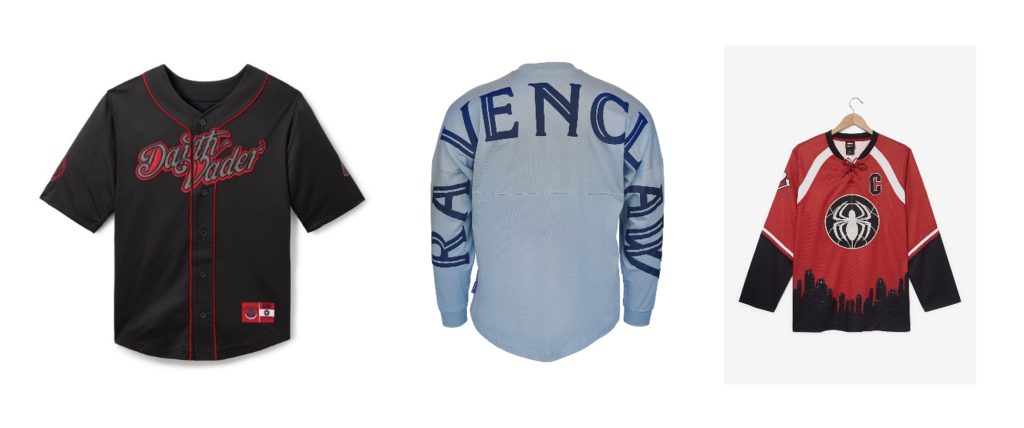
Team-Affiliated merchandise takes visual cues from sports teams, implying that the wearer supports the in-universe category or character out of liking or admiration. The primary goal of wearing this merchandise is to confirm your own identity as a fan (identification) while openly signaling to other potential fans that you share a common interest (interpellation). It comes as no surprise that the merchandise employing team-based rhetoric used a higher number of design elements like team numbers (NUM), jersey-style and Spirit Jersey brand garments (GAR), prominent in-universe logos (UNI-LOGO), distinct brand colors (COLOR), and character names or film references (FILM-REF) positioned on the upper back nameplate, as seen in Figure 1. The product names and descriptions for these items often provided exact labels for the teams (e.g., “dark side,” “avian house,” “Avengers”) or addressed the fans directly (e.g., “this top is perfect for fans of the web-slinging hero”).
Figure 2: Frequencies of the Top Six Visual Elements Among All Franchises
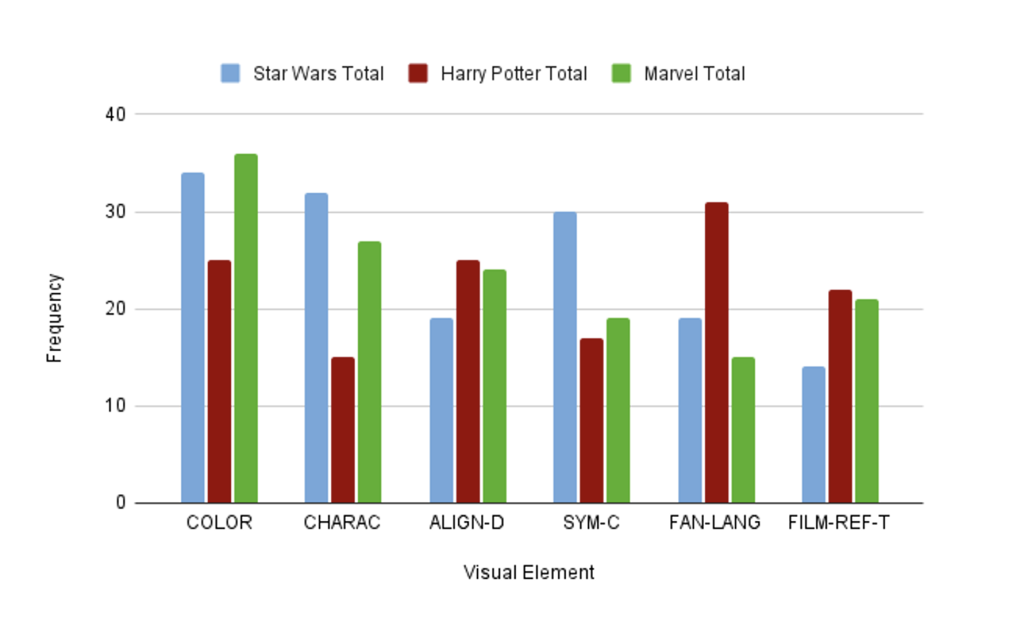
The overall frequency with which visual and textual elements were used in the design of apparel merchandise across all three franchises supports their perceived similarity to sports merchandise. As seen in Figure 2, visual design relied heavily on established in-universe brand colors; character photos or illustrations; symbols of character’s uniforms, tools, or weapons; and typographic representations of character names. Though not every product was designed to emulate an athletic uniform, it was not uncommon for film merchandise to feature Darth Vader or a wizard’s wand in much the same way sports merchandise highlights a specific player or uses depictions of sporting equipment to imply fandom of the sport—strategies that imply division by further specifying the fan’s knowledge or create consubstantiality by generalizing their affinity for the media as a whole.
There’s No Such Thing as Neutral
The remaining 20% of merchandise that did not explicitly reference an in-universe category is considered neutral for the purposes of this research; however, these garments are not neutral. In garments that were considered to use neutrality as a rhetorical strategy, representing familiarity with the franchise as a whole and relying on shared media consumption habits as the basis of consubstantiality, there was a high co-occurrence of exclusion and authenticity strategies as seen in Figure 3. While Exclusion as a strategy leverages esoteric knowledge of the franchise to prevent ‘outsiders’ and ‘shallow fans’ from making meaning, Authenticity uses discourse surrounding fandom and fanship to label the wearer as more of a real, true, or hard-core fan compared to others, typically by referencing longevity, loyalty, or specific knowledge.
Figure 3: Neutral Merchandise with Exclusionary/Authentic Visual Elements
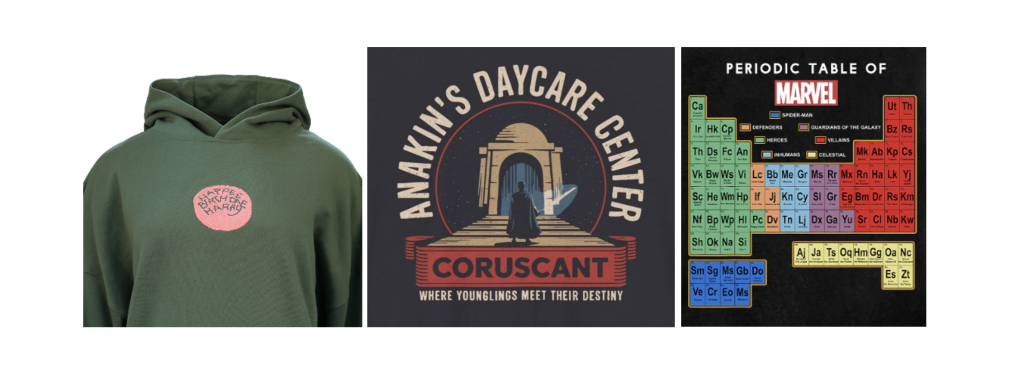
While it can be argued that the act of wearing any kind of branded merchandise represents an implicit division, alienating any person who is unfamiliar with the symbols presented on the garment, Exclusion as a rhetorical strategy goes further insofar as it seeks to alienate people who are familiar with the franchise as a whole, but may not understand more obscure references or recall finer details. For this reason, quotes with no sources (QUOTE), highly specific film references (FILM-REF), and symbols of characters (SYM-C) were the most used visual elements in the designs of neutral merchandise. Symbols of characters, being any illustrated or iconic object that is associated with a character through repeated use or ownership, require an additional level of familiarity to understand and thus appeal more prominently to fans with high levels of franchise exposure. In addition, many garments in this category had product names that included keywords like “retro” and “vintage,” implying the wearer has longevity in the fandom or knowledge of the franchise’s history. The underlying goal of neutral merchandise, then, is to identify the wearer as a true fan as opposed to a fake one.
Major Rhetorical Strategies and Visual Designs
Figure 4: Rhetorical Strategies of Star Wars Merchandise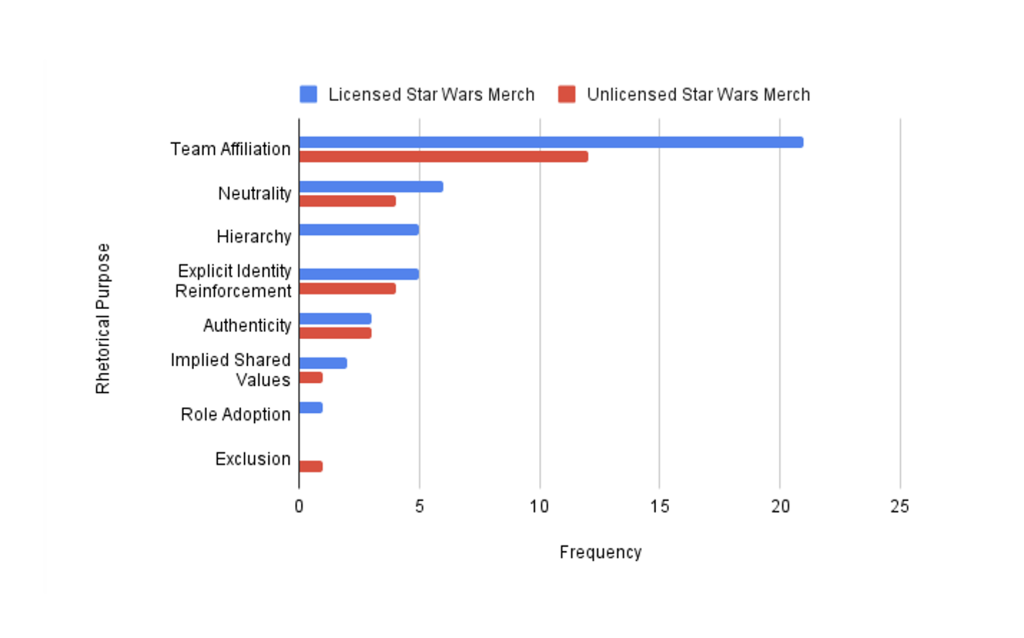
Star Wars officially licensed merchandise used team affiliation (70%), explicit identity reinforcement (16%), and hierarchy (16%) as its most prominent rhetorical strategies, as seen in Figure 4. While many of the garments used a combination of established brand colors (e.g., Imperial grey, Sith red and black, Rebellion orange, Jedi blue and green), character illustrations, and character symbols (e.g., helmets, lightsaber hilts, ships) to show a basic level of identification with one of its in-universe categories, deeper audience connections were driven by intersectional identity traits and character favoritism. Both official and unofficial designs often referenced co-identities like fatherhood or music/band fandom, while highlighting fan-favorite characters like Darth Vader and R2-D2. While Star Wars primarily uses its in-universe dichotomy to encourage self-sorting among their target audiences, the secondary rhetorical strategies suggest that the franchise’s merchandising targets the nostalgia and pride of older fan demographics to ensure long-term consumer engagement.
Figure 5: Rhetorical Strategies of Harry Potter Merchandise
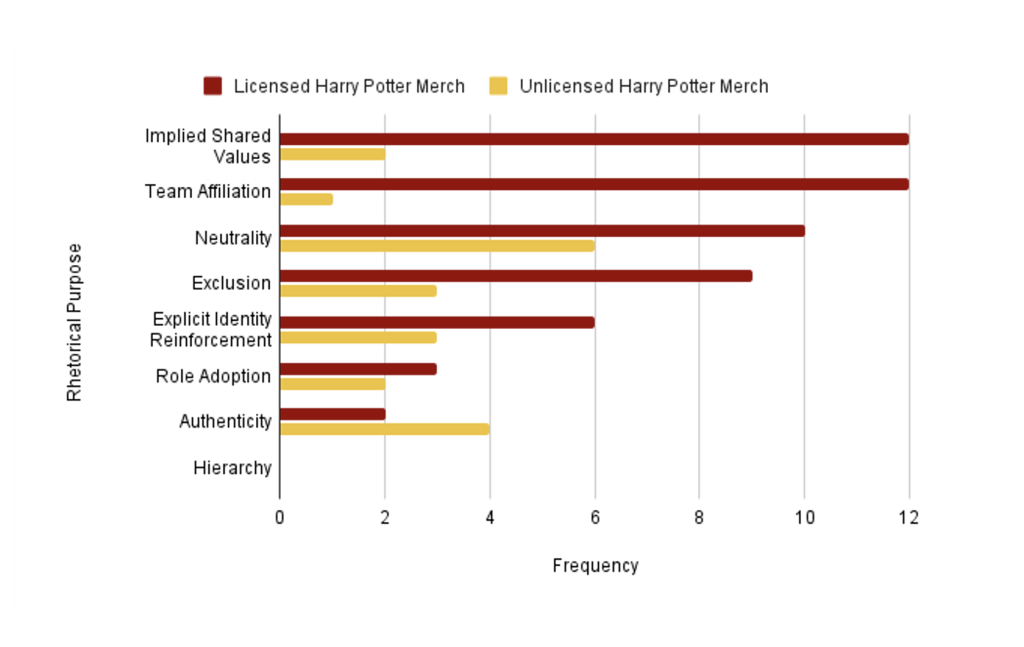
As seen in Figure 5, Harry Potter had an equal amount of team affiliation and implied shared values (40%), which is likely due to the emphasis on competing Hogwarts Houses and the fact that each house is defined by a specific set of personality traits and values. Interestingly, the second most prominent strategy for the franchise was exclusion (30%). Through obscure film references, highly specific character symbols, and fan-affiliated language (FAN-LANG) that explicitly differentiated between fans of the wizarding world and outsiders, the Harry Potter franchise established itself through its merchandise as a bespoke fandom with harsh divisions. Textual elements referred to non-fans as “filthy Muggles” while true fans were referred to as “Potterheads” or “witches and wizards.” Human characters were almost always represented indirectly through objects they wear or own, rather than through illustrations or photos. The merchandising strategy of Harry Potter places the fandom into the role of a mysterious and misunderstood community, relying on obscure symbols and hidden messages to differentiate or hide themselves from non-magical outsiders and providing them the means to subtly signal their alliances.
Figure 6: Rhetorical Strategies of Marvel Merchandise
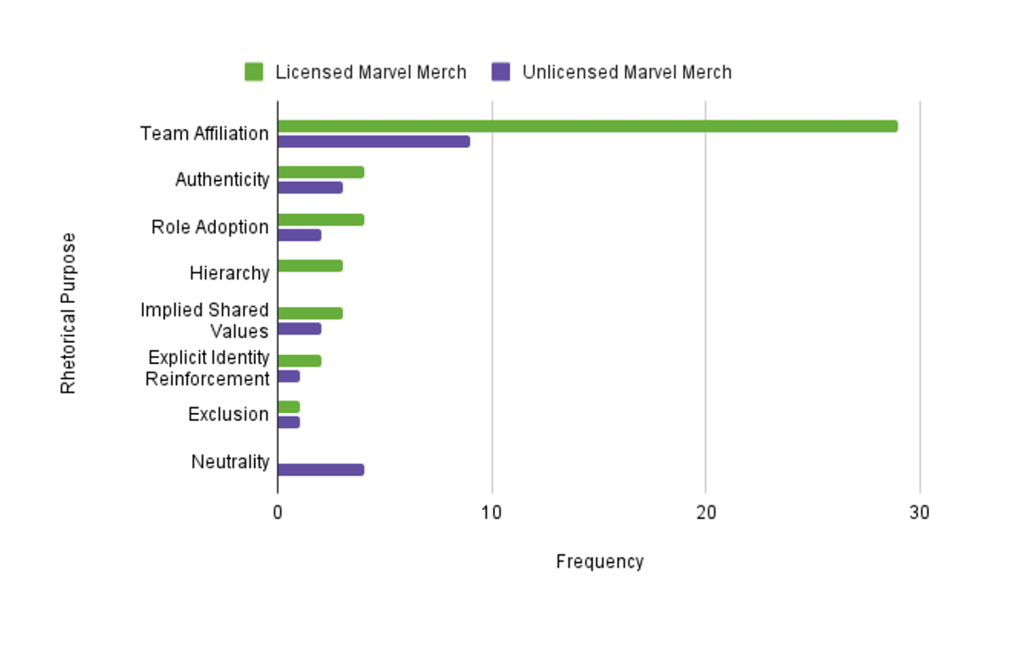 Marvel overwhelmingly used team affiliation as a rhetorical strategy, with 96% of its official merchandise signaling an affiliation with a superhero team or an individual hero. Role adoption and authenticity, as seen in Figure 6, were used as secondary strategies in equal measures. Just as superheroes are recognized by their distinct color scheme and prominent logo or sigil, Marvel used its extensive character roster, in-universe logos (UNI-LOGO), and color palettes as part of the visual merchandise design so fans could represent or emulate their favorite heroes. By taking visual cues from the costume designs of their franchise, garments that use role adoption as a strategy create a parallel between the wearer and the referenced character, suggesting existing similarity with or desire to be like a particular hero (or villain). These pieces of merchandise invite the wearer to become an employee of Stark Industries, a member of the Super Soldier Program, or a fifth member of The Fantastic 4—reminding Marvel fans that anyone can become a hero or grow into the super-suit, so long as they purchase the super-suit first.
Authenticity and Fan Co-Identities
By examining the designs of officially branded merchandise, it is possible to infer what the parent brand assumes of its target audiences. In comparing those designs to those produced organically by members of the fandom, gaps in a brand’s understanding of its audience’s needs can be identified.
Unofficial merchandise featured franchise logos (F-LOGO) and in-universe logos with significantly less frequency than official designs, most likely due to concerns of copyright infringement. Unofficial merchandise featured symbols of places, settings, and key locations (SYM-P) in 20% more garments, far more frequent than official merchandise. There was also an increase in genre-specific text (GENRE) among fan-made designs, which included any typographic elements that do not fit in other categories but add important context to the garment genre (e.g., sports, humor, vacation). Many of these additional elements, including captions, parodied quotes, and cross-references to other media franchises, were unique to fan-made merchandise. While this may seem like the result of a disregard for copyright, it is important to note that many of the cross-references were public domain or owned by the same parent company. The main reason they would have been excluded would be due to the unwillingness of the parent company to jeopardize the franchise’s brand through affiliation with a particular religious holiday, an adjacent but childish franchise, or an inappropriate Internet joke, as seen in Figure 7.
Figure 7: Fan-Produced Merchandise Breaking Brand Conventions
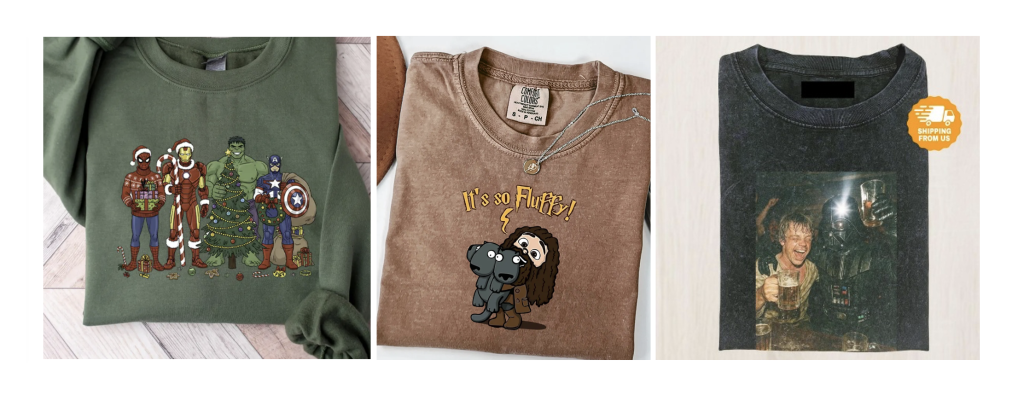 The overall strategy that saw the most change was authenticity. Predictably, an official logo is one of the easiest ways to signal authenticity in merchandise. In unofficial merchandise, however, authenticity becomes a more prevalent strategy insofar as creators must find other ways of visually representing their knowledge of the franchise without the company’s official seal of approval. To overcome this obstacle, fan designers used numerals and dates (e.g., “est. 1977”) to represent longevity or historical knowledge and symbols of places (e.g., Hogwarts Castle) as landmarks to root the garment in a specific setting. It should be mentioned, however, that copyright infringement did not always prevent an official logo from appearing on an unlicensed design.
V. Discussion
The findings of this study confirm that the rhetorical strategies of identification and division are present in modern pop culture merchandising while reinforcing that principles of sport management and brand marketing can and should be applied to the field of fandom studies (Burke, 1999; Stroebel et al., 2021; Muniz & O’Guinn, 2001). The data suggests that the Walt Disney Company and Warner Brothers Studios have leveraged tribalism and group identity to create powerful merchandising strategies, adopting visual languages from sports teams into their own merchandise design to build their film franchises into global consumption-based brands (Carlson et al., 2025).
Past research on team identification and sports merchandise conducted by Stroebel et al. (2021) showed that sports fans feel that wearing merchandise makes them belong to other fans. While wearing merchandise helps a consumer signal their beliefs, interests, and attitudes, it also makes them symbolically “part of the team” (Stroebel et al., 2021). Under this same framework, role adoption, team affiliation, and implied shared value rhetorical strategies can be applied to the merchandise from the prior study as easily as it was applied to this one. Wearing a jersey implies that a person is part of the team, regardless of whether that team plays hockey or guns down TIE fighters. Similar studies that have been conducted on sports merchandising have even aptly called this participatory culture a kind of “sports fandom” (Sveinson & Macaulay, 2024).
The findings of this study also align with prior research conducted by Sveinson & Macaulay (2024), in which they performed a content analysis of children’s sports merchandise and included in their findings a discussion of false neutrality. Sveinson & Macaulay (2024) rejected the notion of gender neutrality on the grounds that each piece of merchandise still carried an implicit division between boy and girl, with boy being the default. Similarly, this study found that merchandise meant to represent an entire franchise failed to take a truly neutral position, as the presence of characters or symbols inherently associated with an in-universe team could sway the interpretation of the garment’s design. This study goes beyond that, however, by implying that even if a garment design does not establish division between in-universe categories, it does establish division between those in the fandom and those outside the fandom.
Fandoms and other consumption-based identity groups are based on haves and have-nots. In their research on brand communities, Muniz & O’Guinn (2001) determined that many brand communities relied heavily on consumptive behaviors, with identity groups forming around the basis of a mutual purchase. While Star Wars, Harry Potter and Marvel formed around the consumption of media, their position as merchandising powerhouses and the recognized link between material goods and identity also implies that their fandoms are equally formed around the consumption of their merchandise (Belk, 1988). Although this study did not examine the reactions and loyalties of fans themselves as Muniz & O’Guinn (2001) did, it provides a potential framework for the strategies brands use to purposefully create a thriving brand community.
Despite creating an effective list of visual design elements and rhetorical strategies that can be used to create and reinforce strong consumer identification, this study presented several limitations. Although 135 samples provided variety, even more examples of fan-made merchandise could have been included—especially considering that Etsy, though popular, is usually home to bootleg and AI-generated content that could skew the data unfavorably. In addition, due to the highly subjective nature of rhetorical studies, it would be recommended to code the data with a secondary coder to establish strong intercoder reliability and eliminate personal biases. However, for fandom studies, some level of personal bias is unavoidable, since it is virtually impossible to code film references when a coder is unfamiliar with the fandom and its media.
VI. Conclusion
This study examined the rhetorical strategies and visual elements used in pop culture merchandise to create identification and division among fictional, in-universe categories. A deliberate examination of Star Wars, Harry Potter, and Marvel merchandise revealed that the film franchises with the most merchandising revenue were frequently using team affiliation and sports-inspired design elements to create strong, long-term identification with their fandoms. In alignment with the rhetorical theory of identification and division from Kenneth Burke, the “neutral” merchandise carried with it the implicit exclusion of those who were not in the fandom. A brief comparison of officially licensed and fan-made merchandise also revealed differences in visual portrayals of authenticity.
While this research covered a previously underrepresented topic in both fandom studies and marketing research, there is potential for further discovery. A potential hypothesis underpinning this research was the notion that these franchises’ in-universe categories and identity-invoking rhetoric may be the key to their long-term success; not just financially, but also as a pop culture icon with global following. Further research might look to the fans and consumers themselves to understand their motivations, loyalties, and satisfaction. Conversely, research focused on the marketing strategies from the parent companies of top-merchandising franchises may be able to confirm the extent to which fan identification and user-generated content is accounted for when creating and marketing a brand.
Acknowledgements
I want to thank Dr. Daniel Haygood, who encouraged me to strive for more than I ever thought possible in my discipline. I want to also thank Dr. Travis Maynard, who is responsible for adding rhetoric to my list of nerdy interests alongside Star Wars. I could not have done this without them.
References
Althusser, L. (2001). Ideology and ideological state apparatuses: Notes towards an investigation (B. Brewster, Trans.). In Lenin and philosophy and other essays (pp. 85–126). NYU Press. (Original work published 1970)
Affuso, E., & Santo, A. (2018). Mediated merchandise, merchandisable media: An introduction. Film Criticism, 42(2), 1–16. https://doi.org/10.3998/fc.13761232.0042.201
Belk, R.W. (1988). Possessions and the extended self. Journal of Consumer Research, 15(2), 139–168. https://doi.org/10.1086/209154
Bhattacharjee, A., Berger, J., & Menon, G. (2014). When identity marketing backfires: Consumer agency in identity expression. Journal of Consumer Research, 41(2), 294–309. https://doi.org/10.1086/676125
Burke, K. (1999). The range of rhetoric. In C. Kallendorf (Ed.), Landmark essays on rhetoric and literature (pp. 20-57). Routledge. https://doi.org/10.4324/9781351225786
Carlson, B., Donavan, D., Wolter, J., Maxham, J., & Xu, P. (2025). The collective identity effect: How group-level identity influences individual behavior. Journal of Marketing, 0(0). https://doi.org/10.1177/00222429251325219
Cohen, J. (2009). Defining identification: A theoretical look at the identification of audiences with media characters. Mass Communication and Society, 4(3), 245–265. https://doi.org/10.1207/S15327825MCS0403_01
Dwisanto, R.R. (2025). Exploring consumer preferences for university merchandise: The impact of university identification, product attributes, social motivation, purchasing experience. Journal on Economics, Management and Business Technology, 3(2), 72–76.
Foucault, Michel. The subject and power. In H. Dreyfus, P. Rabinbow (Eds.) Beyond Structuralism and Hermeneutics (pp. 208–226). The University of Chicago Press, 1983.
Franco, M. (2023, August 6). The 10 most lucrative movie merchandise franchises, from “Star Wars” and “Batman” to “Frozen” and “Cars.” IndieWire. https://www.indiewire.com/gallery/movies-that-sold-the-most-merchandise-star-wars-frozen-batman/msdbatm-wb003/
Guinness World Records. (2016, February 5). Most successful movie merchandising campaign. https://www.guinnessworldrecords.com/world-records/415763-most-successful-movie-merchandising-campaign
Hellekson, K. (2015). Fandom and fan culture. In E.C. Link, G. Canavan (Eds.) The Cambridge Companion to American Science Fiction (pp. 153–163). Cambridge, United Kingdom: Cambridge University Press.
Jakob, L., Garcia-Garzon, E., Jarke, H., & Dablander, F. (2019). The science behind the magic? The relation of the Harry Potter “sorting hat quiz” to personality and human values. Collabra: Psychology, 5(1), 31. https://doi.org/10.1525/collabra.240
Knudsen, G., Hjort, M., & Blaser, L. (2023). Playing with fandom. MedieKultur: Journal of Media and Communication Research, 35(66), 18–36. https://doi.org/10.7146/mediekultur.v35i66.105599
Kwon, H., Do Young, P., & Lim, S. (2022). Relationship between team identification and consumption behaviors: Using a meta-analysis. Frontiers in Psychology, 13(0), 869275. https://doi.org/10.3389/fpsyg.2022.869275
Muniz, A., & O’Guinn, T. (2001). Brand community. Journal of Consumer Research, 27(4), 412–432. https://doi.org/10.1086/319618
Raw, A. E. (2020). Mediating and mediated: Fandom discussion, knowledge-making, and the (re)shaping of fannish realities [Doctoral dissertation, University of Michigan]. https://hdl.handle.net/2027.42/163132
Rosenberry, J. & Vicker, L.A. (2021). Applied mass communication theory: A guide for media practitioners (3rd ed.). Routledge. https://doi.org/10.4324/9781003121695
Stroebel, T., Woratshek, H., & Durchholz, C. (2021). Clothes make the fan: The effect of team merchandise usage on team identification, fan satisfaction and team loyalty. Journal of Global Sport Management, 6(2), 185–202. https://doi.org/10.1080/24704067.2018.1531354
Sveinson, K., & Macaulay, C. (2024). Selling gender through kids’ sport team merchandise: A multimodal critical discourse analysis. Journal of Sport Management, 38(4), 240–256. https://doi.org/10.1123/jsm.2023-0114
Thompson, D.V., & Malaviya, P. (2013). Consumer-generated ads: Does awareness of advertising co-creation help or hurt persuasion? Journal of Marketing, 77(3). https://doi.org/10.1509/jm.11.0403
Visual Rhetoric. (2025). Purdue OWL. https://owl.purdue.edu/owl/general_writing/visual_rhetoric/visual_rhetoric/index.html
Walker, L. (2024, April 9). Reaching for the stars? How merchandising became the film industry’s golden ticket. The Chartered Institute of Trade Mark Attorneys. https://www.citma.org.uk/resources/reaching-for-the-stars-how-merchandising-became-the-film-industry-s-golden-ticket-blog.html