

The B.S. in Computer Science gives you a defined path through computing, mathematics and the sciences, with choices to pursue advanced topics that interest you. You’ll study programming, algorithms, databases, computer architecture and cloud security, then choose four advanced computer science courses to build in a direction of your own. Courses in biology, chemistry or physics bring scientific questions and methods into your computing work. Mathematics courses build the foundation for understanding and applying core concepts in computer science.

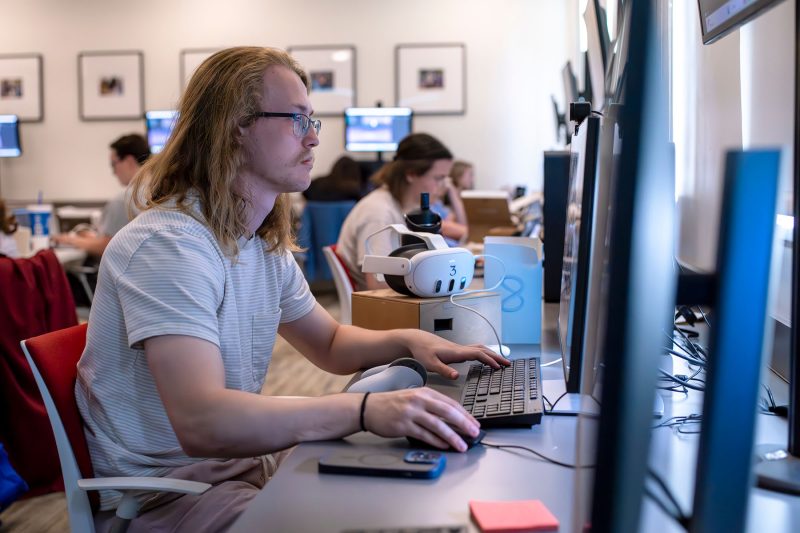
Student studying Computer Science in a VR lab in Duke Building

What You’ll Study

Computer Science

You’ll move from programming into algorithms, databases, programming languages, computer architecture and cloud security. Math and statistics courses strengthen how you analyze problems, while advanced electives let you explore areas such as software design, interactive systems or scientific computing.
Major Requirements & Courses

The B.S. in Computer Science requires 64 to 65 credit hours, depending on the science courses you choose. It combines core computing and quantitative study with four advanced computer science electives and two courses in biology, chemistry or physics.

Required courses — 28 semester hours

  • Computer Science I
  • Computer Science II
  • Organization and Architecture
  • Database Systems
  • Algorithm Analysis
  • Programming Languages
  • Cloud Security
  • Senior Comprehensive Evaluation

Elective courses — 16 semester hours

Choose four 3000 and4000 level CSC elective courses:
The Internship in Computer Science (CSC 4985) may count for a maximum of 4 elective semester hours.

Math and Statistics — 16 semester hours

Required:

  • Introduction to Statistical Reasoning
  • Calculus I

Choose from electives such as:

  • Linear Algebra
  • Calculus II
  • Statistics in Application

Science Breadth - 8-9 semester hours

Choose two courses from the following options.
Students must also register for the corresponding required laboratory or recitation section of the chosen courses.

  • Introductory Cell Biology
  • Introductory Population Biology
  • General Chemistry I
  • General Chemistry II
  • University Physics I
  • University Physics II

Your typical four-year plan

The recommended sequence shows how a full four-year course of study fits together.
You'll work with your advisor to find the right path for you.

Year One — 37 semester hours

Fall Semester

  • Computer Science I
  • Calculus I
  • Global Experience
  • World Language I
  • Orientation

Winter Term

  • Core Curriculum (Expression)

Spring Semester

  • Computer Science II
  • Introduction to Statistical Reasoning
  • General Chemistry I & Recitation
  • Writing: Argument and Inquiry

Year Two — 36 semester hours

Fall Semester

  • Discrete Structures
  • Organization and Architecture
  • Database Systems
  • Core Curriculum (Civilization)

Winter Term

  • Core Curriculum (Expression)

Spring Semester

  • Programming Languages
  • Linear Algebra
  • Introductory Cell Biology & Lab
  • World Language II

Year Three — 36 semester hours

Fall Semester

  • Algorithm Analysis
  • Computer Science Elective (3000 or 4000 level)
  • Advanced Studies (outside computer science)
  • Core Curriculum (Society)

Winter Term

  • Core Curriculum (Society)

Spring Semester

  • Cloud Security
  • Computer Science Elective (3000 or 4000 level)
  • Advanced Studies (outside computer science)
  • Free Elective

Year Four — 36 semester hours

Fall Semester

  • Computer Science Elective (3000 or 4000 level)
  • Core Capstone Seminar
  • Free Elective
  • Free Elective

Winter Term

  • Free Elective

Spring Semester

  • Computer Science Elective (3000 or 4000 level)
  • Senior Comprehensive Evaluation
  • Free Elective
  • Free Elective
  • Free Elective
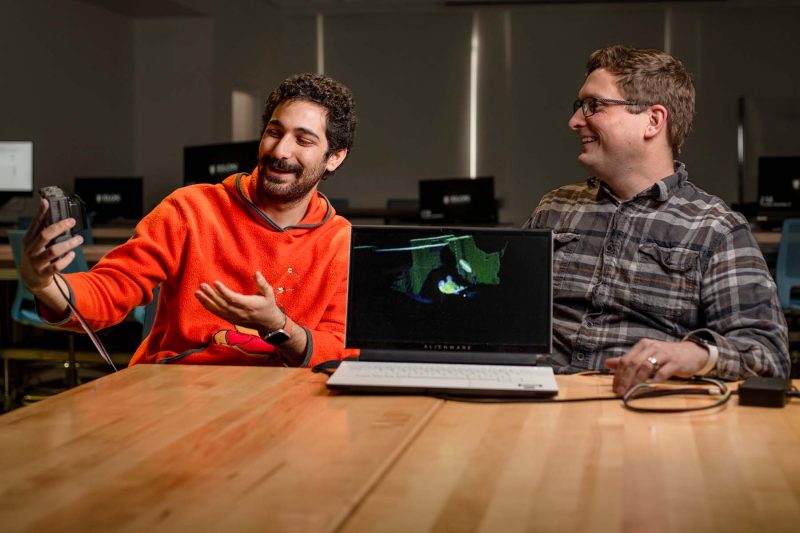
Associate Professor of Computer Science Ryan Mattfield and Rony Dahdal '26 demonstrate LiDAR technology.

Is this program right for you?

Work across computing, math and science.

The B.S. in Computer Science fits if you want a defined path through computing, mathematics and laboratory science. You’ll study how programs, data and systems work, then use four advanced computer science electives to pursue an interest of your own. If you’re drawn to questions that connect computing with biology, chemistry or physics, those sciences are part of the degree itself.

Where a B.S. in Computer Science might lead

There are many combinations of courses that you can add to your degree path, and a wide range of professional opportunities. A few options are here, but talk with your advisor about a combination that fits the direction you're considering.

Software and interactive tools

Additional study in

  • Software Design
  • Human-Computer Interaction
  • Web Development
  • Multimedia Authoring

Possible role as

  • Software Engineer
  • Web Application Developer
  • UX Engineer

Scientific computing

Additional study in

  • High Performance Computing
  • Numerical Analysis
  • University Physics
  • Statistics in Application

Possible role as

  • Scientific Software Developer
  • Simulation Analyst
  • Research Computing Specialist

Security and systems

Additional study in

  • Cloud Security
  • Network Security
  • Cybersecurity Management
  • Public Policy

Possible roles as

  • Cloud Security Engineer
  • Security Analyst
  • Software Security Engineer

Data analysis and administration

Additional study in

  • Data Mining
  • Machine Learning
  • Web Development
  • Artificial Intelligence

Possible roles as

  • AI Analyst
  • Data Analyst
  • Database Administrator

Your Faculty

Faculty traditionally associated with the B.S. in Computer Science major.