Data Breach Response Plan
Created: July 2015
Revised / Approved: January 01, 2026
Next Revision / Approval: January 01, 2027
Author: Information Security Director
Table of Contents
- Plan Overview
- Plan Definitions
- 1.0 Breach Identification
- 2.0 Incident Escalation
- 3.0 Secure and Contain
- 4.0 Remediate
- 5.0 Recovery
- 6.0 Report
- 7.0 Lessons Learned
- Appendix A – Process Flow Chart
- Appendix B – Escalation Process
- Appendix C – Data Breach Response Contacts
Plan Overview
Elon University will comply with all international, federal, state, and local laws and regulations, as well as applicable industry requirements regarding data breach notification and PII that is Elon Data. Elon University will implement internal controls to monitor, detect, prevent, and respond to potential data loss and unauthorized data access as required by applicable laws and regulations.
Elon University has implemented this Data Breach Response Plan so the University can respond to a potential Data Breach in a coordinated, timely and methodical fashion. This Plan will be activated because of an incident being classified as a Data Breach (See Incident Response Plan and Incident Response Policy).
Elon University has also published an Incident Response Plan that outlines the Purpose; Scope; and Definitions; relevant to suspected or confirmed incidents, including data breaches.
Lastly, Elon University has a Written Information Security Program that outlines the scope, responsibilities, internal controls, metrics, and mechanisms used to secure and protect Elon Facilities, Elon Data, Confidential Information and Elon Assets. The Written Information Security Program contains the following tables of information:
- Roles and Responsibilities (Includes compliance responsibilities)
- List of Information Security policies, plans, and procedures
- List of Information Security Control Types, including product and platform
- Information Classification scheme
- List of internal controls
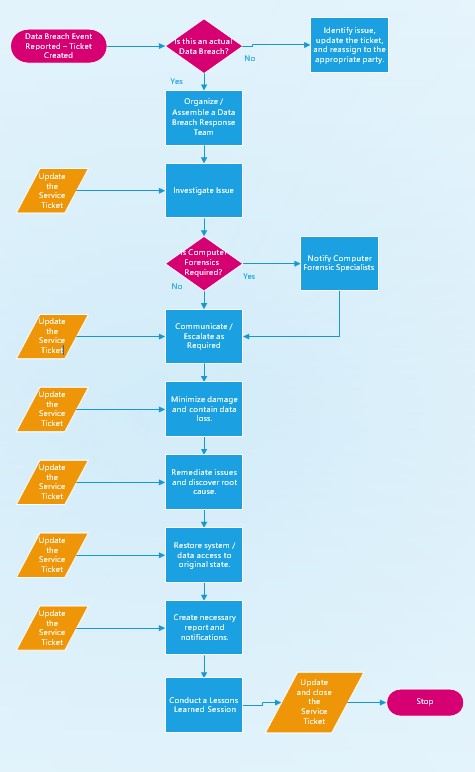
The three documents mentioned above provide foundational, strategic, and tactical components and mechanisms that address Data Breaches and potential unauthorized data access issues at Elon University. If a theft, breach, or exposure has occurred, the Information Security team and designated Compliance Managers will follow the appropriate process (see Appendix A), depending on the type of data involved. The process will include the following steps:
- Identification
- Escalation
- Secure / Contain
- Remediate
- Recover
- Report
- Lessons Learned
This Plan supersedes any other prior plans, policies or requirements related to these topics and will be reviewed and tested at least annually for potential updates.
Plan Definitions
Breach Notification: Laws require breach notification of individuals or entities affected by a data breach and unauthorized data access. Organizations that have regulated data breaches must notify their customers and other parties about the breach, as well as take specific steps to remedy the situation based on state legislature. Data breach notification laws have two main goals. The first goal is to allow individuals a chance to mitigate risks against data breaches. The second goal is to promote company incentives to strengthen data security.
- Compliance Manager(s):
Role / Individual Regulatory Responsibility Associate Vice President for Student Life / Dean of Students / Assistant Professor
(Megan Karbley)HIPAA Compliance (Privacy and Security Rule)
Senior Business Analyst
(Tony Rose)Third-Party Services (Vendor/Supplier Management) – Contract Review Associate Vice President for Finance and Administration
(Susan Kirkland)E-Commerce / GLBA
Director – Information Security
(Gary Sheehan)PCI-DSS Compliance / GDPR Compliance
University Registrar and Assistant Vice President
(Rodney Parks)FERPA Compliance
Director – Information Security
(Gary Sheehan)GDPR Compliance
- Confidential Information: All Elon University proprietary or confidential information, including intellectual property.
- Data Breach: the intentional or unintentional release, unauthorized access, use or disclosure of PII data.
- Data Compliance Team: A team of Compliance Managers called to order in the event of a suspected or confirmed data breach.
- Elon Assets: All Elon University-owned or managed networks, network devices, computer systems, applications, or any other technology or computing assets.
- Elon Data: Any Elon owned or controlled individually identifiable personal data or other personal information for which the privacy, security, retention, and confidentiality are regulated by applicable legal, regulatory, and contractual requirements.
- FERPA: Family Educational Rights and Privacy Act
- PCI-DSS: Payment Card Industry Data Security Standard
- HITECH Act: Health Information Technology for Economic and Clinical Health Act
- HIPAA: Health Insurance Portability and Accountability Act
- GDPR: EU General Data Protection Regulation
- GLBA: Gramm-Leach-Bliley Act
- PII: Personally Identifiable Information. Generally, Elon Data, including any information that can be used to distinguish or trace an individual’s identity, such as name, Social Security number, date and place of birth, mother’s maiden name, or biometric records; and any other information that is linked or linkable to an individual, such as medical, educational, financial, and employment information.
- Senior University Leadership: University President and members of Senior Staff.
1.0 Breach Identification
Any member of the Elon Community who suspects that a data theft, Data Breach or unauthorized exposure of Elon Data or PII has occurred, must immediately report the incident to their supervisor, the Associate Vice President of Information Technology, or via email to: infosec@elon.edu. A service ticket will be created in Elon’s IT ticketing system to track remediation and response activities by the Elon response teams.
Once reported, the Elon response team will investigate the incident and determine if a reportable Data Breach has occurred.
Upon the identification and classification of an actual Data Breach, the Incident Response Leader (See Incident Response Plan) will contact the CIO. The CIO will convene the Data Compliance Team, ensuring the appropriate Compliance Manager(s) are briefed on the cyber incident and able to assist with recovery. In addition to the CIO and Compliance Manager(s), it is recommended that each response team include representatives from the following areas:
- Information Technology
- University Communications
- Risk Management
- The affected unit or department that uses the involved system or output or whose data may have been breached or exposed.
- Additional individuals as deemed necessary by the Compliance Manager
- Outside counsel (if required)
Documentation is a crucial part of the Data Breach Response process. The determination of the severity of the incident may not be obvious during the initial phase of the response. Failure to document all activity beginning at the first phase of the response may result in loss of information and/or actions. It should always be assumed that an incident may result in a legal review, regulatory review, civil action, or criminal investigation. As such, all activities should be recorded in the original ticket created by the Compliance Manager or Information Security. Below is the type of information that should be recorded in the ticket:
- The time and date that the event
- The level of severity of the impact and/or potential
- A summary of the
- The system and type of data
- Explain which policy / regulation was violated and what caused the
- List all corrective actions and remediation steps and activities in the assigned
Note that certain communications, reports, and investigation records should be protected by attorney-client privilege when legal counsel is involved in the response process. Accordingly, all such communications, documentation and working drafts should be marked as “Attorney-Client Privileged and Confidential” unless or until instructed otherwise by Elon Senior Leadership of legal counsel.
2.0 Incident Escalation
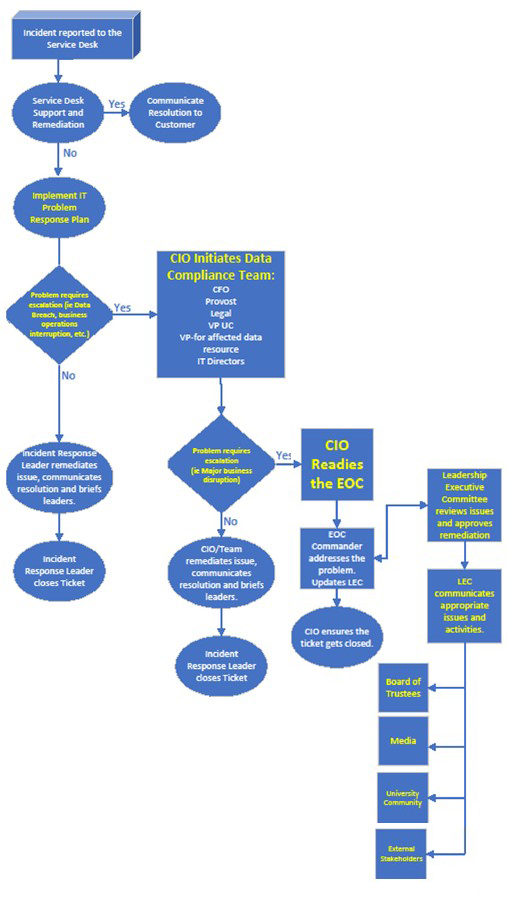
Once the cyber incident has been identified, an evaluation of the issue will be conducted by the responsible Compliance Manager with assistance from Elon’s Risk Management Office, CIO, and the Data Breach Response Team. Appendix B is a process diagram the shows the relationship and escalation path for incidents that impact the Problem Response Plan, the Data Compliance Team, and the Emergency Operations Center (EOC). The Data Compliance Team will determine if Elon’s Emergency Operation’s Center should be readied.
NOTE: If criminal activity is suspected, immediately contact Elon University Campus Safety & Police and notify them of the situation.
During this phase, the following activities should occur:
- Determination by the Data Breach Team if law enforcement is
- Elon’s Risk Management Office and/or the Director of Information Security will determine if the Data Breach requires notification of Elon’s Insurance carrier (Allied World). If so, either the Risk Management Office or the Director of Information Security will contact:
- Allied World Breach Consultant
- Incident Evaluation Hotline # 844-736-2428 or
- AWCyberEvent@awac.com for a breach consultation with no retention applicable
- NOTE Allied World Breach Consultant can provide information and advice to Elon regarding security policy coverage, and recommended remediation steps, outside vendor assistance and notifications to regulatory bodies if needed. The AWB consultant can also be contacted throughout the handling of the breach for advice and remediation strategy. The cost of this service is included in the insurance premium paid for the policy.
- The Data Compliance Team will notify University Senior Leaders as appropriate, and the following departments if appropriate:
Data Type Areas to Notify Financial information, including but not limited to credit card numbers, bank account numbers, investment information, grant information, and budget information Accounting
Information about individual employees, including but not limited to social security numbers Human Resources
Student financial information Admissions, Bursar, Registrar Student information protected by FERPA Registrar, Provost Student health information Student Life Student information not listed above Student Life, University Communications, Provost Research data Provost Information Containing PHI under HIPAA Privacy Rule Office of the Dean of Students PII concerning faculty Human Resources, Provost, Risk Management PII concerning donors or unreleased information about gifts received Advancement Payroll Information Controller and Human Resources - Information Technology will review impacted technical controls and system
- Affected department personnel will brief staff on current
Note: Any action taken on an affected system by the system administrator to investigate an event could affect and even alter evidence of malware and unauthorized access and may affect the use or security of the system or network. At the first indication of the need for computer forensics analysis, Information Security will contact a forensics specialist to investigate and advise on next steps and ensure the appropriate Elon Data Breach Team members are notified.
- Information Security will be responsible for coordinating the use of computer forensics for one or more phases of this Computer forensics can be utilized to collect and recover destroyed data, create forensic images of affected systems, analyze logs and data for suspicious activity, and coordinate with law enforcement if necessary.
3.0 Secure and Contain
The purpose of this step is to minimize the potential impact of the incident on Elon Data, Confidential Information and Elon Assets, with an emphasis on acting swiftly to prevent a worsening situation. At this point, the Data Breach Response Team should be working through an Action Plan to secure the data and contain the exposure. The Data Breach Response Team Leader should consider the following steps, while also preserving evidence, log files and other artifacts crucial to retrospective forensic investigation, to identify affected persons or data, etc.:
- Secure the area where the incident
- Disable access to data
- Estimate the impact of
- Estimate the impact of
- Change authentication
- Preserve
- Do not alter affected
- Back up information
- Document events (include date, time, and explanation of event/events).
- Disconnect the affected and related systems or networks from Internet
- Document date and time the breach occurred, what files the user was accessing at the time of the breach, the breach team member contacted, and actions taken to secure data.
- If appropriate, detect and remove the malware or other information related to the
- Review virus/malware/other protective software to review system vulnerabilities and increase the level of protection for the system.
- If appropriate, reimage the system and restore from backup
4.0 Remediate
The purpose of this step is to mitigate the potential impact of the incident. The Data Breach Response Team should consider the following steps:
- Determine the root cause of the Data Breach
- If the incident was caused by a virus, Trojan, or malware, make sure all virus definitions are up to date and verify that the antivirus application is functioning properly on all systems.
- If the incident occurred because of an unpatched system or software, verify that all similar systems and all relevant software are reviewed. Also, make sure all software updates are
- If the incident was a result of human error, educate the people
- If the incident was a result of a third-party service provider, Elon will re-evaluate the vendor contract for expected compensation and assistance.
- If the incident was the result of an application vulnerability, Elon will take the necessary steps to close the vulnerability as quickly as possible.
- Use any information gathered during this phase to secure other similar systems in the network that have yet to be affected by the incident.
- Put proper measures in place to protect all network systems and applications from similar
- Defend and protect systems, applications, networks, and data against unauthorized activity and adverse authorized activity.
- If necessary, restore and/or repair damaged information systems affected during the
5.0 Recovery
The purpose of this step is to restore systems to original functioning status and restore customer service. Included in this step is the testing and verification that all systems are operating normally and are fully functional (as in pre-incident). The Compliance Manager and Data Breach Team Leader should ensure the Service Ticket has been updated with all the Recovery and Remediation steps taken.
In addition, steps may need to be taken to comply with various regulations. These steps could include the following but will be determined by legal requirements (confer with outside counsel as applicable to ensure alignment with all state and federal requirements):
- Preparing external communications and notifying appropriate authorities
- Notifying affected individuals via email and postal mail
- Creating a Data Breach web site with breach information for internal and external communications
- Activating a toll-free number to answer questions for external communications
- Activating a special email address for internal and external communications
6.0 Report
The purpose of this step is to ensure all reporting, notifications and communication requirements have been met. The Compliance Manager and Data Breach Team Leader should ensure the appropriate reports, ticket updates and notifications are created and disseminated. The types of reporting, notifications and communication requirements may include:
- Inform University Senior Leadership that the Data Breach has been
- Inform all other relevant parties involved that the Data Breach has been
- Ensure the Data Breach is fully documented in the Service Ticket (this can be used to generate detailed Data Breach reports if required).
- Ensure the legal requirements for Breach Notification have been
- Communicate with appropriate constituency and departmental
- Complete a “Lesson Learned” report in preparation for closure of the
7.0 Lessons Learned
The objective of this section is to conduct a closing meeting to discuss the Data Breach to determine potential enhancements in policies and/or procedures to reduce the likelihood of this type of incident in the future. The CIO and Compliance Manager will be responsible for coordinating which individuals are to attend the meeting.
Questions and comments to be included in the meeting:
- Was there documentation about every event?
- Discuss what, when, where, how, and why of the
- What happened? Worm? Virus? Theft? Hacker? Other?
- Why did it happen? Are there vulnerable areas that need to be addressed?
- Where did this incident occur? Was it monitored?
- How did the incident occur? What was the severity? Was it minimal, serious, or critical?
- Are there potential weaknesses in the system that need to be remediated?
- Why did this happen? Was it an internal lapse? If so, how can it be fixed? Was it an unforeseeable external occurrence? If so, how can it be avoided in the future?
- Discuss what preventative measures could be taken to avoid the incident in the Additional procedures or a change in policy, if needed.
- Inform employees of safe network security practices to avoid potential
After consolidating the information obtained from the meeting, further steps may be required to document, implement, and enforce the corrective courses of action.
Appendix A – Process Flow Chart
- Data Breach Event Reported – Ticket Created
- Is this an actual Data Breach? Yes / No
- No: Identify issue, update the ticket, and reassign to the appropriate party.
- Yes: Proceed to number 3
- Organize /Assemble a Data Breach Response Team
- Investigate Issue
- Update the Service Ticket
- Is Computer Forensics Required? Yes / No
- Yes: Notify Computer Forensic Specialists (number 6)
- No: (proceed to number 6)
- Communicate / Escalate as Required
- Update the Service Ticket
- Minimize damage and contain data loss.
- Update the Service Ticket
- Remediate issues and discover root cause.
- Update the Service Ticket
- Restore system / data access to original state.
- Update the Service Ticket
- Create necessary report and notifications.
- Update the Service Ticket
- Conduct a Lessons Learned Session
- Update and close the Service Ticket
- Stop
Appendix B – Problem/Incident Resolution Escalation Process
-
Incident reported to the Service Desk.
-
Service Desk Support and Remediation.
-
Yes: Communicate Resolution to Customer.
-
No: Continue to Step 3.
-
-
Implement IT Problem Response Plan.
-
Problem requires escalation (i.e. Data Breach, business operations interruption, etc.)?
-
No:
-
Incident Response Leader remediates issue, communicates resolution and briefs leaders.
-
Incident Response Leader closes Ticket.
-
-
Yes: Go to Step 5.
-
-
CIO Initiates Data Compliance Team: CFO, Provost, Legal, VP UC, VP for affected data resource, and IT Directors.
-
Problem requires escalation (i.e. Major business disruption)?
-
No:
-
CIO/Team remediates issue, communicates resolution and briefs leaders.
-
Incident Response Leader closes Ticket.
-
-
Yes: Go to Step 7.
-
- CIO Readies the EOC (Emergency Operations Center)
-
EOC Commander addresses the problem. Updates LEC (Leadership Executive Committee)
-
Leadership Executive Committee reviews issues and approves remediation
-
LEC communicates appropriate issues and activities.
-
Board of Trustees
-
Media
-
University Community
-
External Stakeholders
-
-
-
-
CIO ensures the ticket gets closed.
Appendix C – Data Breach Response Contacts
Outside consultants may also be activated and included in the CSIRT by the Incident Response Leader. Outside consultants include but are not limited to:
1. Rusty Gilmore & Associates (Forensic Investigator Risk Management Associates)
- Contact: Russell Gilmore
- Phone:
- During business hours (Monday-Friday, 8:00 AM-5:00 PM): 919-834-8584 ext. 315
- After business hours (Please leave message): 919-417-1787
- Email: rgilmore@rmasecurity.com
2. Allied World Insurance (Elon’s cyber insurance provider)
- Contact: Incident Evaluation Hotline
- Phone:
- During business hours(Monday-Friday, 8:00 AM-5:00 PM): 1-844-736-2428
- After business hours(Please leave message): 1-844-736-2428
- Email: AWCyberEvent@awac.com
- To initiate Service, you must provide:
- the full name of the insured organization
- the name and phone number of the individual authorized to discuss this matter, and if available.
- the insurance policy number.
3. IT Escalation
-
First Contact
Christopher Waters
336-633-8683 -
Second Contact
Patrick Donohue
336-269-9015 -
Third Contact
Gary Sheehan
336-317-6996