


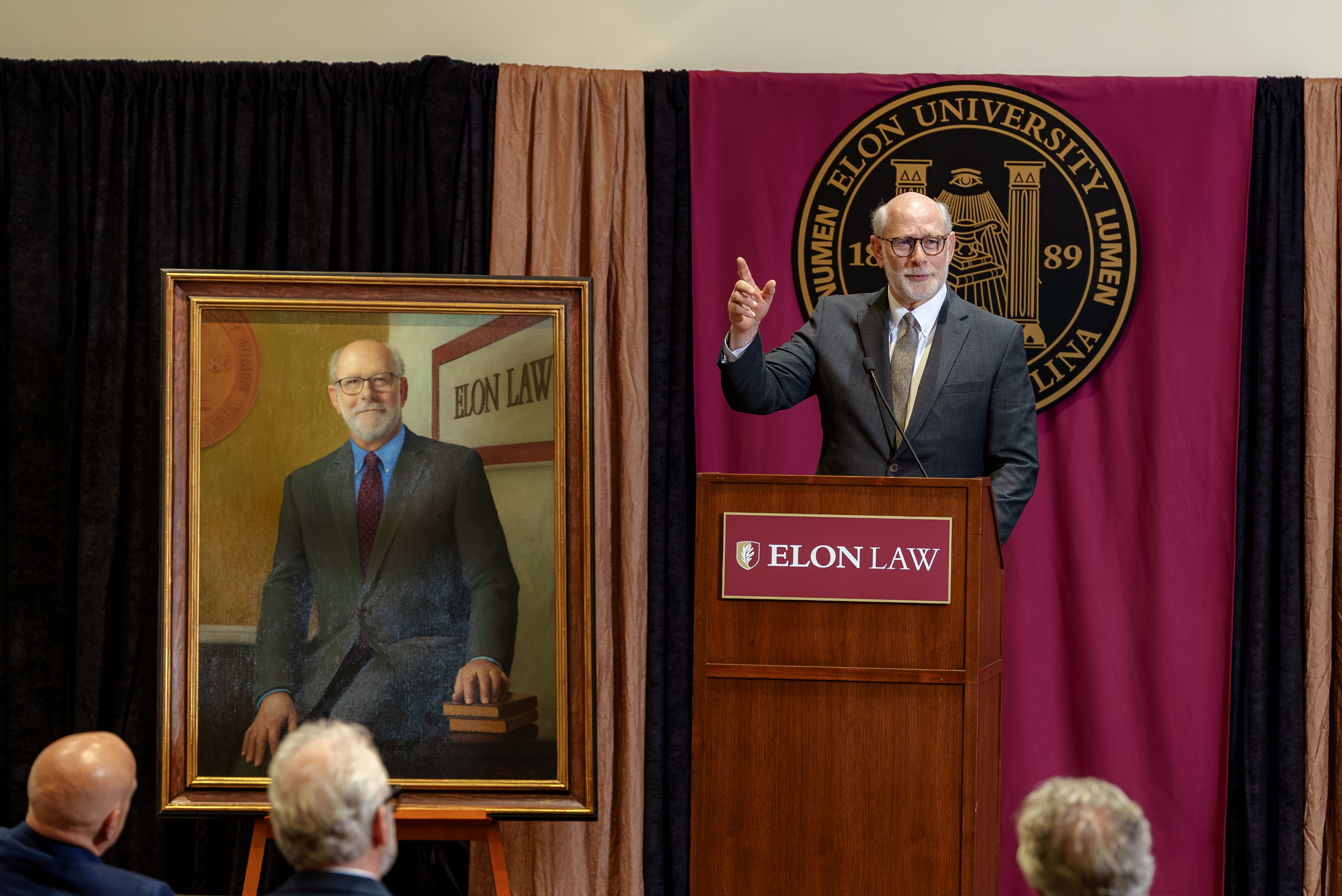
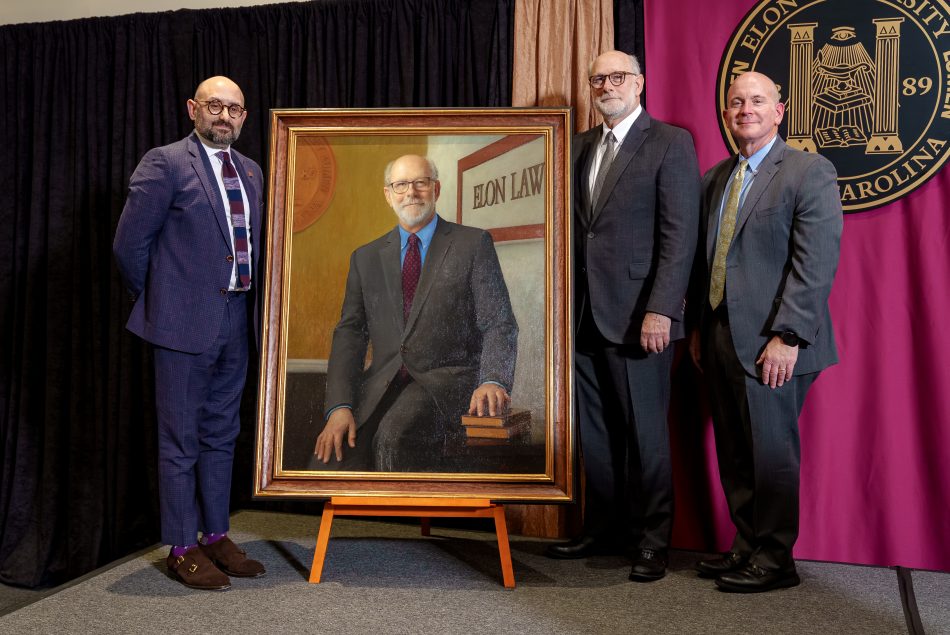
Colleagues honored the dean emeritus and professor of law with a portrait unveiling to recognize the 2.5-year J.D. curriculum and Residency-in-Practice Program he pioneered at Elon Law, creating a new model for legal education.
His portrait now hangs on the wall, but some legacies are written into the life of an institution.
At Elon University School of Law, Dean Emeritus and Professor of Law Luke Bierman left his mark on a curriculum unlike any other in legal education: a 2.5-year J.D. program built around a full-time Residency-in-Practice. Already proven “a law school with a difference,” that curriculum has become a nationally recognized model of experiential legal education, consistently ranked for the quality of its programs and the success of its graduates.
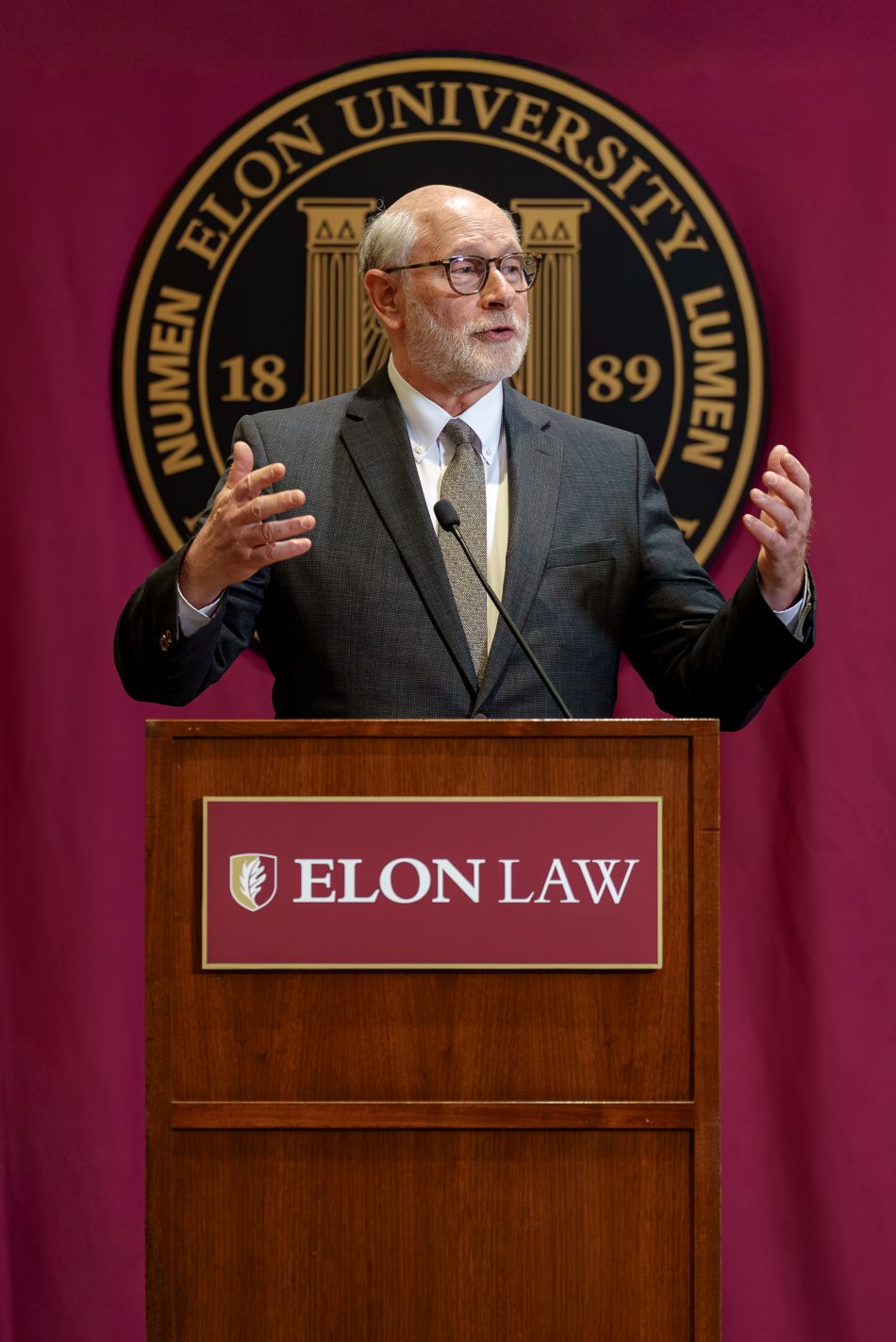
“Everything that distinguishes Elon Law today traces back to Luke’s vision and the decisions he made to reimagine legal education,” said Dean Zak Kramer. “Our students learn the law by living it, and that distinctive model continues to shape every graduate who walks across our stage.”
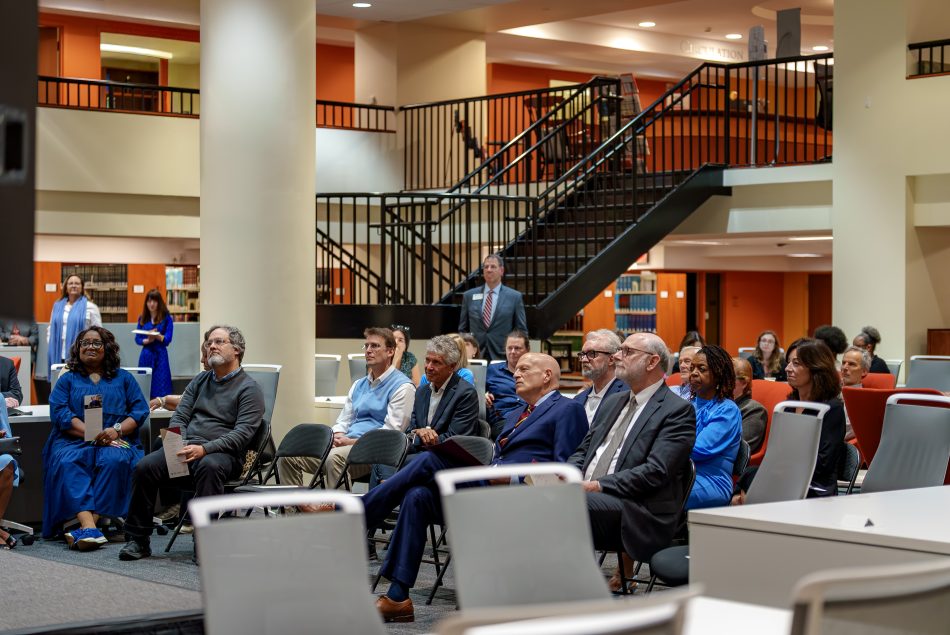
Faculty, staff, university leaders and friends gathered May 12 in the Elon Law Library to celebrate Bierman’s career and unveil an impressively detail portrait painted by Laurel Boeck, honoring a teacher, scholar and dean whose influence continues to impact every Elon Law student.
“Without question, Luke was the right person to lead Elon Law when he arrived in 2014,” said Vice Dean Alan Woodlief, who has served as an associate or vice dean since the law school’s inception, on May 12. “Luke is truly an innovator, and his innovations at Elon Law have been central to the school’s success and prosperity over the past 12 years.”
When Bierman arrived, legal education faced a crisis of cost, time and relevance. Applications were plummeting nationwide, and critics — including then-President Barack Obama — argued that law school took too long, cost too much and left too many graduates unprepared for the realities of practice.
Bierman turned that critique into an opportunity.
Working with Elon Law’s faculty and staff, he led the curriculum redesign, shortened the path to a law degree and embedded every student in full-time legal residency before graduation. Elon Law students now complete their degrees in seven trimesters over 2.5 years and spend a full trimester in a course-connected Residency-in-Practice that pairs them with judges and lawyers in judicial chambers, law firms, businesses, government agencies and other organizations. Tying the residency program to academic requirements emphasizes professional development and mentorship from both faculty and site supervisors.
The redesign reduced average student loan debt by nearly 30 percent — a fact he’s most proud of — and propelled Elon Law to record enrollment, stronger academic credentials, improved bar passage and employment outcomes, and sustained national recognition for practical training. In 2021, the American Bar Association reaccredited the law school following a successful review under Bierman’s leadership.
“Luke Bierman’s contributions to Elon University extend far beyond his tenure as dean of the School of Law,” said Elon University President Connie Ledoux Book. “He guided Elon Law through a period of transformative change and continued to invest in our students as a teacher and mentor. His legacy is reflected in the strength of the law school, its distinctive place in legal education, and the generations of lawyers who will continue to find their purpose at Elon Law.”
“Elon University has been fortunate to have the right dean at the right time in the evolution of its young law school,” said Leo M. Lambert, Elon University’s president emeritus and professor of education. “Dean Bierman brought a tremendous spirit of innovation and experimentation to Elon Law, building on Elon’s national reputation for experiential learning. It was a perfect DNA match.”
“Luke is first and foremost a teacher, and a lawyer second,” said Steven D. House, who served as Elon’s provost from 2009 through 2019. “His focus has been and always will be transformation. The program he built transforms students’ lives while strengthening and serving the broader legal and civic community.”
An Educator First
Bierman always carries two items with him: A Bic pen and a pocket Constitution.
For him, they symbolize a commitment to teaching and to the institutions that sustain democracy. As dean, he began the tradition of giving every Elon Law student a pocket Constitution.
“Education is important to us because we know how important it is to America,” Bierman said May 12. “Thomas Jefferson, James Madison and all those folks from 250 years ago thought that education was incredibly important to the American experiment in self-government. That’s the rule of law. That’s what we’re here at this law school and across the country thinking about and are terribly worried about at this moment in our national history.”
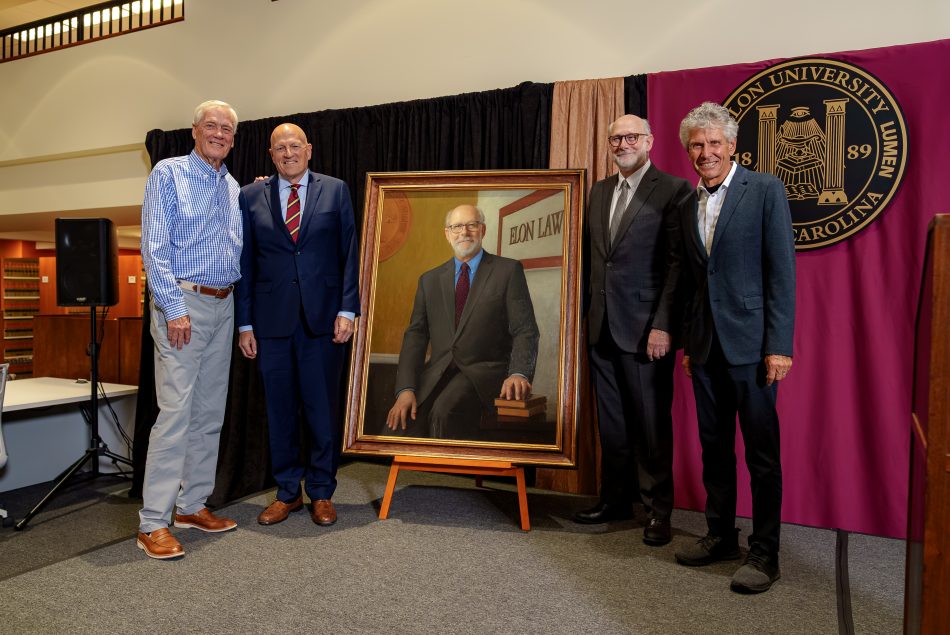
He is a third-generation lawyer but didn’t grow up anticipating a legal career. Perhaps because of that, his career rarely followed a straight line.
He moved among roles in legal practice, public service, policy and higher education, pursuing work that interested him and challenged him. Before joining Elon Law in 2014, he served as associate dean for experiential education at Northeastern University School of Law, executive director of the Institute for Emerging Issues at North Carolina State University, general counsel to the New York State Comptroller and leader of the American Bar Association Judicial Division. These responsibilities reflect academic and professional achievements that include election to Phi Beta Kappa and the American Law Institute.
“The attraction was to do something different where I could learn something,” Bierman said recently. “Coming to Elon to think about curriculum and curricular programs and activities was natural for me.”
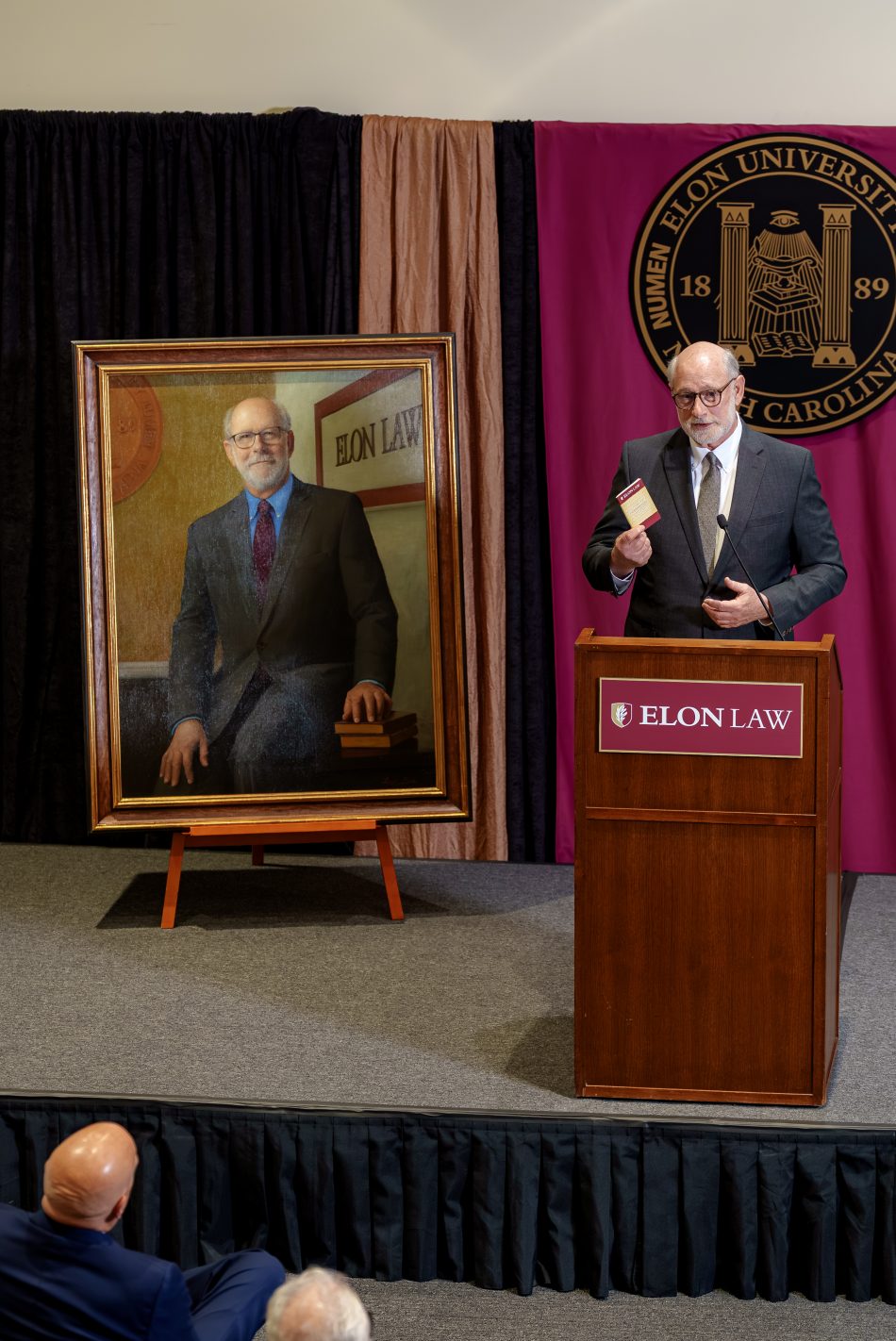
That motivation — to learn, to experiment, to acquire new skills — stemmed from a core family value: Education.
“I think of myself as an educator, maybe even more than I think of myself as a lawyer,” Bierman said.
He is the second of three generations of teachers. His mother taught in public schools. His sister leads a school in Vermont. Two of his daughters work in education, and all three have earned doctoral degrees.
Reflecting on his legacy at Elon Law, he returned to the same concerns that guided Elon Law’s transformation.
“I do hope the work that we did at Elon Law remains. The ideas about cost, length and relevance: I hope those remain top of mind. Higher education is critically important in the world. We need to be responsive to how the world functions and operates.”