


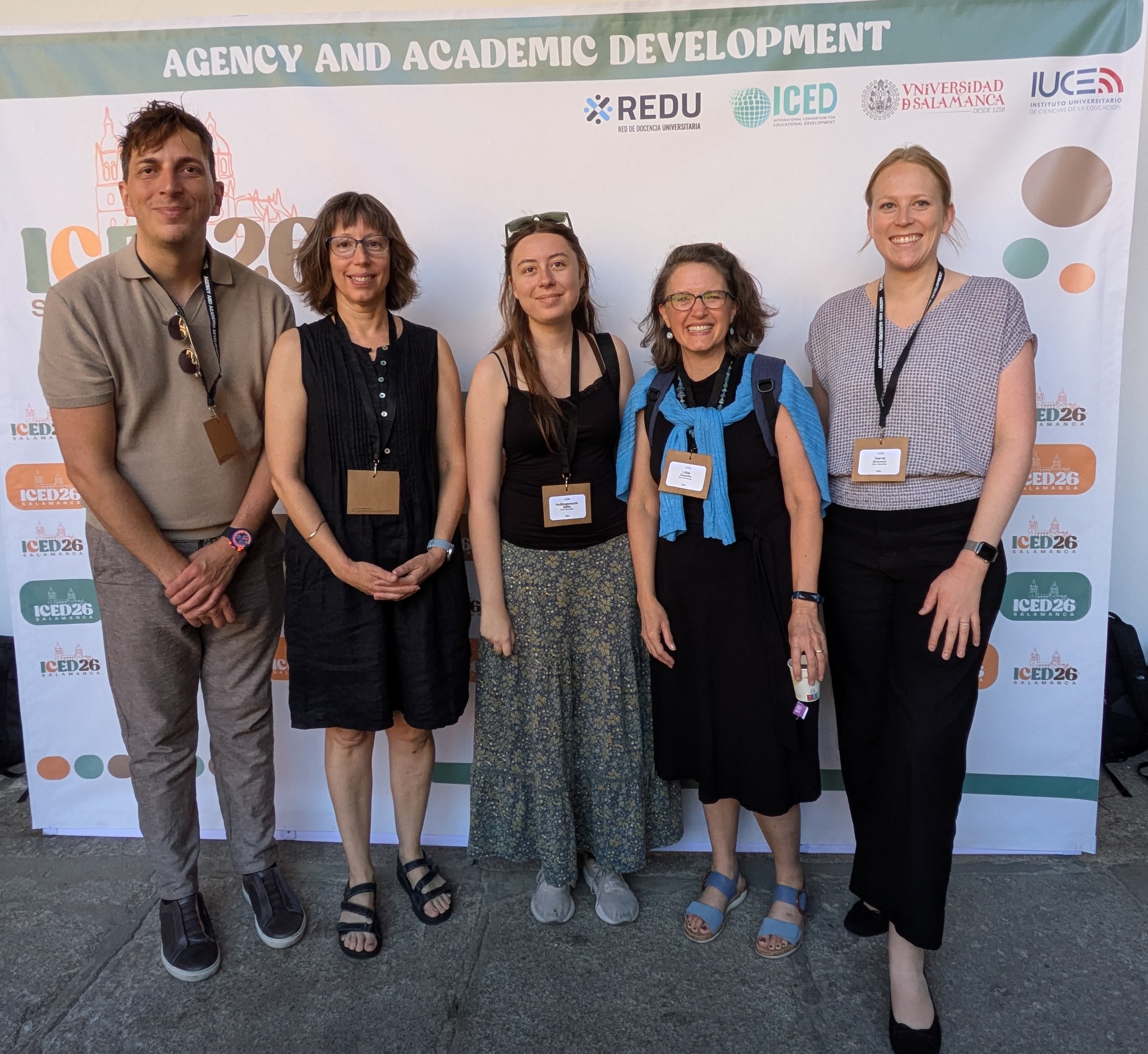
Elon faculty and students presented at the International Consortium for Educational Development (ICED), held at the University of Salamanca in Spain. The event was hosted by the Spanish Network of University Teaching.
The work of various Elon faculty and students was presented at the International Consortium for Educational Development, held at the University of Salamanca in Spain, from June 24 to June 26. The conference, hosted by the Spanish Network of University Teaching, centered on the theme of agency and academic development, highlighting how educators, students and institutions can actively shape and transform higher education through purposeful action, innovation and collaboration. Below are the Elon-affiliated presentations featured at ICED 2026:
Ethical Agency: A Values-First Approach to Academic Development
Deandra Little and David Green
This session explored how academic developers navigate change with trust and ethical practice, balancing new initiatives with limited resources and resistance. Participants reflected on their professional identities and ethical priorities, guided by emerging ethical guidelines for educational developers. The goal was to empower participants to make intentional, sustainable decisions rooted in their core values.
Walking Besides, Not Ahead: A Mentoring Story of Shared Power
Vanessa Drew-Branch
This presentation shared a mentoring model rooted in equity and cultural responsiveness that shifts from faculty-led hierarchy to a collaborative inquiry with students. By empowering students as knowledge producers, the project revealed insights often overlooked by institutions and reshaped how faculty view teaching and student engagement. Attendees were invited to rethink mentoring as a space for shared power and student leadership in higher education.
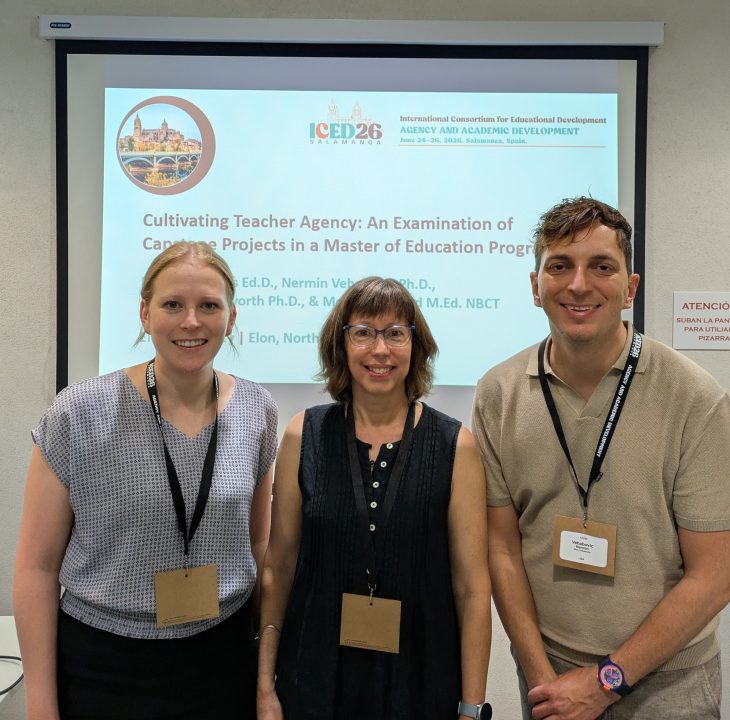
Cultivating Teacher Agency: An Examination of Capstone Projects in a Master of Education Programme
Bronwyn Harris, Nermin Vehabovic, Heidi Hollingsworth and Melaine Rickard
This presentation examined how M.Ed. candidates enacted teacher agency through equity-focused capstone projects, integrating research and reflection to design meaningful K-12 instruction. The projects emphasized student agency, social justice, and community impact, highlighting graduate study’s role in fostering educators who challenge inequities. It showcased how equity-driven curriculum design deepens engagement and supports inclusive education.
Beyond Books – A Game of Life for First Year Students’ Academic, Social, and Emotional Development
Margret S. Sigurdardottir, Jill Marie McSweeney, Saffie Hollingsworth and Berglind Eva Benediktsdóttir
Introducing “Beyond Books,” an interactive board game designed to help first-year students navigate academic, social, and emotional challenges. The game provides a safe space to practice real-life decisions, fostering empathy, communication, and self-advocacy. The workshop included gameplay experience, theoretical insights and discussions on adapting the tool to support holistic student transitions.

Expanding Our Understanding of Student Trust Perceptions: A Trust Collaborative Project
Kathryn Sutherland, Ted Murcray, Jill McSweeney, Peter Felten, Rachel Forsyth, Debra Grantham, Laurel Schut, Nancy Chick, Kate Thompson, Saffie Hollingsworth, Neal Blank and Subin Kim
This collaborative project explored student perspectives on trust in university teachers through four dimensions: cognition, affect, values and identity. Participants discussed adapting the trust model across diverse cultural and institutional settings to strengthen relational and inclusive learning environments. The session aimed to build global partnerships for advancing research and practice on teacher-student trust.
Fostering Sense of Belonging in and Through Educational Development
Peter Felten and Gabriela Pleschova
This workshop examined how a strong sense of belonging supports students and staff to thrive amid challenges, while belonging uncertainty can lead to isolation and disempowerment. Drawing on recent research and literature, participants reflected on belonging and explored ways educational developers can foster inclusive academic environments. The interactive session emphasized agency in creating equitable, collaborative spaces for all.
A Framework for Building and Assessing Equity-Centered Peer Mentoring Programs
Olivia Choplin, Krista Craven, Margarita Safronova, Gabriel Kwek Wu-Xin and Diana Gregory
This session introduced a research-based framework for equity-centered peer mentoring in academic support, developed through a comparative study across three countries. Participants engaged with key findings and an assessment tool designed to help institutions build or improve peer mentoring programs. The framework addresses the complex realities of higher education, offering practical ways to support equitable student success.
-
Deandra Little
Associate Provost for Faculty Affairs and Professor of English
-
Vanessa Drew-Branch
Associate Professor of Human Service Studies and Chair of the Department of Human Service Studies
-
Bronwyn Harris
Assistant Professor of Education
-
Nermin Vehabovic
Assistant Professor of Education
-
Heidi Hollingsworth
Professor of Education and Director of the Master of Education Program
-
Melaine Rickard
Instructor in Education
-
Jill McSweeney
Assistant Director of the Center for the Advancement of Teaching and Learning and Assistant Professor of Wellness
-
Peter Felten
Assistant Provost for Teaching and Learning, Executive Director of the Center for Engaged Learning, and Professor of History
-
Olivia Choplin
Professor of French in the Department of World Languages and Cultures